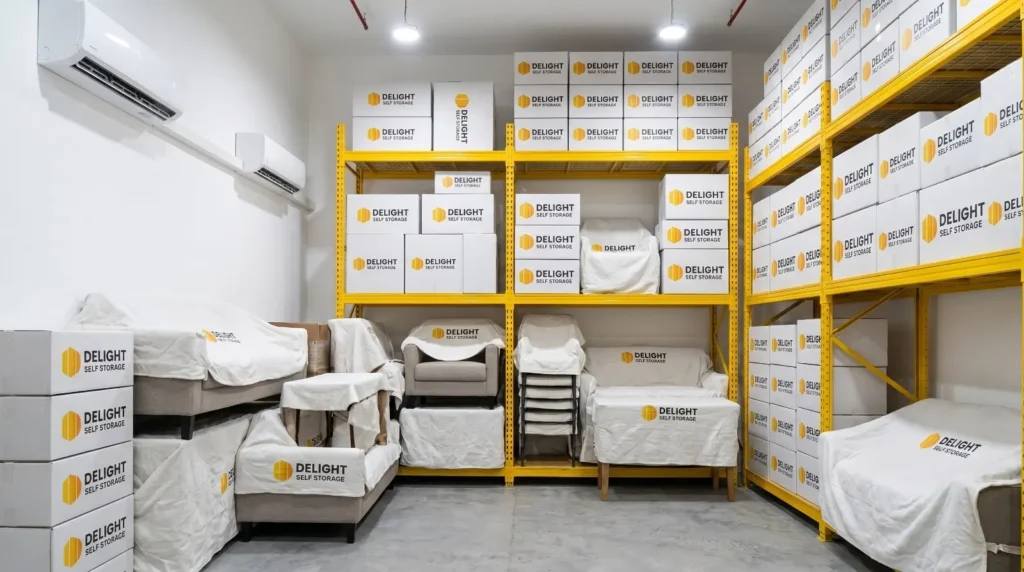
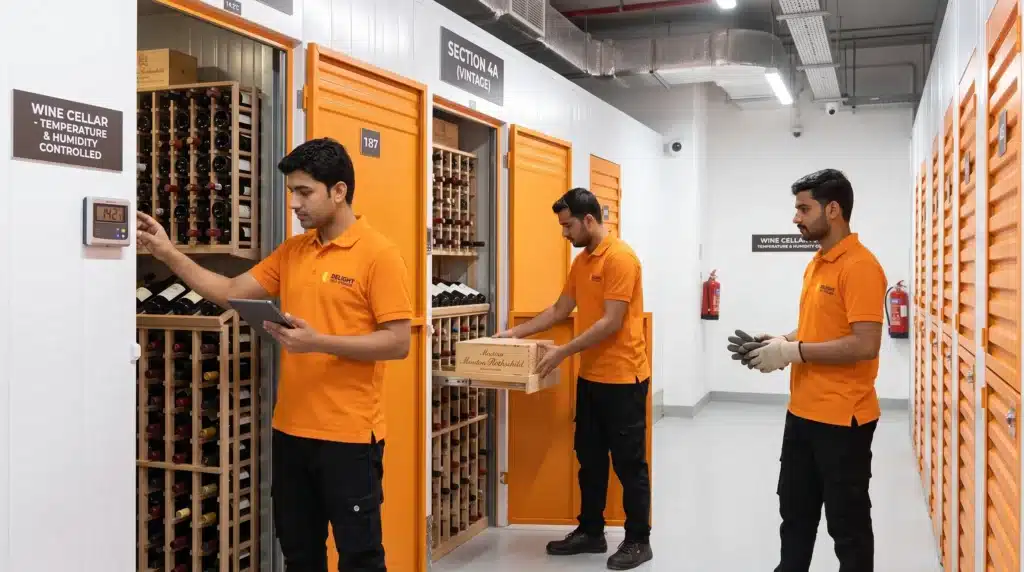
In Dubai, premium wine storage depends on the environment, not empty space. A bottle can sit safely in a home cabinet for a short period, but heat, sunlight, dry cork conditions, vibration, and poor handling can change wine quality before the bottle is opened. The risk becomes more serious in Dubai, where average summer highs reach about 41.8°C, while long-term wine storage guidance sits near 10°C to 15°C. Temperature-controlled wine storage in Dubai helps protect premium bottles during apartment moves, villa renovations, overseas travel, tenancy handovers, and long-term storage.
This guide explains how temperature, humidity, light exposure, bottle position, packing method, and storage records affect bottle condition. It also gives practical checks for choosing a suitable storage unit in Dubai when wine needs more protection than ordinary household items.
What is wine storage in Dubai?
Wine storage in Dubai is the controlled placement of wine bottles in an environment that manages temperature, humidity, light, bottle position, movement, and access. Wine is defined as fermented grape juice. Vitis vinifera supplies most of the wine grapes used globally.
For a Dubai homeowner, apartment resident, collector, or frequent traveler, wine storage is not only shelving. Storage, wine, and environment create the core entity relationship. The bottle contains a temperature-sensitive liquid. The cork, capsule, label, and closure react to air, dryness, pressure, and handling.
A normal storage room protects space. A temperature-controlled storage unit protects the environment. That difference matters during a villa move, apartment handover, overseas trip, renovation, downsizing, or seasonal travel.
Wine storage in Dubai works when the storage environment matches the object. Furniture, clothing, and suitcases tolerate broader conditions. Premium wine responds to smaller environmental changes because heat, oxygen, and light can alter bottle condition.
Why does the Dubai climate make wine storage more sensitive?
Dubai’s climate makes wine storage more sensitive because the city combines high summer heat, high annual humidity, strong sunlight, and long warm seasons. Due to the Arabian Gulf’s shallow waters, humidity is high in Dubai, with an annual average of 59% to reach its peak in January and February, registering 65%.
Wine does not respond to Dubai heat like furniture, books, or boxed household goods. The liquid inside the bottle changes through chemical reactions. The closure responds to pressure, dryness, and temperature movement. The label and capsule respond to humidity and abrasion.
The Australian Wine Research Institute reports that elevated storage temperature accelerates wine development and reduces shelf life. The same technical review links heat exposure with fruity aroma loss, premature browning, sulfur dioxide loss, and oxidation-related defects.
This means a Dubai storage decision carries two risks. The first risk is space availability. The second risk is environmental suitability. Wine storage in Dubai works when you solve the second risk before you pay for the first.
What temperature protects wine bottles?
A stable range of 10°C to 15°C protects wine intended for long-term storage. Wine and Spirit Education Trust (WSET) recommends controlled and regulated storage at 10°C to 15°C for wines kept for aging.
Prude Extension gives additional thresholds. Temperatures above 16°C may stimulate dormant microbes and change the wine’s condition. Temperatures above 24°C can greatly and atypically age most wines.
Temperature control matters more than a single cold setting. Wine reacts poorly to repeated changes because expansion and contraction stress the closure. Purdue Extension states that temperature fluctuations test cork integrity and can introduce air into wine, followed by rapid spoilage.
The Dubai heat gap is the practical point. If a bottle moves from a cool apartment into a non-controlled store, loading bay, balcony, vehicle, or garage, the bottle can cross several risk thresholds in one day. Purdue Extension also argues that wine shipments and storage should avoid even short-term exposure to 30°C or above.
Temperature conversion scale for wine storage
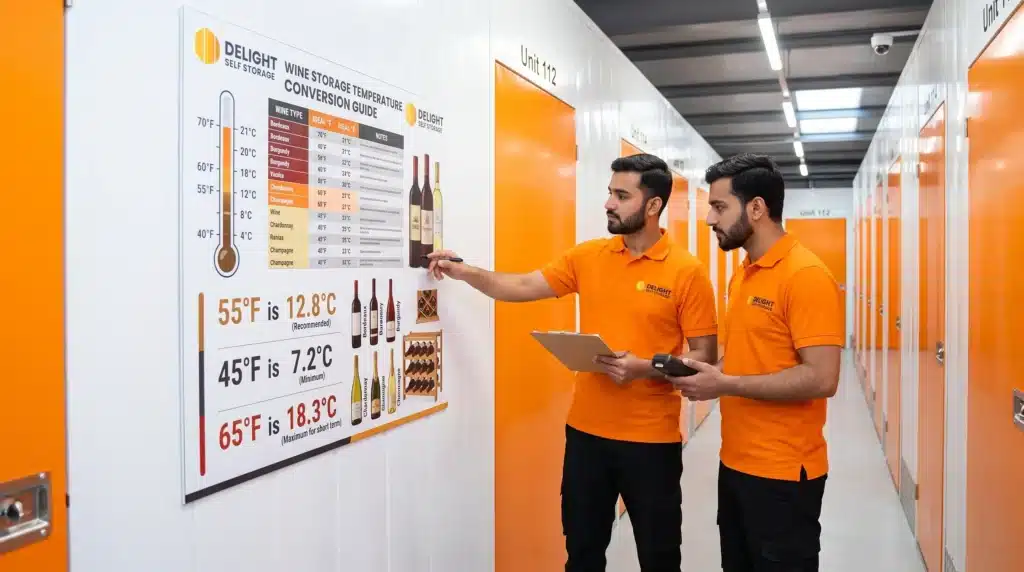
This table converts core Celsius thresholds into Fahrenheit. It helps you compare international wine advice, appliance settings, and storage unit readings.
| Celsius | Fahrenheit | Storage meaning |
|---|---|---|
| 10°C | 50°F | Lower end of the WSET long-term storage range |
| 15°C | 59°F | Upper end of the WSET long-term storage range |
| 16°C | 60.8°F | Purdue threshold where dormant microbes may become a concern |
| 24°C | 75.2°F | Purdue threshold for atypical aging in most wines |
| 30°C | 86°F | Purdue threshold to avoid even for short-term exposure |
| 41.8°C | 107.2°F | Dubai’s average summer high is reported by the Dubai Government Media Office |
To convert Celsius to Fahrenheit, multiply Celsius by 9, divide by 5, then add 32. For example, 15°C converts to 59°F, and 30°C converts to 86°F. Use this conversion when you compare a temperature-controlled storage unit Dubai quote with wine storage guidance.
How does heat damage premium wine?
Heat damages premium wine by accelerating chemical aging, reducing protective sulfur dioxide, changing aroma compounds, and increasing oxidation risk. The heat-related wine changes can remain unnoticed until the consumer opens the bottle.
Sulfur dioxide matters because winemakers use sulfur dioxide to protect wine against microorganisms and oxidative reactions. The Australian Wine Research Institute states that free sulfur dioxide declines during storage and bottle aging. Elevated temperatures speed that loss.
Heat affects white and red wines differently. The Australian Wine Research Institute reports that heat-produced chemical changes are often more prominent in white wines. It identifies fruity aroma loss, premature browning, sulfur dioxide loss, and oxidation attributes as noticeable effects.
Red wines carry their own risk. Heat can affect color, flavor, mouthfeel, and aroma characteristics. For a premium bottle, those attributes influence drinking quality and resale confidence.
Heat damage often becomes visible only after opening. That makes prevention more useful than inspection. A bottle can look normal and still taste prematurely aged.
Why does humidity matter for corked wine?
Humidity matters because corked bottles rely on the closure condition. Wine and Spirit Education Trust explains that corked bottles belong on their side because wine contact helps keep the cork moist and limits oxidation.
Dubai creates two humidity conditions. Outdoor humidity can be high. Indoor air-conditioning can create dry storage pockets. Both conditions affect storage decisions.
Dryness can affect cork elasticity. High humidity can damage labels, cartons, and printed inventory marks. For premium bottles, external condition affects identification, resale confidence, gift value, and collection records.
Ask storage providers these humidity questions:
- Do you monitor humidity in the storage area?
- Do you keep bottles away from direct air-conditioning flow?
- Do you protect labels from carton moisture?
- Do you separate wine from damp flooring?
- Do you provide elevated racking or palletized placement?
Humidity does not replace temperature control. A cool room with poor humidity practices can still create cork or label problems.
Why does light exposure matter in Dubai homes?
Light exposure matters because bright light and ultraviolet exposure can change wine chemistry. Aging wine should be kept away from bright light, including ultraviolet sunlight and fluorescent lights.
Dubai homes often have large windows, bright kitchens, balcony storage, open shelving, and glass-front display cabinets. These features can look premium but function poorly for wine storage.
Wine stored near sunlight faces two linked risks:
- Light exposure
- Heat gain
Clear or pale glass bottles deserve extra caution. WSET notes that wine rarely uses clear glass for long-term protection because light can create chemical changes and unpleasant flavors.
A temperature-controlled storage unit Dubai solution works better when bottles stay inside dark cartons, closed cabinets, or low-light racking. Darkness protects the bottle without changing the wine.
Why does bottle position matter?
Bottle position matters because corked wine benefits from side storage. Bottles sealed with cork stay better protected when stored on their side because the wine keeps the cork moist and limits air entry.
This rule applies mainly to natural cork closures. Screwcap bottles follow a different logic. WSET notes that screwcap wines can stand vertically and that around 25% to 30% of wines use screwcaps.
For a Dubai storage unit, bottle position also affects breakage risk. Horizontal racking protects cork contact. Stable cartons protect bottles during movement. Divided wine boxes reduce glass-to-glass contact during pickup, storage, and handover.
Do not treat a mixed household box as wine storage. A premium bottle belongs in a bottle-specific carton, foam insert, rack, or crate. That packaging separates wine from cookware, perfumes, detergents, tools, and electronics.
What happens if wine enters normal self-storage?
Wine in normal self-storage can face heat, temperature swings, dry air, light exposure, vibration, odor transfer, and undocumented handling. Normal storage can work for durable household goods, but premium wine is a temperature-sensitive item.
A standard storage unit Dubai service may protect furniture, luggage, appliances, and boxes. Premium wine needs extra environmental control because it changes chemically under heat.
Temperatures above 24°C greatly and atypically age most wines. Dubai’s average summer low of 29.7°C already exceeds that threshold, according to the Dubai Government Media Office.
That comparison makes the risk clear. Non-controlled storage can expose wine to aging conditions even outside peak afternoon heat.
For general storage planning, compare size, access, security, climate control, and handling. You can review a storage unit Dubai option when you want a broader self-storage framework before choosing wine-specific arrangements.
How do you choose temperature-controlled wine storage in Dubai?
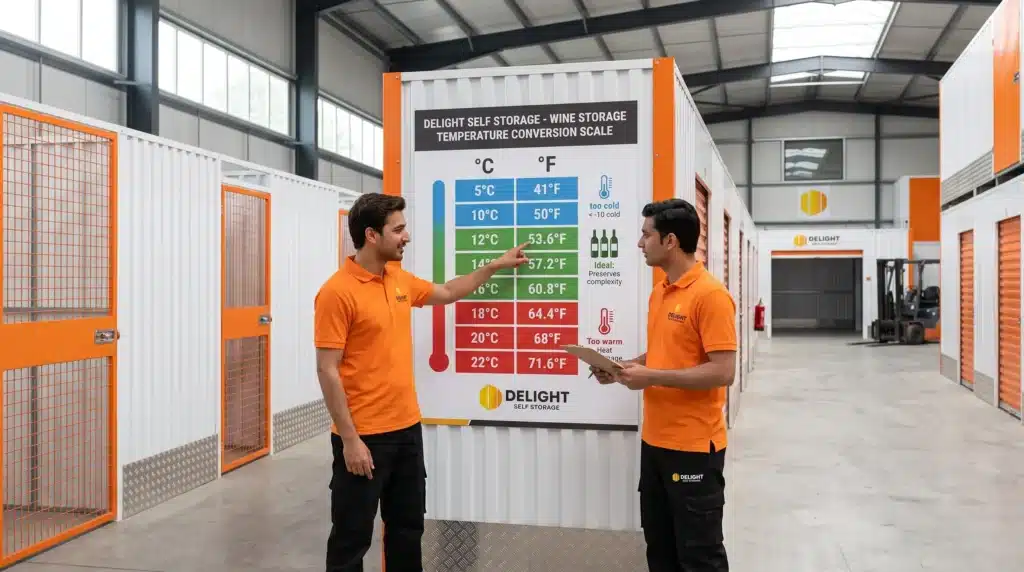
Choose temperature-controlled wine storage in Dubai by checking the temperature range, monitoring records, humidity control, dark storage, bottle position, packing, access control, and handover documentation. The right choice protects the storage environment, not only the floor space.
Use this checklist before booking:
- Confirm the temperature range in Celsius.
- Ask how the facility monitors and records temperature.
- Check whether humidity readings exist.
- Confirm dark storage or covered bottle placement.
- Use horizontal storage for corked bottles.
- Separate wine from scented products and chemicals.
- Photograph the bottle condition before handover.
- Record bottle count, labels, vintages, and closure type.
This checklist supports both quality control and dispute readiness. Temperature logs, handover photos, bottle counts, and access records create an evidence pack. That evidence matters when bottles hold financial or sentimental value.
What facts should a Dubai resident compare before booking?
A Dubai resident should compare the wine’s sensitivity, storage duration, outdoor temperature, transport time, facility temperature, and documentation quality before booking. These variables decide whether the storage unit fits the bottle.
Decision table for Dubai wine storage
| Decision factor | Low-risk case | Higher-risk case | Storage action |
|---|---|---|---|
| Bottle value | Everyday wine | Premium or rare bottle | Add photos and inventory |
| Storage duration | 1 to 3 days | Several weeks or months | Use controlled storage |
| Closure type | Screwcap | Natural cork | Store corked bottles horizontally |
| Wine style | Young red | White or sparkling | Prioritize heat control |
| Dubai season | Winter | Summer | Avoid non-controlled storage |
| Access frequency | Rare access | Frequent handling | Reduce movement and reboxing |
| Evidence need | Personal use | Insurance or resale | Keep logs and handover records |
This framework keeps the article practical. A buyer does not always need a wine cellar. A buyer needs a storage environment that matches the wine risk category.
What storage risks affect different bottle types?
Different bottle types carry different storage risks because of wine style, closure, age, pressure, and value change sensitivity. A young screwcap red wine does not carry the same storage risk as a mature corked Bordeaux or vintage Champagne.
| Bottle type | Main risk | Priority level | Practical action |
|---|---|---|---|
| Young red wine | Heat-accelerated aging | Medium | Keep cool, dark, and stable |
| White wine | Aroma loss and browning | High | Use controlled temperature quickly |
| Sparkling wine | Pressure and heat stress | High | Avoid heat, vibration, and rough handling |
| Mature corked wine | Cork failure and oxidation | High | Store horizontally with stable conditions |
| Fine or rare bottle | Quality and evidence risk | Very high | Use logs, photos, and restricted access |
| Screwcap wine | Heat and light exposure | Medium | Control the temperature and keep away from sunlight |
High temperatures can increase pressure in sparkling wine bottles. The same source reports a bottle bursting under high-temperature exposure.
This makes sparkling wine one of the most sensitive categories during the Dubai summer moves. Reduce transport time and avoid afternoon loading delays.
What does a storage evidence pack include?
A storage evidence pack includes bottle photos, inventory, temperature records, handover notes, access logs, packing details, and condition comments. This pack helps you prove what entered storage, how it entered storage, and how the storage environment performed.
A useful wine storage evidence pack includes these items:
- Record each bottle name, vintage, region, and quantity.
- Photograph front label, back label, capsule, fill level, and closure.
- Note bottle position, carton type, and packing material.
- Save pickup and delivery timestamps.
- Request temperature data for the storage period.
- Document any visible seepage, label stains, or capsule damage.
Dubai’s hospitality licensing context shows why stock records matter in regulated alcohol environments. Al Tamimi & Company notes that licensed hotel, club, and restaurant operators keep documentation for quantities and liquor stock movement under Type C license rules.
That commercial rule does not create a household storage rule. It shows how documentation supports alcohol custody in Dubai. For private storage, keep your own record.
What should you check before booking a storage unit in Dubai?
Check the storage environment before you check the unit size. Temperature range, humidity monitoring, access control, dark placement, bottle-safe packing, and documentation decide whether the unit suits wine.
Ask these 10 questions before booking:
- What temperature range does the storage area maintain?
- How often does the facility record temperature?
- Does the facility monitor humidity?
- Are bottles stored away from sunlight?
- Can corked bottles stay horizontal?
- How does the team pack premium bottles?
- Who can access the storage area?
- Are pickup and delivery times recorded?
- Does insurance cover temperature-sensitive items?
- Can the provider share a handover evidence pack?
Cost belongs after the risk review. A cheaper unit that lacks climate control may cost more if the heat changes the bottle condition.
Use AED quotes, but compare the full custody chain. Pickup, loading, transport, unloading, storage, access, and return delivery all affect bottle safety.
What is the safe timeline for moving bottles into storage?
The safe timeline moves bottles from inventory to packing, then controlled transport, storage placement, documentation, and monitored holding. Each step reduces time outside controlled conditions.
Use this 7-step timeline:
- Create the bottle inventory 24 to 48 hours before pickup.
- Photograph labels, capsules, closures, and fill levels.
- Pack corked bottles horizontally in bottle-safe cartons.
- Schedule pickup away from peak afternoon heat where possible.
- Move bottles directly into temperature-controlled storage.
- Save photos, timestamps, and condition notes.
- Review the bottle condition during return delivery.
Dubai’s summer climate makes timing practical. The city’s average summer high of 41.8°C creates avoidable risk during loading-bay delays, vehicle waiting, and open-door handling.
Repeat the same sequence when bottles leave storage. Storage quality includes both entry and exit conditions.
What are the common myths about wine storage in Dubai?
Myth 1: Air-conditioning is enough
Air-conditioning cools the living space. Wine storage needs stable temperature, low light, controlled humidity, correct bottle position, and limited movement.
Myth 2: A kitchen rack is acceptable
WSET identifies the kitchen as one of the worst storage places because kitchens often experience large temperature fluctuations. This matters in Dubai apartments where kitchens may sit near windows, appliances, or balcony doors.
Myth 3: A refrigerator solves long-term storage
WSET notes that prolonged refrigerator storage can harden corks and affect the seal. That can make wines stale and reduce fizz in sparkling wines.
Myth 4: Heat damage always looks obvious
AWRI reports that heat-related changes may go unnoticed until the consumer opens the bottle. This means appearance alone cannot confirm safe storage.
Myth 5: All bottles need the same storage method
Closure, style, age, pressure, and value change storage risk. A screwcap bottle and a mature corked bottle need different handling logic.
Final takeaway: Protect the bottle before the Dubai heat reaches it
Wine storage in Dubai is a climate decision before it is a space decision. A premium bottle can survive a short period in a home cabinet, but heat, light, cork dryness, vibration, and poor handling can reduce quality before the bottle reaches the glass.
Temperature-controlled storage gives wine a more stable environment during moves, renovations, travel, tenancy changes, and long-term holding. The key is not only cold air. The key is controlled temperature, humidity awareness, low-light placement, correct bottle position, careful packing, and clear condition records.
Before choosing a storage unit Dubai option, treat every premium bottle as a temperature-sensitive item. Check the storage range, ask about monitoring, photograph the bottle condition, and keep a simple handover record. These steps protect the wine, the label, the closure, and your confidence when the bottle returns.
FAQS
Can Dubai heat damage wine during a short move?
Yes, Dubai heat can affect wine during a short move if bottles sit in corridors, vehicles, loading bays, or non-controlled rooms.
Is a home wine fridge better than normal storage?
A home wine fridge is better for small collections, but temperature-controlled storage suits larger collections, relocations, renovations, and long absences.
Why does a storage unit Dubai service need climate control for wine?
A storage unit Dubai service needs climate control for wine because premium bottles react to heat more quickly than furniture, luggage, or household boxes.
Can wine stay in cardboard boxes during storage?
Wine can stay in cardboard boxes when the boxes are dry, clean, stable, dark, and placed inside a temperature-controlled environment.
Should corked bottles stay flat in storage?
Corked bottles should stay flat because wine contact helps keep the cork moist and limits unwanted air entry.
Are screwcap bottles easier to store than corked bottles?
Screwcap bottles are easier to position, but they still need protection from heat, light, vibration, and long temperature swings.
What is the first sign of poor wine storage?
The first visible sign can be seepage, a raised cork, label staining, capsule damage, or an unusual fill level.
Do premium white wines need stricter storage than red wines?
Premium white wines often need stricter heat control because aroma loss, browning, and oxidation can appear faster in lighter wine styles.
Is temperature control enough for long-term wine storage?
Temperature control is essential, but long-term wine storage also needs humidity awareness, darkness, stable placement, and limited handling.
What should I record before sending wine to storage?
Record bottle name, vintage, quantity, label photos, capsule condition, closure type, fill level, pickup time, and storage handover details.
Storage & Warehousing Operations Specialist
14+ years in UAE self-storage and warehousing, managing facilities across Dubai, Abu Dhabi, and the Northern Emirates. Specializes in climate-controlled storage, unit sizing, security systems, and Free Zone vs Mainland compliance.
Content Lead & Storage Solutions Researcher
8 years researching and writing on UAE storage and logistics. Focuses on storage costs, unit-size guides, and packing for Dubai's climate, working closely with facility teams for accurate pricing and specs.