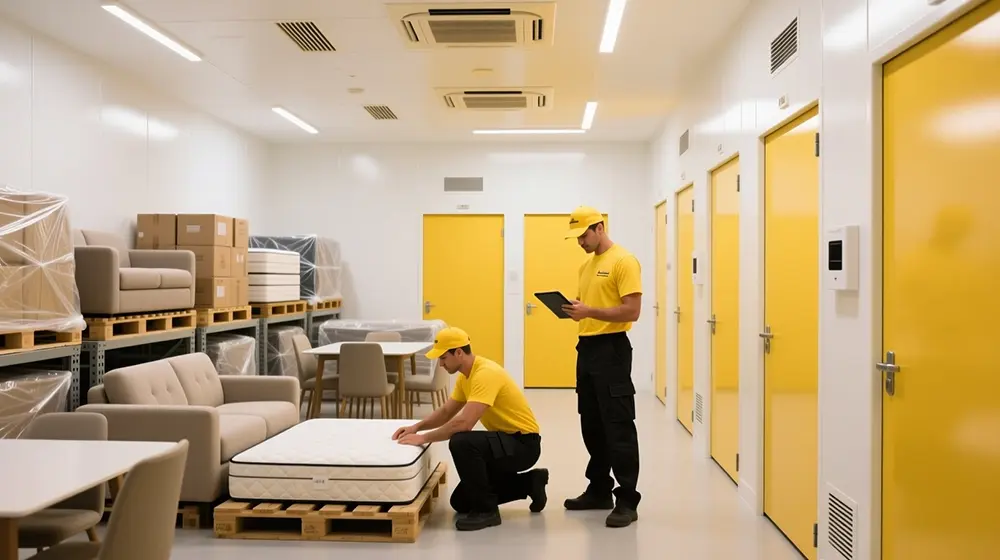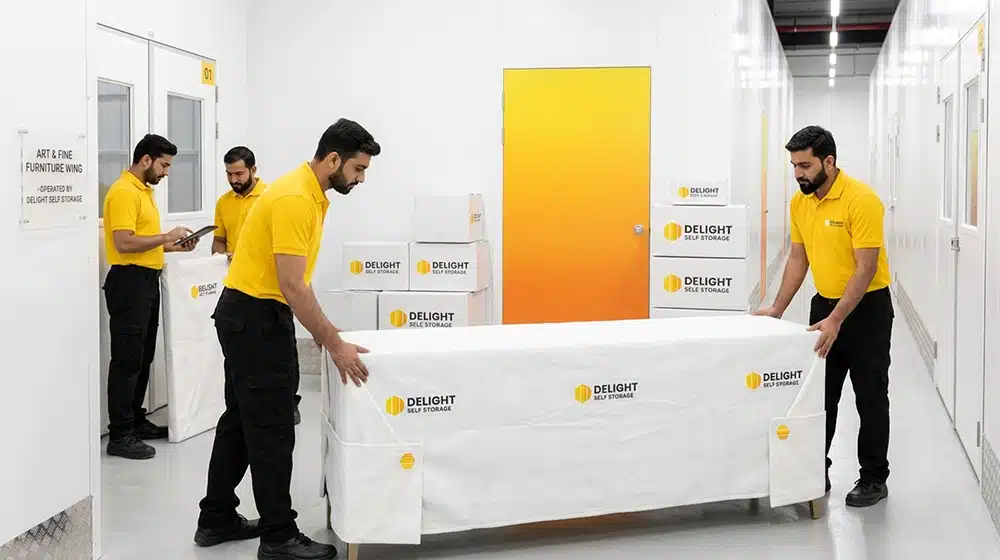
Office Storage Size Guide Dubai: 25, 50, 100, 200 Sq Ft
Office Storage Size Guide Dubai: what fits in 25, 50, 100, and 200 sq ft, so you rent the right unit, not too big.
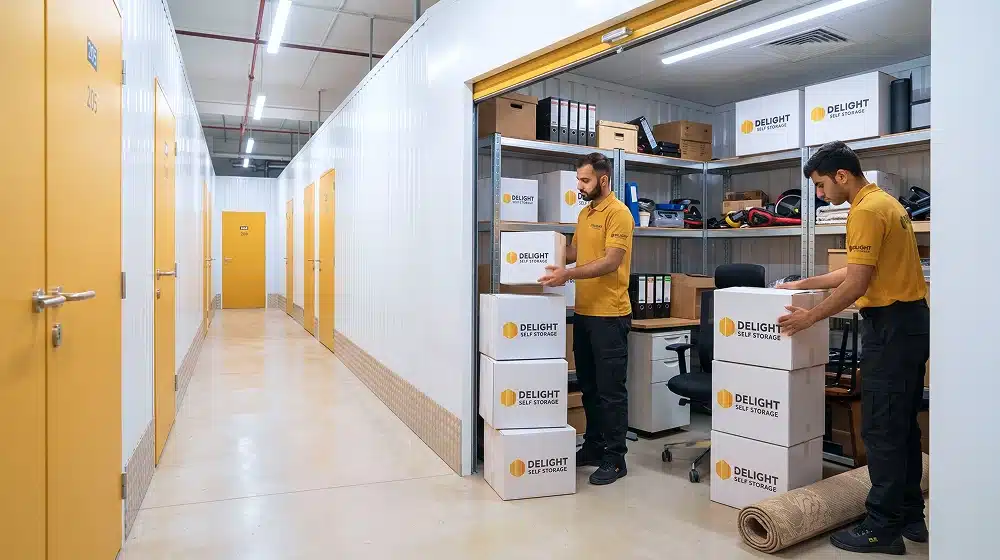
You need 25 square feet for compact files, 50 square feet for a small office zone, 100 square feet for furniture plus cartons, and 200 square feet for a full small-office move or renovation buffer.
Dubai’s storage demand links to business density, population growth, office rent pressure, and document retention. As of June 2025, Dubai’s population stands at approximately 3.95 million, according to the Dubai Statistics Center. Dubai welcomed 19.59 M overnight visitors in Jan-Dec 2025, with an increase of +5% compared to Jan-Dec 2024. That means offices, home offices, freelancers, and small businesses operate in a city with heavy daily movement and limited working space.
Dubai’s business base also keeps expanding. Dubai Chamber of Commerce reported 292,486 active members at the end of 2025, up from 258,318 in 2024, with 71,830 new companies joining in 2025. This growth creates practical storage demand for records, desks, chairs, displays, samples, spare IT equipment, and seasonal stock.
What does this storage size guide cover?
This guide compares office storage sizes in Dubai by floor area, cubic volume, item type, access frequency, and damage risk.
You get 2 clear benefits:
- You can estimate storage space before booking a storage facility with a Dubai provider.
- You can avoid paying for a unit that is too large, too small, or poorly laid out.
This article uses a size-first structure because the main search intent is practical:
- What can I store in 25, 50, 100, and 200 square feet?
- The answer depends on both square feet and usable height.
How do you calculate office storage size?
You calculate office storage size by multiplying length by width for square feet, then multiplying square feet by usable height for cubic feet.
The basic formula is simple:
- Length x width = square feet
- Square feet x usable height = cubic feet
Most small storage size examples use 8 feet as an easy planning height. Actual usable height depends on the facility, door clearance, shelving rules, ceiling layout, and safe stacking limits.
Unit footprintFloor areaPlanning heightApproximate volumeBest use5 ft x 5 ft25 sq ft8 ft200 cu ftFiles and small office items5 ft x 10 ft50 sq ft8 ft400 cu ftOne small office zone10 ft x 10 ft100 sq ft8 ft800 cu ftFurniture plus cartons10 ft x 20 ft200 sq ft8 ft1,600 cu ftOffice move or renovation buffer
The table gives a planning estimate. Your real storage capacity changes when you add aisles, shelves, fragile items, irregular furniture, or access requirements.
What can you store in 25 square feet?
A 25 square feet storage unit fits boxed documents, compact office electronics, stationery, small marketing items, and a limited number of disassembled furniture parts.
Use 25 square feet when your office storage need is narrow and controlled. This size works for consultants, freelancers, home-office owners, clinics, salons, training providers, and small agencies that want to remove records or supplies from a working room.
A 25 square feet unit often works for:
- 10 to 25 archive cartons, depending on carton size and stacking strength
- 1 compact printer or scanner
- 2 to 4 desktop monitors in protective packaging
- Stationery cartons, branded uniforms, or small event materials
- Folded signage, banners, and light exhibition items
- Disassembled chair parts or small shelving sections
This size does not fit a normal office room. It functions like a large walk-in cupboard. Keep one narrow access lane if you retrieve files monthly. Fill the full floor area only when you do not require frequent access.
The Federal Tax Authority (FTA) states that taxable and exempt persons under UAE Corporate Tax must retain relevant records for at least seven (7) years after the end of the related tax period. A 25 square feet unit can support small archive storage when you label cartons by tax period, supplier, department, and retention date.
What can you store in 50 square feet?
A 50 square feet storage unit fits the contents of a small office zone, including archive cartons, 1 to 2 desks, 2 to 4 chairs, small cabinets, and packaged electronics.
Use 50 square feet when your office storage includes mixed items. This size suits a microbusiness, real estate team, training office, small clinic’s administration room, or e-commerce seller with light non-hazardous stock.
A 50 square feet unit often works for:
- 25 to 50 archive cartons, if stacked safely
- 1 to 2 standard office desks after disassembly
- 2 to 4 office chairs
- 1 filing cabinet or low storage cabinet
- Small printers, routers, monitors, and computer accessories
- Promotional materials, samples, and seasonal retail packaging
A 50 square feet unit gives more flexibility than 25 square feet because it allows zones. You can place documents at the back, furniture along one wall, and fragile electronics on shelving. This layout improves retrieval and reduces handling damage.
Standard office desks often fall around 48 to 72 inches wide, 24 to 30 inches deep, and 28 to 30 inches high, although exact dimensions vary by product type. Disassemble desks before storage because legs and panels waste less space when stacked flat.
What can you store in 100 square feet?
A 100 square feet storage unit fits a larger office clear-out, including multiple desks, chairs, filing cabinets, boxed documents, small appliances, and business inventory.
Use 100 square feet when you store office furniture and documents together. This size works for a company that closes one department, renovates a small office, changes premises, or pauses a branch office.
A 100 square feet unit often works for:
- 50 to 100 archive cartons, depending on stacking plan
- 4 to 6 desks after disassembly
- 6 to 10 office chairs
- 2 to 4 filing cabinets or storage cupboards
- Packaged monitors, printers, scanners, routers, and office phones
- Light inventory, exhibition items, or point-of-sale materials
A 100 square feet unit gives a practical balance between cost and access. You can create one central aisle, one document wall, one furniture wall, and one electronics corner. This layout works better than mixed stacking because archive cartons, furniture panels, and electronics carry different damage risks.
A storage facility Dubai users select for larger office contents requires credible fire safety controls, clear access, and proper building compliance.
What can you store in 200 square feet?
A 200 square feet storage unit fits a complete small-office move, a renovation buffer, bulky furniture, palletized inventory, archive cartons, and larger commercial equipment.
Use 200 square feet when your storage requirement has volume, time pressure, and multiple asset classes. This size suits office relocation, lease handover, temporary downsizing, fit-out delay, or branch consolidation.
A 200 square feet unit often works for:
- 100 to 200 archive cartons, if box quality allows safe stacking
- 8 to 15 disassembled desks
- 10 to 25 chairs
- Several filing cabinets, shelves, cupboards, and reception items
- Packaged IT equipment, monitors, small server racks, and telecom hardware
- Non-hazardous commercial inventory and event equipment
A 200 square feet unit needs a floor plan before loading. Put heavy furniture at the back and sides. Keep archive cartons in labelled rows. Keep electronics off the floor. Leave a walking lane that reaches the document and IT zones.
A 200 square feet unit can also support small inventory operations when you use cartons, shelving, and labelled locations. The UAE warehouse management regulations emphasize protection from weather, humidity, heat, dust, insects, fire, and poor electrical safety in warehouse environments.
Which storage size is right for each office situation?
The right office storage size depends on item type, access frequency, storage period, and damage sensitivity.
Use this sizing matrix before you contact a storage facility Dubai provider. The table compares use cases, not prices, because storage rates vary by location, access model, climate control, and contract term.
Office situationBest starting sizeWhy this size fits****Upgrade triggerTax files only25 sq ftBoxed records take compact vertical spaceMore than 25 cartonsHome-office clear-out25 to 50 sq ftSmall furniture plus filesDesk or chair volume increasesSmall office renovation50 to 100 sq ftMixed cartons and furnitureAccess lane requiredBranch closure100 to 200 sq ftMultiple asset classesCabinets and desks remain assembledLease handover100 to 200 sq ftFast removal from premisesUnknown item listE-commerce overflow50 to 200 sq ftCarton count changes weeklyStock requires shelvingIT equipment holding25 to 100 sq ftHigh value, low footprintServer rack or UPS units added
The safest estimate adds 10% to 20% empty working space for access, labels, and inspection. A unit that fits on paper can fail in practice when boxes differ in weight, furniture stays assembled, or retrieval happens weekly.
How do Dubai office rents affect storage decisions?
Dubai office rents affect storage decisions because inactive items consume paid workspace.
Dubai’s office market closed Q4 2025 with rents continuing to rise, supported by sustained occupier demand and limited availability across key business districts. Average rents reached AED 255 per sq ft, reflecting a 32.4% year-on-year increase, although growth began to moderate towards the end of the year.
Tenant demand remains focused on smaller office units, with 63% of enquiries targeting spaces below 5,000 sq ft, while prime locations continue to command premium rents. Regulatory protections and cost certainty are increasingly influencing occupier decision-making, as many businesses prioritise tenure security over relocation.
A simple example shows the space logic:
- 25 sq ft of unused office space equals 25 sq ft of rent exposure.
- 50 sq ft of unused office space equals 2 small workstations or a file zone.
- 100 sq ft can equal a compact meeting room or a small operations area.
- 200 sq ft can equal a sizeable back-office area.
This does not mean every office needs storage. It means inactive assets deserve a separate cost check. Closed tax records, old chairs, backup monitors, and seasonal items rarely justify premium office space.
How do tax rules affect office document storage in Dubai?
Tax rules affect office document storage because UAE Corporate Tax records carry a 7-year retention requirement.
According to the FTA, taxable and exempt persons must retain relevant records for at least 7 years after the end of the related tax period. The FTA also notes that required records can include transaction records, asset records, liability records, and shareholding records.
That rule changes storage behavior. A carton with tax evidence is not the same as a carton with old stationery. Treat statutory records as controlled assets.
Use this archive label format
Use a consistent label on every carton:
- Company name
- Department
- Financial year
- Tax period
- Document type
- Box number
- Retention review year
- Authorized access owner
Example: ABC Trading, Finance, FY2025, Corporate Tax, Supplier invoices, Box 04 of 18, Review 2033, Finance Manager.
How do Dubai’s climate and warehouse controls affect stored office items?
Dubai’s climate affects stored office items through heat, humidity, dust, and occasional weather exposure.
The National Center of Meteorology forecast bulletin for the UAE shows coastal and island relative humidity ranges reaching 90% to 65% in the cited June 2026 bulletin, with coastal maximum temperatures listed at 43°C to 37°C. Heat and humidity matter for paper, wood, upholstery, adhesives, and electronics.
Select storage controls according to item sensitivity. Paper records require dry cartons and raised placement. Wooden desks require wrapping that does not trap moisture. Upholstered chairs require breathable covers. Electronics require sealed packaging, dust control, and stable placement away from doors.
The warehouse management regulations mention protection from rain, humidity, the heat of the sun, and dust as factors that can damage stored materials. This official language supports practical storage checks for Dubai office users.
How do warehouse and fire-safety controls affect office storage?
Warehouse and fire-safety controls affect office storage because mixed materials can create preventable risks.
Industrial and logistics rents rose 13% annually in Dubai due to a persistent undersupply of high-spec warehousing, though relief is expected starting in mid-2026 as major new facilities from Terralogix and Aldar edge towards completion. This matters because warehouse demand and storage demand compete for secure, accessible, well-controlled space.
Dubai Civil Defence provides the UAE Fire and Life Safety Code of Practice through its official preventive safety section. Larger storage units hold more paper, cardboard, wood, plastics, upholstery, and electronics, so fire safety becomes more important as unit size increases.
UAE warehouse management regulations also require organized material classification, proper storage protection, and separation of materials that may increase fire risk. The same regulatory source mentions protection from rain, humidity, sun heat, dust, insects, and fire as storage-related controls.
How do IT assets change storage size?
IT assets change storage size because electronics need access control, dust protection, cable mapping, and careful placement.
Small IT storage may include monitors, docking stations, routers, keyboards, mice, phones, scanners, and laptops. Larger IT storage may include switches, server racks, network cabinets, uninterruptible power supply units, and telecom hardware.
IT items do not always take much floor area. They do pose an increased risk. You need inventory control, serial-number records, safe packaging, and restricted access.
IT storage checklist
Use this checklist before storing IT assets:
- Record serial numbers.
- Remove confidential data where required.
- Photograph device condition.
- Label cables by device.
- Bag power adapters separately.
- Keep monitors upright when packed.
- Keep electronics off the floor.
- Avoid stacking heavy cartons on IT boxes.
- Use tamper-evident labels for sensitive devices.
- Keep access rights limited.
Use 25 square feet for a small electronics-only set. Use 50 square feet when IT shares space with files. Use 100 square feet when monitors, printers, and office furniture share one unit.
How can you avoid paying for the wrong office storage size?
Avoid the wrong office storage size by counting cartons, measuring furniture, separating fragile items, and adding access space before booking.
Use this 5-step method:
- Count every archive carton and storage box.
- Measure desks, cabinets, shelves, and reception items.
- Separate IT assets from furniture and paper records.
- Decide whether access happens weekly, monthly, or rarely.
- Add 10% to 20% working space for movement and retrieval.
A common error is booking based on floor area only. Volume matters because cartons stack vertically, desks store flat, and chairs waste airspace. Access matters because a packed 100 square feet unit may hold more items than a walkable 100 square feet unit.
Choose 25 square feet when you store files only. Choose 50 square feet when you store one small office zone. Choose 100 square feet when furniture and documents share one unit. Choose 200 square feet when your storage connects to relocation, renovation, or multi-department clearance.
What is the best size for short-term office storage?
The best size for short-term office storage is 50 to 100 square feet because temporary storage often includes both boxes and furniture.
Short-term office storage happens during painting, fit-out delays, maintenance work, tenancy handover, staff reshuffling, or apartment-to-office transitions.
Dubai’s 2040 Urban Master Plan targets population growth to 5.8 million residents by 2040 and references a larger active city population linked to urban growth. The same plan also emphasizes 5 urban centers and more balanced city development.
Urban growth increases office movement, home-office activity, fit-outs, and flexible work patterns. That is why short-term storage often becomes a practical bridge between one space decision and the next.
What is the best size for long-term archive storage?
The best size for long-term archive storage is 25 to 50 square feet for small businesses and 100 square feet for multi-year records.
Long-term storage does not require daily access. It requires labels, retention rules, dryness, and controlled retrieval. The FTA’s 7-year record retention requirement makes this especially relevant for UAE businesses.
Long-term archive rules
Use these rules for long-term record storage:
- Store records by year.
- Use one carton sequence per department.
- Keep tax records separate.
- Avoid mixed boxes.
- Keep boxes raised from the floor.
- Put high-value files away from the door.
- Keep a digital index.
- Review retention dates once per year.
What is the best size for office furniture storage?
The best size for office furniture storage is 100 square feet for a small office and 200 square feet for several rooms.
Furniture takes more floor area than files because desks, chairs, cabinets, and counters have irregular shapes. Disassembly improves storage density. Drawer removal reduces weight. Wrapping reduces surface damage.
Furniture storage by size
Furniture loadSuggested sizeNotes1 desk, 2 chairs, cartons50 sq ftDisassemble desk first4 desks, 6 chairs, files100 sq ftKeep one access aisle8 or more desks, cabinets, reception items200 sq ftUse a loading planPalletized or high-volume furnitureWarehouse optionCompare with warehouse storage
Furniture storage depends on shape more than item count. A curved reception desk can use more floor area than several flat-packed desks.
What is the best size for office inventory storage?
The best size for office inventory storage is 50 square feet for light cartons, 100 square feet for organized stock, and 200 square feet for larger non-hazardous overflow.
Inventory differs from archive storage because items move more often. You need SKU labels, shelf locations, batch references, and clear access.
Dubai Chamber’s 2025 data shows active goods movement through certificates of origin and ATA Carnets, with 852,184 certificates of origin and AED 5.6 billion in ATA Carnets issued and received. These figures support Dubai’s role as a trading hub and explain why business storage often includes product samples, documents, and temporary stock.
Inventory layout rules
Use these layout rules:
- Keep fast-moving stock near the door.
- Keep heavy cartons on lower levels.
- Keep fragile stock in separate rows.
- Use aisle labels.
- Use carton counts in your inventory sheet.
- Separate returned items from saleable items.
- Review stock monthly.
Choose a warehouse in Dubai when your storage involves pallet access, dispatch, frequent picking, or large commercial inventory.
What storage mistakes increase cost?
Storage mistakes increase cost when you book by guesswork, ignore volume, skip labels, or mix asset types.
The most common storage mistakes are:
- Booking floor area without checking usable height.
- Storing assembled furniture instead of disassembling it.
- Mixing tax records with general office clutter.
- Putting electronics under heavy cartons.
- Leaving no access lane.
- Using weak cartons for long-term files.
- Ignoring humidity and dust exposure.
- Forgetting to photograph stored items.
- Paying for 200 square feet when 100 square feet works.
- Booking 50 square feet when furniture requires 100 square feet.
Savills reported that some Dubai occupiers kept existing offices because downsizing into smaller premises could increase overall occupancy costs in certain cases. That detail matters because storage decisions often support space efficiency without forcing a full relocation.
Final office storage size decision table
Use this final matrix before booking.
Storage sizeChoose this whenDo not choose this when****Best asset type25 sq ftYou store files and small itemsYou have desks or cabinetsArchive cartons50 sq ftYou store one office zoneYou need wide accessFiles plus small furniture100 sq ftYou store desks, chairs, and recordsYou have a full office moveMixed office contents200 sq ftYou store relocation or renovation contentsYou only store documentsFull small-office contents
Add 10% to 20% working space when you need access. A unit that fits mathematically can still fail operationally when every box blocks another box.
Bottom line: Choose the storage size that protects space, budget, and access
The right office storage size in Dubai depends on what you store, how often you need access, and how much working space your items require.
Choose 25 square feet when you only need compact storage for files, small electronics, stationery, or archive cartons. Choose 50 square feet when your storage includes a small office zone with documents, 1 or 2 desks, chairs, and boxed supplies. Choose 100 square feet when you need separate areas for furniture, files, IT equipment, and a clear access path. Choose 200 square feet when your storage connects to relocation, renovation, lease handover, or larger mixed office contents.
The largest unit is not always the right unit. The right unit gives you enough floor area, usable height, access space, and item separation without charging you for empty space. That difference matters when you store tax records, office furniture, electronics, inventory, or business materials in Dubai.
Before you book a storage facility Dubai provider, count your cartons, measure your largest furniture, separate fragile items, and add 10% to 20% working space for movement and retrieval. This simple step helps you avoid overpacking, blocked access, furniture scratches, document damage, and unnecessary storage cost.
For basic office storage, use the 25, 50, 100, and 200 square feet matrix as your starting point. For palletized stock, frequent dispatch, larger commercial inventory, or operational storage, compare a storage unit with a warehouse in Dubai before making the final decision.
FAQS
How do I know if 25 square feet is enough for office storage?
A 25 square feet unit is enough when you store mostly files, small electronics, stationery, and compact cartons without bulky furniture.
When does a 50 square feet unit become a better choice?
A 50 square feet unit becomes better when your storage includes documents plus 1 or 2 desks, several chairs, and office supplies.
Why do businesses often choose 100 square feet for mixed office storage?
Businesses often choose 100 square feet because it separates files, furniture, electronics, and access space without moving into a large unit.
What type of office move needs 200 square feet?
A 200 square feet unit fits a small-office relocation, renovation buffer, branch closure, or lease handover with furniture, cartons, and IT equipment.
How much extra space should I leave inside an office storage unit?
Leave 10% to 20% extra space when you need access, inspection, file retrieval, or regular inventory checks.
Should office files and IT equipment go in the same unit?
Office files and IT equipment can share one unit when electronics stay raised, labelled, dust-protected, and separate from heavy cartons.
What is the biggest mistake when choosing office storage size?
The biggest mistake is booking by floor area only and ignoring cubic volume, item shape, access needs, and furniture disassembly.
Is 200 square feet always better than 100 square feet?
A 200 square feet unit is not always better because unused space increases cost when 100 square feet can hold the same organized contents.
How do I prepare office furniture before storage?
Disassemble desks, empty drawers, wrap surfaces, label screws, tape chair wheels, and keep polished furniture away from metal cabinets.
When should I choose warehouse storage instead of a storage unit?
Choose warehouse storage when your items include pallets, frequent dispatch, large commercial inventory, or stock that needs operational handling.
Storage & Warehousing Operations Specialist
14+ years in UAE self-storage and warehousing, managing facilities across Dubai, Abu Dhabi, and the Northern Emirates. Specializes in climate-controlled storage, unit sizing, security systems, and Free Zone vs Mainland compliance.
- Khalid Al Mansoori**Storage units in JVC: a practical guide to secure, flexible storage in Jumeirah Village Circle
- Khalid Al Mansoori**Storage units in Dubai Marina: What to verify before signing a storage agreement
- Khalid Al Mansoori**How to pack furniture for storage in Dubai humidity: Wood, leather, fabric, and metal packing rules
- Khalid Al Mansoori**What You Cannot Store in Self Storage: UAE Rules Behind Everyday Household Items
Content Lead & Storage Solutions Researcher
8 years researching and writing on UAE storage and logistics. Focuses on storage costs, unit-size guides, and packing for Dubai’s climate, working closely with facility teams for accurate pricing and specs.
Khalid Al Mansoori
Storage & Warehousing Operations Specialist
14+ years in UAE self-storage and warehousing, managing facilities across Dubai, Abu Dhabi, and the Northern Emirates. Specializes in climate-controlled storage, unit sizing, security systems, and Free Zone vs Mainland compliance.
Sarah Mitchell
Content Lead & Storage Solutions Researcher
8 years researching and writing on UAE storage and logistics. Focuses on storage costs, unit-size guides, and packing for Dubai's climate, working closely with facility teams for accurate pricing and specs.