

Choosing the wrong villa storage unit in Dubai can turn a full villa move into a space, cost, and access problem. A unit that looks large on paper may still fail when sofas, wardrobes, appliances, cartons, patio furniture, and fragile décor start taking up real cubic volume.
The benefit of this guide is direct. You can estimate the right storage unit size before move day and avoid paying for the wrong storage space option in Dubai.
The guide also covers practical size ranges for 2-bedroom to 6-bedroom villas, common storage mistakes, and quick calculations that help you avoid paying for unused space or booking a unit that is too small.
What size storage unit fits a Dubai villa?
A Dubai villa usually fits storage by cubic volume, not by bedroom count. Bedroom count gives a first range, while furniture size, carton count, and access requirements decide the final unit.
The table below gives a practical starting point for villa storage Dubai planning. It assumes standard household goods, an 8-foot internal unit height, and normal packing density.
| Villa type | Estimated storage range | Approx. metric volume | What changes the size the most? |
|---|---|---|---|
| 2-bedroom villa or townhouse | 600 to 900 cubic feet | 17 to 25 cubic meters | Appliances, outdoor set, carton count |
| 3-bedroom villa | 900 to 1,300 cubic feet | 25 to 37 cubic meters | Sofas, beds, wardrobes, patio items |
| 4-bedroom villa | 1,300 to 1,800 cubic feet | 37 to 51 cubic meters | Dining set, extra bedroom, garden items |
| 5-bedroom villa | 1,800 to 2,500 cubic feet | 51 to 71 cubic meters | Oversized furniture and extra appliances |
| 6-bedroom villa or luxury villa | 2,500+ cubic feet | 71+ cubic meters | Décor, artwork, gym items, large outdoor zones |
A cubic meter equals about 35.3 cubic feet. NIST lists 1 inch as exactly 2.54 centimeters, which matters when your furniture dimensions mix inches, centimeters, feet, and meters.
Storage companies often list units by floor size. A 10 x 20 storage unit gives 200 square feet of floor space. With 8-foot walls, the gross volume is 1,600 cubic feet.
Gross volume is not the same as usable volume. Fragile items, access aisles, heavy cartons, and awkward shapes reduce practical storage capacity.
- Measure cubic volume before you compare unit sizes
Cubic volume means the total length, width, and height of packed items. You use cubic volume when your villa contains bulky furniture, dismantled beds, wardrobes, cartons, appliances, and garden equipment.
Use this formula:
- Length x width x height = cubic volume
Measure every large item in inches, feet, or centimeters. Convert measurements into one unit before calculating.
Use this quick method:
- Measure sofas, beds, wardrobes, dining tables, appliances, and outdoor furniture.
- Count cartons by size, not only by total number.
- Add 10% to 20% for irregular shapes and packing gaps.
- Add access space if you plan to retrieve items during storage.
A three-seat sofa can occupy around 50 to 70 cubic feet before wrapping. A king mattress can occupy around 40 cubic feet before adding the frame and headboard. A large refrigerator can occupy around 35 to 50 cubic feet, depending on model depth and height.
Do not estimate storage space from villa square footage. A 3-bedroom villa with modular furniture can use less storage than a 2-bedroom villa with heavy solid-wood furniture. Volume controls the storage unit size.
Skipping cubic measurement creates 2 common costs. You either pay for unused space, or you book a small unit and add overflow storage on moving day.
Quick volume example
The table below shows how a moderate 3-bedroom villa can approach 1,000 cubic feet before climate control or access planning.
| Item group | Quantity | Approx. volume per item | Estimated total |
|---|---|---|---|
| Three-seat sofa | 2 | 60 cubic feet | 120 cubic feet |
| King bed set | 1 | 90 cubic feet | 90 cubic feet |
| Queen bed set | 2 | 70 cubic feet | 140 cubic feet |
| Dining table and chairs | 1 set | 120 cubic feet | 120 cubic feet |
| Fridge | 1 | 45 cubic feet | 45 cubic feet |
| Washing machine | 1 | 20 cubic feet | 20 cubic feet |
| Medium cartons | 80 | 3 cubic feet | 240 cubic feet |
| Patio furniture | 1 set | 150 cubic feet | 150 cubic feet |
| Subtotal | 925 cubic feet | ||
| 15% packing gap | 139 cubic feet | ||
| Planning total | 1,064 cubic feet |
This example points to a unit above 1,000 practical cubic feet. A 3-bedroom villa with outdoor furniture often needs more space than an apartment with the same number of bedrooms.
What happens if you skip this step?
You may book a unit that looks correct by floor area but fails by volume. A small error of 150 cubic feet can equal 50 medium cartons. That error can force a second unit or a same-day upgrade.
- Separate villa rooms by storage density
Storage density means how tightly a room’s contents convert into packed volume. Bedrooms pack more predictably than living rooms because mattresses and cartons stack better than curved sofas or fragile décor.
Use room-based grouping before you choose a storage facility Dubai unit. This method helps tenants, families, and villa movers estimate storage space before dismantling starts.
| Villa area | Common items | Storage density | Size effect |
|---|---|---|---|
| Master bedroom | King bed, side tables, wardrobe contents | Medium | The bed frame changes volume |
| Children’s rooms | Beds, study desks, toys, boxes | High | Cartons stack well |
| Living room | Sofas, TV unit, rugs, tables | Low to medium | Sofas waste corner space |
| Dining room | Table, chairs, crockery boxes | Medium | Table dismantling reduces volume |
| Kitchen | Fridge, freezer, small appliances | Medium | Appliances require upright handling |
| Garden and patio | Outdoor sofas, umbrellas, tools | Low | Weathered items use awkward space |
| Maid’s room and store | Boxes, cleaning tools, spare items | High | Sorting reduces volume fast |
For a full villa move, list each room as a storage zone. Mark each zone as store, dispose, donate, sell, or move directly.
Dubai Municipality’s bulky waste service covers used household furniture, electrical appliances, and electronics for Dubai residents outside some development and free zones.
Use storage only for items with future value. Store a dining table if the replacement cost exceeds the storage cost. Dispose of broken furniture if repair, storage, and handling cost exceed the item’s value.
Skipping room density creates cluttered storage. A mover may pack heavy boxes in front of fragile furniture, which reduces access and increases handling time.
- Match unit size to access, not only total volume
A storage unit with enough cubic volume can still fail if access is poor. Choose access space when you plan to retrieve documents, baby items, seasonal décor, sports gear, or villa handover records.
There are 3 access styles:
- Archive layout: You store everything and retrieve nothing for months.
- Access layout: You leave a center aisle for regular retrieval.
- Segmented layout: You divide household goods by room or priority.
Archive layout uses less space. Access layout uses more floor area because the aisle reduces stackable volume. Segmented layout helps large villas because outdoor furniture, fragile décor, and boxes stay in separate zones.
Use the 70% rule for access storage. If the storage unit has 1,000 cubic feet of gross volume, treat 700 cubic feet as practical storage volume when you need aisle space and safer handling. This is a planning assumption, not a facility standard.
Dubai villa residents often store items during tenancy changes, renovations, overseas travel, or delayed handovers. DEWA’s move-out service covers deactivation of electricity and water and final bill requests. DEWA’s move-in service connects activation with Dubai Land Department (DLD) after Ejari issuance.
Skipping access planning creates a retrieval problem. You may pay movers to unload half the unit to reach one document box or appliance.
How much space does access reduce?
Access aisles can reduce practical capacity by 20% to 30%. A 1,600 cubic foot unit can feel closer to 1,120 to 1,280 usable cubic feet when you keep a center aisle and protect fragile furniture.
Use this planning rule:
| Unit gross volume | Archive layout estimate | Access layout estimate |
|---|---|---|
| 800 cubic feet | 700 to 760 cubic feet | 560 to 640 cubic feet |
| 1,200 cubic feet | 1,050 to 1,140 cubic feet | 840 to 960 cubic feet |
| 1,600 cubic feet | 1,400 to 1,520 cubic feet | 1,120 to 1,280 cubic feet |
| 2,000 cubic feet | 1,750 to 1,900 cubic feet | 1,400 to 1,600 cubic feet |
Access planning matters during handover gaps. According to DEWA’s move-out service, electricity and water deactivation takes place within 24 working hours from the selected date and time, and the final bill is sent within 24 working hours from the disconnection date and time.
Keep admin documents outside storage. A sealed unit is not the right place for passports, Emirates IDs, Ejari documents, DEWA records, tenancy contracts, cheque books, or medical files.
- Use bedroom count only as a first filter
Bedroom count is a starting filter, not a final storage size. A 4-bedroom villa in Arabian Ranches, Mirdif, Jumeirah, or Dubai Hills can differ in furniture volume, outdoor area, and storage needs.
Use this bedroom-based filter before a measured survey:
- 2-bedroom villa: Start near 600 to 900 cubic feet.
- 3-bedroom villa: Start near 900 to 1,300 cubic feet.
- 4-bedroom villa: Start near 1,300 to 1,800 cubic feet.
- 5-bedroom villa: Start near 1,800 to 2,500 cubic feet.
- 6-bedroom villa: Start above 2,500 cubic feet.
Then adjust by furniture type. Add space for L-shaped sofas, marble dining tables, large wardrobes, chandeliers, patio sets, gym equipment, bicycles, and kids’ play structures.
Reduce space if your mover dismantles beds, tables, shelving, and modular wardrobes. Dismantling changes awkward furniture volume into flatter, more stackable volume.
Dubai’s villa demand makes this distinction important. DLD highlighted stronger villa price appreciation across premium suburban and waterfront areas, which often include larger layouts and more outdoor items.
A storage quote based only on bedrooms can miss real volume. A site survey or video survey gives a stronger estimate because the survey records actual items.
Skipping the adjustment step often leads to the wrong unit size. Large garden furniture and oversized décor usually cause the mismatch.
- Account for Dubai heat, humidity, and material sensitivity
Dubai storage planning requires material control because heat affects wood, leather, electronics, documents, artwork, and adhesives. The UAE has an arid desert climate, and summer mean temperatures range from 32°C to 37.2°C. Extreme temperatures can climb toward 50°C in some areas.
Choose climate-aware storage for sensitive villa items. Climate control matters most for leather sofas, solid wood furniture, musical instruments, paintings, books, mattresses, electronics, and designer wardrobes.
Use this material-risk table before selecting a Dubai storage facility:
| Item type | Main risk | Storage action |
|---|---|---|
| Leather sofa | Drying, cracking, surface marks | Clean, condition, wrap with breathable cover |
| Solid wood furniture | Expansion, contraction, warping | Avoid direct heat and tight plastic sealing |
| Electronics | Heat stress, dust exposure | Use original boxes or rigid cartons |
| Documents | Humidity marks, paper curl | Use sealed archive boxes and silica gel |
| Mattresses | Odor, dust, compression | Use mattress bags and store flat where possible |
| Rugs | Dust, pests, fiber pressure | Roll around a tube and cover with breathable fabric |
| Artwork | Heat, glass pressure, frame damage | Use corner protectors and vertical storage |
Climate-controlled storage Dubai options usually cost more than standard storage. The extra cost makes sense when replacement value exceeds the monthly price difference.
Do not store flammable liquids, gas cylinders, food, plants, or wet items. UAE legislation on residential fire detection shows the regulatory importance of fire safety in homes, and storage facilities apply their own prohibited-item lists.
Skipping material control increases damage risk. Heat-sensitive goods can lose value even when the unit has enough space.
What does climate risk change about unit size?

Climate-sensitive items need gentler stacking. You cannot compress a leather sofa, artwork crate, glass table, or wooden cabinet like cartons.
Add 10% to 15% extra space for fragile and climate-sensitive goods. Add 20% extra space when you need access aisles and separate zones.
Skipping climate planning can damage items even when the unit size looks correct.
- Match storage timing with tenancy and utility steps
Villa storage often becomes necessary because moving dates do not align. Your old villa may require handover before your new villa is ready. Renovation, painting, pest control, or new furniture delivery can also create a temporary storage gap.
DLD provides a service to cancel an expired tenancy contract after the property has been vacated. The service page lists Emirates ID, original tenancy contract requirements, power of attorney conditions, service fees, and trustee service timing.
DEWA’s move-in service activates electricity and water for a new premise and integrates digitally with DLD after Ejari issuance.
What timeline fits a full villa move?
Use this timeline for a full villa move with storage.
- 14 days before move: Create an inventory by room. Separate store, move direct, donate, sell, and dispose categories.
- 10 days before move: Measure large furniture and estimate cubic volume. Share photos or videos with your mover.
- 7 days before move: Choose the storage facility Dubai option by usable volume, access, climate control, and loading access.
- 5 days before move: Pack hand-carry documents. Keep passports, Emirates IDs, tenancy papers, jewelry, medicine, and laptops outside storage.
- 3 days before move: Confirm building or community access, truck parking, gate pass requirements, and lift timing if relevant.
- Move day: Load storage items by retrieval priority. Put urgent items near the unit entrance.
- After storage: Check the inventory list, photos, and unit condition before signing completion documents.
What happens if timing is ignored?
A timing gap can create double handling. Your movers may load items into a truck, unload them temporarily, then reload for storage. Every extra handling cycle increases labor cost and damage risk.
- Compare storage facilities by volume, security, loading, and evidence
A storage facility Dubai comparison has 4 practical dimensions:
- Unit volume
- Access control
- Loading process
- Inventory evidence
Price matters, but the cheapest quote may exclude packing, handling, insurance, or climate control.
Ask each provider for these details:
- Internal unit dimensions in feet or meters
- Gross cubic volume and practical loading volume
- Access hours and retrieval procedure
- Ground-floor access or lift access
- Loading bay height and truck access
- Closed-circuit television coverage
- Pest control schedule
- Climate-control option
- Inventory list and photo record
- Insurance scope and exclusions
The best comparison uses total cost per usable cubic foot, not monthly unit price alone. For example, AED 900 for 900 usable cubic feet equals AED 1.00 per usable cubic foot. AED 750 for 600 usable cubic feet equals AED 1.25 per usable cubic foot.
Use this cost formula:
- Monthly storage price ÷ usable cubic feet = cost per usable cubic foot
Skipping facility comparison creates hidden cost. You may pay less monthly but spend more on retrieval, rehandling, repacking, or damaged-item replacement.
How can you calculate villa storage volume quickly?
You can calculate villa storage volume by listing large items, adding carton volume, and applying a packing factor. This method works before a mover visits your villa.
Use this basic calculator logic:
- Convert all dimensions into feet.
- Multiply length by width by height for each item.
- Add all item volumes.
- Add carton volume.
- Add 10% to 20% for packing gaps.
- Add aisle space if retrieval matters.
Example calculation:
| Item | Quantity | Approx. volume per item | Total volume |
|---|---|---|---|
| Three-seat sofa | 2 | 60 cubic feet | 120 cubic feet |
| King bed set | 1 | 90 cubic feet | 90 cubic feet |
| Dining table and chairs | 1 set | 120 cubic feet | 120 cubic feet |
| Fridge | 1 | 45 cubic feet | 45 cubic feet |
| Washing machine | 1 | 20 cubic feet | 20 cubic feet |
| Medium cartons | 80 | 3 cubic feet | 240 cubic feet |
| Outdoor furniture | 1 set | 180 cubic feet | 180 cubic feet |
| Estimated subtotal | 815 cubic feet | ||
| Packing gap at 15% | 122 cubic feet | ||
| Estimated storage volume | 937 cubic feet |
This example points to a unit near 1,000 usable cubic feet. Choose a larger unit if you want access aisles, delicate stacking, or separate zones for fragile items.
What items increase storage unit size fastest?
Large, rigid, and fragile items increase storage unit size fastest. These items reduce stacking efficiency and create air gaps inside the unit.
The main volume drivers are:
- L-shaped sofas
- King beds with tall headboards
- Large dining tables
- Solid wardrobes
- Patio sofas
- Outdoor umbrellas
- Gym equipment
- Large framed mirrors
- Artwork crates
- American-style refrigerators
Small items also matter when quantity is high. Eighty medium cartons at 3 cubic feet each equal 240 cubic feet. That carton volume alone can equal a small storage locker.
Use vertical stacking only for safe items. Stack books, linens, toys, and kitchen items. Avoid stacking heavy cartons on leather, glass, mattresses, lamps, and framed artwork.
How do you choose between short-term and long-term villa storage?
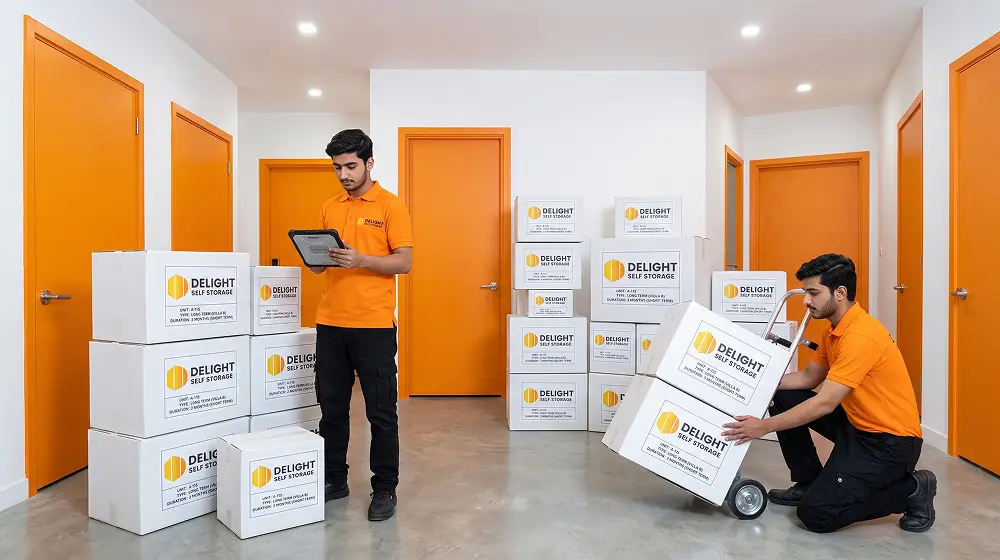
Choose short-term storage for handover gaps, renovation, delayed keys, or travel under 3 months. Choose long-term storage for overseas relocation, downsizing, property leasing, or staged furnishing.
The table below connects duration with layout and packing quality.
| Storage duration | Main priority | Unit layout | Packing standard |
|---|---|---|---|
| 1 to 30 days | Speed and access | Simple room zones | Standard moving wrap |
| 1 to 3 months | Handover flexibility | Aisle access | Strong cartons and labels |
| 3 to 12 months | Damage prevention | Stable stacking | Better covers and moisture control |
| 12+ months | Preservation | Low handling layout | Inventory, photos, insurance review |
Dubai’s 2040 Urban Master Plan expects the resident population to reach 5.8 million by 2040 and the daytime population to reach 7.8 million. Population growth supports long-term demand for housing, relocation, storage facilities, and household services.
Long-term storage requires better packaging. Use stronger cartons, moisture control, photo inventory, and climate-aware storage for sensitive goods.
How can you calculate villa storage volume quickly?
You can calculate villa storage volume by listing large items, adding carton volume, and applying a packing factor.
Fast calculator method
- Convert all dimensions into feet.
- Multiply length by width by height for each item.
- Add furniture volume.
- Add appliance volume.
- Add carton volume.
- Add outdoor furniture volume.
- Add 10% to 20% for packing gaps.
- Add 20% to 30% if access aisles matter.
Sample quick calculations
- 20 medium cartons at 3 cubic feet each equal 60 cubic feet.
- 50 medium cartons at 3 cubic feet each equal 150 cubic feet.
- 80 medium cartons at 3 cubic feet each equal 240 cubic feet.
- 100 medium cartons at 3 cubic feet each equal 300 cubic feet.
- A 10 x 10 x 8 unit equals 800 gross cubic feet.
- A 10 x 15 x 8 unit equals 1,200 gross cubic feet.
- A 10 x 20 x 8 unit equals 1,600 gross cubic feet.
- A 10 x 25 x 8 unit equals 2,000 gross cubic feet.
The calculation gives a planning estimate. A measured survey gives a stronger storage quote.
Which unit is right for your full villa move?

The right unit is the smallest storage unit that fits your measured volume, access plan, material risk, and storage duration. Choose by usable cubic volume first, then refine by climate control, security, loading access, and inventory evidence.
For a typical Dubai villa, start with these rules:
- Use 900 to 1,300 cubic feet for many 3-bedroom villa moves.
- Use 1,300 to 1,800 cubic feet for many 4-bedroom villa moves.
- Use 1,800 to 2,500 cubic feet for many 5-bedroom villa moves.
- Add more space for outdoor furniture, large décor, and access aisles.
- Choose climate-aware storage for leather, wood, electronics, artwork, and documents.
Your final choice comes from measurement, not guesswork. Measure large items, count cartons, add packing gaps, decide access needs, and compare facilities by cost per usable cubic foot.
Final takeaway: Choose storage by usable volume, not guesswork
A full villa move in Dubai becomes easier when you treat storage as a volume decision, not a bedroom-count estimate. Sofas, wardrobes, appliances, cartons, outdoor furniture, and fragile décor all take different amounts of usable cubic space.
The right storage unit gives your items enough room to fit, breathe, and remain accessible. A smaller unit may look cheaper at first, but overcrowding can increase handling time, damage risk, and last-minute upgrade costs.
Before booking a storage facility Dubai unit, measure large furniture, count cartons, add a 10% to 20% packing buffer, and decide whether you need access aisles. Add more space for outdoor items, climate-sensitive materials, and long-term storage.
Use bedroom count as your first filter. Use usable cubic volume as your final decision. That one shift helps you choose the right unit, control your moving budget, and protect your villa furniture during storage.
FAQS
Why can two villas with the same bedroom count need different storage sizes?
Two villas with the same bedroom count can need different storage sizes because furniture scale, carton count, outdoor items, and access needs vary.
How much extra storage space should I add for packing gaps?
Add 10% to 20% extra space for wrapping, odd shapes, carton gaps, and safer stacking.
Why is usable cubic volume better than floor area?
Usable cubic volume shows how much furniture and box space the unit can hold after height, stacking, and access limits.
Which villa items usually take the most storage space?
Sofas, wardrobes, king beds, dining tables, patio furniture, gym equipment, and large appliances usually take the most storage space.
Can dismantling furniture reduce my storage unit size?
Dismantling beds, tables, shelves, and modular wardrobes can reduce storage volume because flat parts stack more efficiently.
When does a Dubai villa move need climate-aware storage?
A Dubai villa move needs climate-aware storage when you store leather, wood, electronics, artwork, documents, rugs, or mattresses.
What should stay near the storage unit entrance?
Keep seasonal items, baby items, school supplies, sports gear, and quick-access boxes near the storage unit entrance.
What should not go inside villa storage?
Passports, Emirates IDs, tenancy papers, DEWA records, jewelry, medicine, food, plants, gas cylinders, and flammable liquids should not go inside storage.
How early should I estimate storage size before villa handover?
Estimate storage size 10 to 14 days before villa handover so you can measure, sort, book, and avoid move-day changes.
How do I compare two storage facility Dubai quotes fairly?
Compare quotes by usable cubic foot, access terms, climate control, handling charges, insurance scope, and retrieval fees.
Storage & Warehousing Operations Specialist
14+ years in UAE self-storage and warehousing, managing facilities across Dubai, Abu Dhabi, and the Northern Emirates. Specializes in climate-controlled storage, unit sizing, security systems, and Free Zone vs Mainland compliance.
Content Lead & Storage Solutions Researcher
8 years researching and writing on UAE storage and logistics. Focuses on storage costs, unit-size guides, and packing for Dubai's climate, working closely with facility teams for accurate pricing and specs.