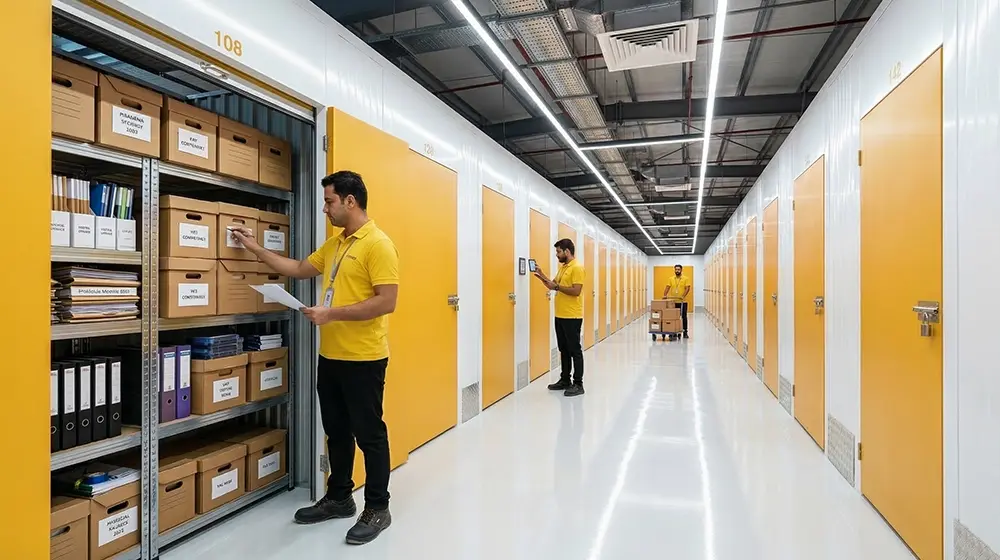

Documents take up more space than most homes and businesses expect. In Dubai, that problem grows quickly because tenancy files, Emirates ID copies, contracts, invoices, tax records, property papers, and client documents all need safe storage, fast retrieval, and clear protection.
Document storage in Dubai is not only about putting files into boxes. A home may need safe storage for passports, certificates, tenancy records, and warranties. A business may need archive storage for accounting records, employee files, contracts, audit papers, and tax documents. The wrong storage choice can create document loss, humidity damage, privacy exposure, retrieval delays, and weak evidence during disputes.
This guide explains how document storage in Dubai works for homes and businesses. It covers common storage myths, document risks, secure archiving choices, storage unit Dubai use cases, warehouse storage options, retention rules, privacy concerns, and practical checklists for choosing the right storage method.
By the end, you can decide what to keep at home, what to archive, what to scan, and what to place in managed storage.
What is document storage in Dubai?
Document storage in Dubai is the organized storage, archiving, retrieval, and disposal of paper or digital records in Dubai homes, offices, storage units, and warehouse facilities.
For residents, document storage covers passports, Emirates ID copies, visas, birth certificates, marriage certificates, education certificates, insurance records, medical records, and warranty documents. For businesses, document storage covers licenses, tax records, invoices, contracts, payroll files, audit documents, client records, and board records.
The term document archiving means keeping records for reference, legal evidence, tax review, or operational continuity. The term record retention means keeping each record type for a defined period before transfer, scanning, shredding, or permanent preservation. Information stays useful only while business, legal, or historical value exists.
This distinction matters in Dubai because a storage unit Dubai query often mixes household clutter, business archives, moving boxes, and regulated records. A simple box room solves space pressure. A controlled archive system solves custody, indexing, access, and audit readiness.
Why does document storage in Dubai need a stronger system?
Document storage in Dubai needs a stronger system because Dubai combines population growth, business growth, property activity, and regulated record retention.
Dubai Land Department reported 226,000 real estate transactions worth AED 761 billion in 2024. Transaction volume increased by 36%, while transaction value increased by 20%. Each transaction can produce ownership documents, payment records, mortgage papers, valuation reports, handover documents, maintenance records, tenancy files, and agency correspondence.
The UAE Ministry of Economy and Tourism reported 558,000 micro, small, and medium enterprises in 2022, with a national target of 1 million SMEs by 2030. The same official source lists 395,000 micro-enterprises, 150,000 small enterprises, and 13,000 medium enterprises.
Dubai’s long-term growth plans add another layer. The Dubai 2040 Urban Master Plan targets a population increase to 5.8 million residents and 7.8 million daytime population by 2040. More residents and more economic activity mean more tenancy documents, school records, medical records, trade files, tax records, and relocation paperwork.
The practical point is simple. Dubai’s document volume does not come only from offices. Homes, villas, apartments, small businesses, warehouses, clinics, schools, brokers, consultants, and retailers all create records that need retention, retrieval, and protection.
Which documents need secure storage?

Secure document storage covers records with identity value, legal value, tax value, property value, financial value, or privacy value.
- Store passports, Emirates ID copies, visas, birth certificates, marriage certificates, and academic certificates in protected home storage or controlled archive storage.
- Store tenancy contracts, Ejari records, title deeds, mortgage documents, payment receipts, and handover reports with clear indexing.
- Store trade licenses, corporate tax records, invoices, contracts, bank statements, payroll files, and audit packs by retention category.
- Store medical records, insurance policies, warranties, vehicle records, and maintenance documents by renewal date.
- Store scanned copies separately from originals, with access control and backup rules.
This list separates documents by risk. A folder with passport copies can carry more identity risk than ten cartons of old brochures.
The table below explains common document categories and the storage method that fits each category.
| Document category | Common owner | Risk level | Storage choice | Why it matters |
|---|---|---|---|---|
| Passport and Emirates ID copies | Home and business | High | Locked safe plus encrypted scan | Identity misuse risk |
| Tenancy and Ejari records | Tenant, landlord, broker | High | Indexed folder plus digital copy | Dispute and renewal evidence |
| Title deed and mortgage files | Owner and property firm | High | Secure archive box | Ownership and finance proof |
| Tax invoices and accounting files | Business | High | Archive storage with retention date | FTA review and audit support |
| Human resources files | Business | High | Access-controlled archive | Salary, identity, and privacy data |
| Warranty and service records | Home and business | Medium | Dated folder | Claim and repair evidence |
| Old marketing material | Business | Low | Short-term storage or disposal | Low legal value |
The table shows that document storage in Dubai works best when you classify records before choosing space. Storage cost in Dubai, retrieval speed, and security level depend on document value, not box count.
What myths create document storage problems?
Document storage myths create problems when homes and companies treat every box as safe, every scan as final, or every storage unit as an archive system.
Myth 1: A home cupboard protects important documents
A home cupboard protects against visual clutter, not heat, humidity, leakage, pests, light, or retrieval mistakes.
The Library of Congress recommends a cool, relatively dry, clean, stable environment for paper materials. The same guidance recommends minimal light exposure, no direct or intense light, distance from radiators and vents, and protective enclosures.
Dubai apartments and villas often use spare cabinets, balcony storage, under-bed boxes, laundry rooms, and maid’s rooms for documents. These locations may work for short-term folders. They do not work for original certificates, property files, old photographs, or signed contracts that need long-term preservation.
Myth 2: Any storage unit in Dubai works for business archives
A storage unit Dubai option can solve space pressure, but business archiving needs indexing, access control, retention rules, and retrieval logs.
ISO 11799:2015 specifies characteristics of repositories used for long-term storage of archive and library materials. The standard covers building characteristics, installation, equipment, and repository conditions.
A business archive box needs at least 6 fields:
- Box number
- Department owner
- Document type
- Date range
- Retention end date
- Retrieval authorization
Without these fields, a storage unit becomes a locked room with unknown papers.
Myth 3: Scanning removes the need for originals
Scanning improves access, but original documents can still carry legal, contractual, tax, property, or notarized value.
Digital copies also create privacy duties. UAE Federal Decree-Law No. (45) of 2021 on the Protection of Personal Data applies to personal data processing. The law refers to controllers, processors, personal data, sensitive personal data, and privacy safeguards.
A smart system keeps high-use scanned files and protects original documents. This model works for tenancy files, employee documents, contracts, tax packs, property papers, and board records.
Myth 4: Old documents are harmless
Old documents can contain signatures, account numbers, client data, medical details, salary records, passport copies, and residential addresses.
IBM’s 2025 Cost of a Data Breach Report for the Middle East reported an average breach cost of SAR 27 million, down about 18% from SAR 32.8 million in the previous year. The same report named AI and machine learning insights, encryption, and DevSecOps as cost-reducing factors.
This matters because scanned archives, employee folders, customer records, and access logs connect paper records with data custody.
Myth 5: More boxes mean better archiving
More boxes do not create better document storage. Classification creates better document storage.
A useful archive record has a box number, category, file range, owner, retention date, access rule, movement history, and destruction rule. Without those details, storage creates delay instead of control.
What risks decide the right storage choice?
The right storage choice depends on five risks:
- Climate damage
- Legal retention
- Privacy exposure
- Retrieval delay
- What is climate and material risk?
Climate and material risk means paper, ink, adhesive, photographs, folders, and labels degrade when storage conditions expose records to heat, humidity, light, dust, pests, or water.
The U.S. National Archives recommends keeping relative humidity (RH) below 65% to reduce mold growth and insect activity. It also recommends keeping the temperature below 75°F for family papers and photographs.
The Archives and Records Association recommends a consistent RH range of 35% to 60% for paper archival materials. It explains that high relative humidity can increase mold, pest activity, warping, corrosion, and sticking. Low relative humidity can cause brittleness and tears.
Use these controls for climate-sensitive records:
- Keep documents away from balconies, garages, bathrooms, kitchens, and laundry rooms.
- Use acid-free folders for long-term papers.
- Store boxes on shelves, not directly on floors.
- Avoid direct light on certificates, photographs, and old records.
- Check stored boxes every 6 to 12 months.
You risk mold, yellowing, brittle paper, faded ink, stuck photos, and lost evidence if climate controls remain absent.
- What is legal and tax retention risk?
Legal and tax retention risk means you cannot produce the right document when a landlord, bank, auditor, regulator, tax adviser, client, court, or insurer requests proof.
The UAE Federal Tax Authority (FTA) states that taxable persons and exempt persons must retain relevant corporate tax records for at least seven (7) years after the end of the tax period.
UAE Federal Decree-Law No. (32) of 2021 on Commercial Companies also requires every company to keep accounting records at its headquarters for at least five (5) years after the end of the fiscal year.
These two figures create a practical rule for Dubai businesses. Finance teams need retention labels that separate five-year company records from seven-year corporate tax records. Tax files, contracts, invoices, payroll records, and bank statements need retention dates, not only box labels.
- What is privacy and data custody risk?
Privacy and data custody risk involve personal data moving into storage without clear access rules, processor duties, retrieval approval, breach handling, or disposal of evidence.
DIFC Data Protection Law 2020 prescribes rules and obligations for collecting, handling, and using personal data. It also covers rights and remedies for individuals affected by processing.
Companies face this risk when stored files include:
- Emirates ID copies
- Passport copies
- Salary records
- Medical details
- Bank details
- Client addresses
- Employee disciplinary records
- Customer contracts
- Property buyer or tenant records
Use role-based access, sealed cartons, retrieval approvals, visitor logs, scan logs, shredding certificates, and processor contracts. A locked storage room helps. A documented access trail helps more.
- What is retrieval risk?
Retrieval risk means a document exists, but you cannot find the exact record within the required time.
Residents face retrieval risk during visa renewal, school admission, tenancy disputes, mortgage applications, insurance claims, and property sales. Businesses face retrieval risk during audits, license renewals, tender submissions, client disputes, employee claims and corporate tax reviews.
Use a six-column index for retrieval:
| Index field | Example | Purpose |
|---|---|---|
| Box number | BX-2026-014 | Finds the physical carton |
| File name | 2024 supplier invoices | Identifies content |
| Date range | Jan 2024 to Dec 2024 | Matches the audit or claim period |
| Owner | Finance department | Assigns responsibility |
| Retention date | 31 Dec 2031 | Supports disposal planning |
| Access level | Finance manager only | Controls privacy and access |
This index reduces repeated searching, duplicate scanning, missed deadlines, and unnecessary storage costs.
How do you choose between home storage, a storage unit, archive storage, and warehouse storage?
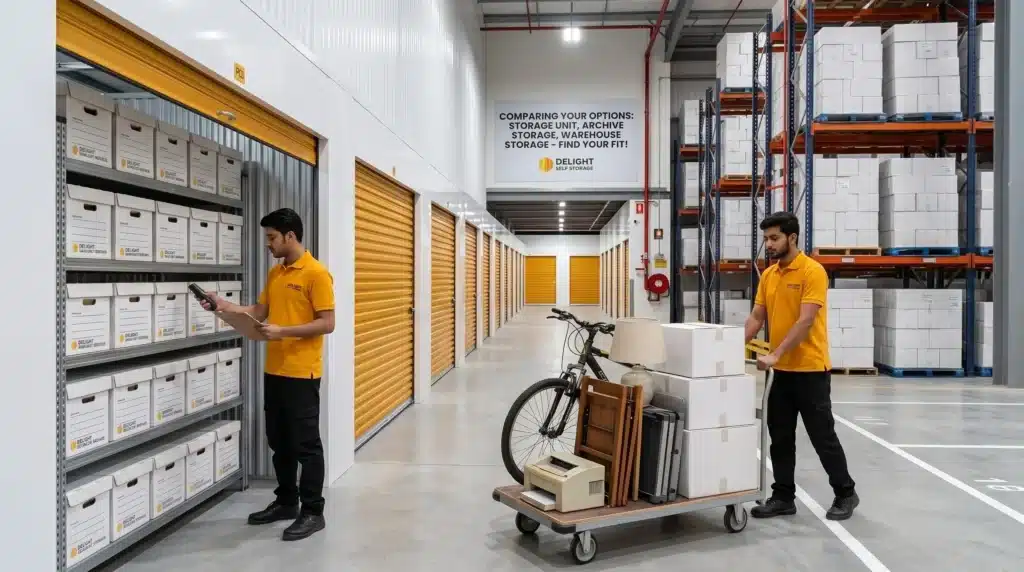
Choose storage by document value, retrieval frequency, access sensitivity, retention period, and climate sensitivity.
A storage unit Dubai facility works for mixed household boxes, temporary moving storage, and low-risk archives. Archive storage works for indexed business records with retention rules. Warehouse storage works for larger archive volumes, office moves, inventory-linked records, and managed cartons.
The table below compares document storage choices by user, purpose, and control level.
| Storage choice | Best fit | Control level | Weak point |
|---|---|---|---|
| Home cabinet | Active personal files | Low to medium | Weak climate and disaster protection |
| Fire-resistant safe | Passports, certificates, deeds | Medium | Limited space |
| Storage unit Dubai | Moving boxes and low-risk files | Medium | Requires your own index |
| Archive storage | Business and legal files | High | Requires retention discipline |
| Warehouse storage | Large office archive cartons | High | Requires service-level planning |
| Digital document system | Searchable scans | High | Originals may still matter |
Use home storage for active records. Use archive storage for evidence records. Use warehouse storage for high-volume business records. For larger archive loads, connect storage planning with warehouse storage in Dubai so cartons, access, retrieval, and movement stay part of one managed process.
What smart storage choices work for Dubai homes?
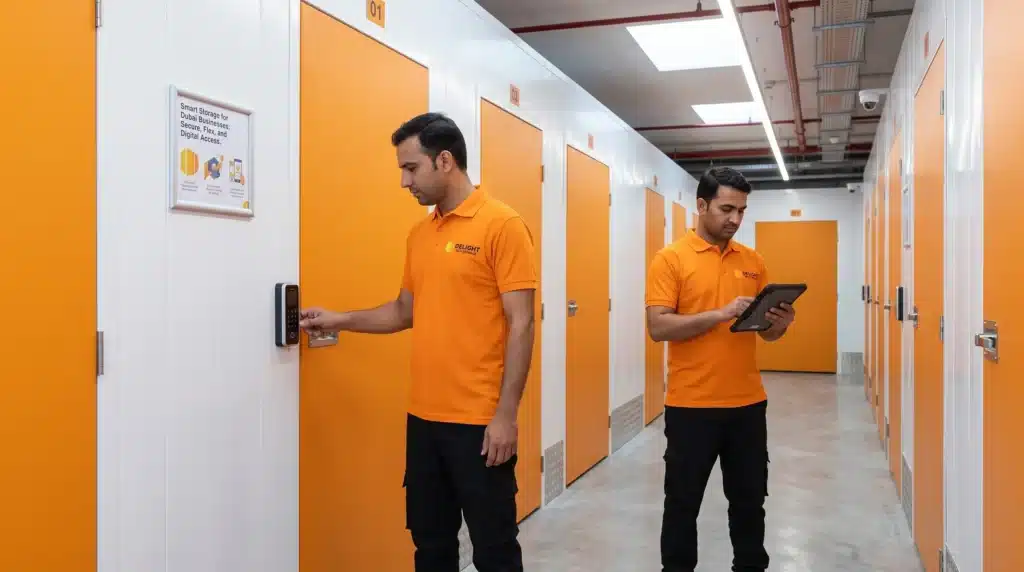
Smart home document storage in Dubai starts with a two-folder system: active originals and archived proof.
Active originals include passports, Emirates ID cards, visas, birth certificates, insurance policies, tenancy documents, title deeds, medical cards, and current school files. Keep active originals in a fire-resistant safe or locked cabinet.
Archived proof includes old tenancy contracts, old DEWA bills, move-in photos, maintenance receipts, appliance warranties, travel records, school reports, and past insurance documents. Keep archived proof in labeled folders with date ranges.
Use three labels on every home archive folder:
- Keep permanently: Identity records, education certificates, property deeds, and major legal documents.
- Keep by renewal date: Insurance, warranties, tenancy papers, vehicle records, and service contracts.
- Review yearly: Duplicate copies, expired quotes, old brochures, and outdated receipts.
This folder logic reduces clutter without deleting useful evidence. The Library of Congress also recommends supportive enclosures such as acid-free folders and document boxes for paper preservation.
What smart storage choices work for Dubai businesses?
Smart business document storage in Dubai starts with a retention matrix, not with extra cartons.
A retention matrix connects document type, department, legal basis, storage location, access owner, retention period, and disposal method. Finance, human resources, legal, sales, procurement, and operations teams need separate categories because document value differs by department.
For corporate tax records, the seven-year FTA rule gives finance teams a clear minimum retention baseline. For client records and employee records, data protection duties require tighter access and documented processing logic.
Use this business archive workflow:
- Classify records by department, document type, date range, and risk level.
- Index cartons with box numbers, file ranges, owners, and retention dates.
- Restrict access by role, approval level, and retrieval reason.
- Scan high-use records for daily operations and keep originals for evidence.
- Review retention every 12 months with finance, legal, and operations.
- Destroy expired records with approval notes and shredding evidence.
The workflow fits SMEs and larger companies because UAE business formation allows more than 2,000 economic activities and six license types, including industrial, commercial, crafts, tourism, agricultural, and professional licenses. Different license activities create different document sets.
What evidence pack helps with handover, claims, and disputes?
A document evidence pack helps you prove condition, ownership, payment, access, and chain of custody.
For home storage, the evidence pack includes a box inventory, document list, photos before packing, storage receipt, access log, and retrieval date. For business archive storage, the evidence pack includes a carton index, retention schedule, authorized requester list, movement log, scan log, and destruction certificate.
For tenancy or property disputes, a useful evidence pack includes the tenancy contract, Ejari confirmation, payment receipts, move-in photos, the handover form, maintenance requests, contractor invoices, and communication records. Dubai’s real estate transaction volume shows why property documentation has become a recurring storage category.
For business disputes, a useful evidence pack includes contract versions, purchase orders, invoices, delivery notes, approvals, bank proofs, emails, meeting minutes, and tax records. Keep the final executed contract separate from negotiation drafts.
What security gates belong in document storage?
A secure document storage process includes access, location, handling, retrieval, and destruction.
Access gate: An access gate defines who can view, open, scan, remove, or approve a document request. Access rules matter most for identity files, salary files, client contracts, medical files, and legal records.
- Location gate: A location gate defines where records can move. It also defines where visitors, cleaners, technicians, drivers, or temporary staff can enter.
- Handling gate: A handling gate defines how staff pack, seal, label, lift, transport, and return document cartons. This gate reduces mixed boxes, broken labels, and untraceable movement.
- Retrieval gate: A retrieval gate defines who can request a file, how quickly retrieval occurs, and what gets recorded after retrieval. Businesses need this gate for audits, renewals, disputes, and client requests.
- Destruction gate: A destruction gate defines who approves shredding, which documents qualify, and what proof the storage provider returns.
The UAE Personal Data Protection Law requires a Data Protection Officer in cases involving high-risk processing, systematic sensitive data assessment, or large volumes of sensitive personal data. These conditions make access gates important for document storage that contains personal data.
What should you check before choosing a document storage provider?
Choose a document storage provider by checking security, climate control, indexing, retrieval speed, access logs, insurance, and disposal procedures.
Use this procurement checklist:
- Check storage scope: Confirm whether the provider handles household files, business archives, warehouse cartons, or all three.
- Check access control: Ask who can enter storage areas and who can retrieve documents.
- Check indexing: Ask whether boxes receive unique IDs and searchable records.
- Check climate controls: Ask how the provider manages heat, humidity, dust, pests, and water risk.
- Check retrieval process: Ask how requests work and how retrieval gets logged.
- Check privacy controls: Ask how staff handle files containing personal data.
- Check disposal proof: Ask whether shredding produces a certificate or written record.
- Check location fit: Choose a location that supports your home move, office move, or warehouse route.
This checklist keeps the decision practical. The cheapest space may not be the lowest-risk option if your documents contain identity records, corporate tax evidence, or client data.
Storage strategy: Match each document to the right level of control
Smart document storage in Dubai starts with one clear rule: match each document to its value, risk, and retrieval need. A passport copy, tenancy contract, tax invoice, title deed, employee file, and old brochure do not need the same storage method.
For homes, this means keeping active originals close, storing archived proof in labeled folders, scanning high-use records, and reviewing duplicate papers every year. This protects identity documents, property files, warranties, insurance papers, and tenancy records before a renewal, claim, or handover creates pressure.
For businesses, document storage needs stronger control. Contracts, invoices, payroll files, corporate tax records, client files, and audit documents need retention dates, box indexes, access rules, retrieval logs, and disposal evidence. These controls turn stored files into usable records.
A storage unit Dubai facility can help with space during moving, renovation, travel, or office changes. Archive storage and warehouse storage add more structure when documents carry legal, tax, privacy, employee, client, or property value.
The right storage strategy is not about keeping more boxes. It is about knowing what you have, where it is stored, who can access it, how fast you can retrieve it, and when it can be safely removed.
FAQS
What is the first step before using document storage in Dubai?
Start by separating documents into active originals, archived proof, business records, sensitive files, and discardable copies.
Which home documents deserve the highest protection?
Passports, Emirates ID copies, visas, title deeds, birth certificates, marriage certificates, and insurance papers deserve the highest protection.
When does a storage unit in a Dubai facility make sense for documents?
A storage unit Dubai facility makes sense for low-risk files, moving boxes, household archives, and temporary office document storage.
Which business records are risky to store without indexing?
Tax files, contracts, invoices, payroll records, employee files, client files, and audit documents are risky without indexing.
Why is scanning not enough for important documents?
Scanning improves access, but original documents may still carry legal, tax, property, contractual, or notarized value.
What makes document archiving different from normal storage?
Document archiving uses classification, retention dates, access rules, retrieval logs, and disposal evidence instead of simple box storage.
How often should homes review stored documents?
Homes can review stored documents every 12 months to remove duplicates, update records, and check renewal dates.
What should businesses write on archive boxes?
Businesses should write the box number, department, document type, date range, retention date, and access owner.
Which documents require restricted access in storage?
Passport copies, Emirates ID copies, salary records, bank records, medical files, contracts, and client records require restricted access.
What is the smartest storage choice for mixed home and business files?
The smartest choice is a split system: keep active originals nearby, archive evidence records, scan high-use files, and store bulk cartons in managed storage.
Storage & Warehousing Operations Specialist
14+ years in UAE self-storage and warehousing, managing facilities across Dubai, Abu Dhabi, and the Northern Emirates. Specializes in climate-controlled storage, unit sizing, security systems, and Free Zone vs Mainland compliance.
Content Lead & Storage Solutions Researcher
8 years researching and writing on UAE storage and logistics. Focuses on storage costs, unit-size guides, and packing for Dubai's climate, working closely with facility teams for accurate pricing and specs.