How Secure Is a Storage Unit in Dubai?
How secure is a storage unit in Dubai? CCTV, access control, alarms & unit locks explained check before you sign. Book Now!
When you put furniture, business stock, documents or personal belongings into a storage unit, security is probably one of the first things you should think about. A low monthly price means very little if the facility has weak access controls, poor surveillance or no clear process for dealing with security incidents. So, how secure is a storage unit in Dubai?
The answer depends on the storage facility you choose. A professional facility should not rely on one security feature alone. Good protection usually comes from several layers working together, including controlled entry, CCTV, alarms, secure unit access, proper verification and trained staff or monitoring systems.
This matters even more in Dubai because storage facilities can hold everything from household furniture and electronics to business inventory and important documents. Before signing a rental agreement, it is worth looking beyond phrases such as “24/7 security” and checking what that actually means.
What a Secure Storage Facility in Dubai Should Have
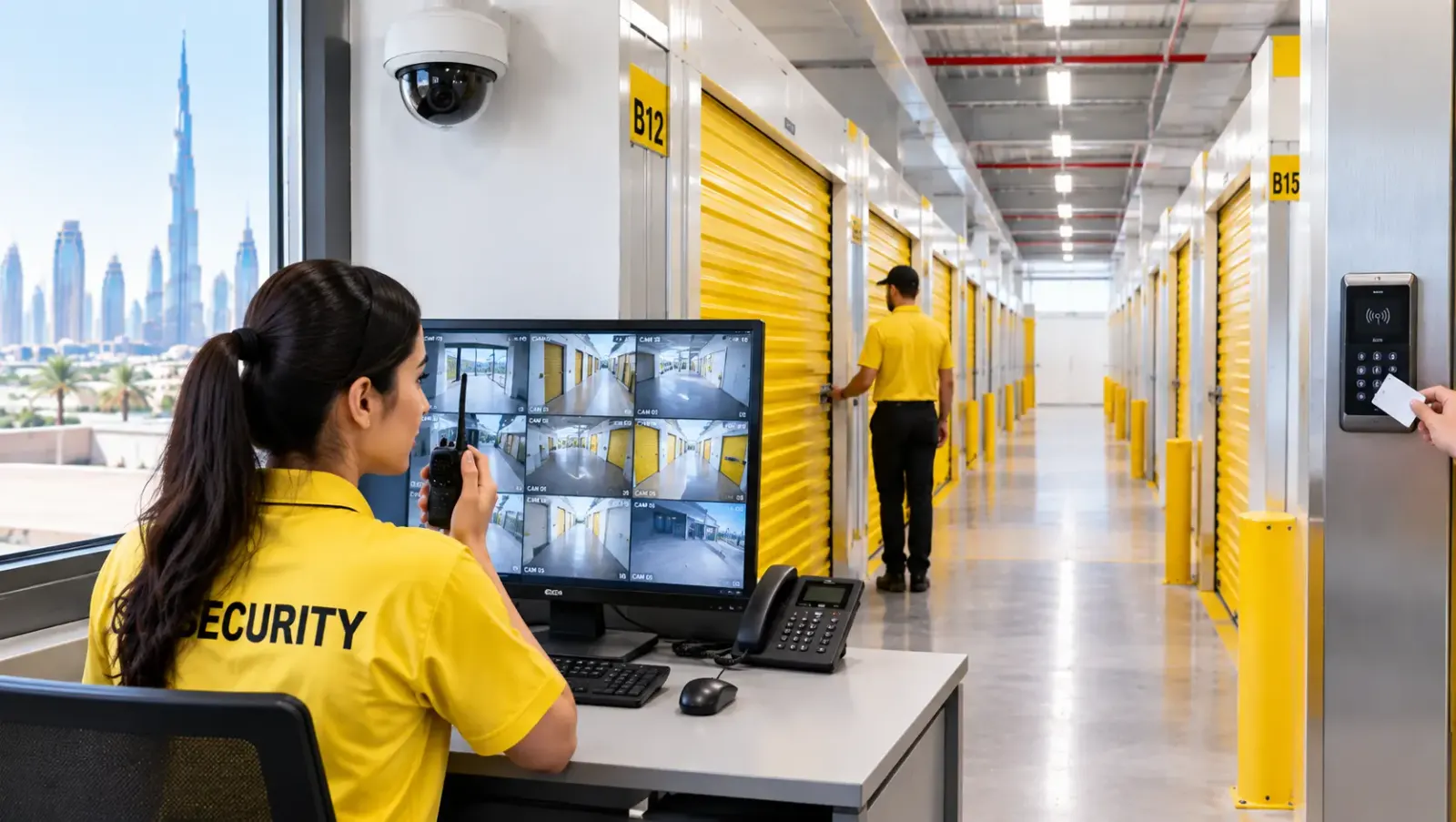
A secure storage facility should make it difficult for unauthorised people to enter, access individual units or move around the premises without being noticed. The strongest facilities usually combine physical security with electronic monitoring. Controlled entrances can restrict who enters the building, while CCTV provides visibility across important areas. Individual unit locks or alarms add another layer of protection around the customer’s belongings.
Security also depends on how these systems are managed. Cameras that nobody checks, access cards that are freely shared and alarms that are not maintained do not provide the same protection as a properly managed security system. When comparing storage providers, look for evidence rather than relying entirely on marketing language.
A useful starting point is to check whether the facility offers features such as:
- Controlled entry and exit
- CCTV monitoring
- Individual unit locks or alarms
- Access verification
- Secure perimeter areas
- Appropriate lighting
- Fire detection and protection systems
- Staff or security monitoring
- A clear process for reporting incidents
Not every facility will use exactly the same combination, but a serious storage provider should be able to explain how its security setup works.
Access Control and Audit Trails
Access control is one of the most important parts of secure storage. A facility should have some way of controlling who can enter the premises. Depending on the facility, this could involve an access card, PIN, biometric verification, electronic gate or another controlled-entry system. The important question is not simply whether the door is locked. It is whether the facility can identify authorised users and control access to storage areas. For example, if a customer gives their access credentials to another person, the provider may have limited control over who is entering the facility. That is why customers should understand the rules around sharing access.
A well-managed access system can also create records showing when access was granted or used. These records can become useful if there is ever a dispute or security incident. Dubai’s Security Industry Regulatory Agency, or SIRA, publishes security requirements covering access control, surveillance and related security systems. You can review the official SIRA security requirements for storage services to understand the standards that apply to security systems used in storage activities. Its requirements for storage services specifically address security systems and requirements for storage activities. When viewing a facility, ask whether access is restricted to authorised customers and staff and whether access activity can be traced when necessary.
CCTV: Coverage Matters More Than Having Cameras
Almost every storage provider can say it has CCTV. That statement alone does not tell you much. The better question is: where are the cameras located, how long is footage retained, and who is responsible for monitoring or reviewing it? Cameras should cover important areas such as entrances, exits, corridors, loading areas and other relevant parts of the facility. Blind spots around doors or storage corridors can weaken an otherwise good security setup.
SIRA’s published technical requirements include specifications for surveillance systems and recording. Its standards include requirements around recording quality, storage of recorded footage and the ability to retrieve specific recordings when needed. That does not mean a customer needs to inspect the technical specification of every camera. But it does mean that asking practical questions is worthwhile. Ask how long CCTV footage is retained. Ask whether cameras operate continuously or are event-based. Ask who can access recordings and what happens if an incident occurs. A provider that can answer these questions clearly gives you a much better indication of how seriously it treats security.
Individual Unit Security
CCTV protects the wider facility, but your actual storage unit needs protection too. A secure storage setup should make it difficult for another customer to access your individual space. This could involve a strong lock, electronic access, an individual alarm or another method of restricting access. The type of security can depend on the storage model. A private storage unit with controlled access is different from an open warehouse where multiple people may work around stored goods. This is particularly important for business customers storing inventory. If dozens of customers share the same general storage area, ask how individual stock is separated and protected. If you are storing valuable personal belongings, also consider your own responsibility. Use a suitable lock where required, do not share access credentials unnecessarily and keep an inventory of important items. Security is a shared responsibility between the storage provider and the customer.
Fire Detection and Suppression
Security is not only about preventing theft. Fire protection is another major part of keeping stored belongings safe. A facility should have appropriate fire detection and protection systems for its building and storage conditions. Dubai Civil Defence maintains a UAE Fire and Life Safety Code of Practice that serves as a reference for implementing Civil Defence safety requirements. Its systems also cover commercial and industrial buildings, including warehouses.
Dubai Civil Defence also operates remote monitoring systems designed to detect and report certain fire and safety alarms in real time. For a customer, the practical takeaway is simple: ask what fire detection and suppression measures are in place rather than assuming that a secure door and CCTV are enough. You should also ask whether the facility has clearly marked emergency exits, appropriate fire equipment and procedures for dealing with emergencies.
Staffed Hours vs Unstaffed Sites
A facility does not necessarily need security staff standing at the entrance every minute of the day to be secure. Some facilities operate with on-site personnel during specific hours and electronic monitoring outside those hours. Others may use security staff, remote monitoring or a combination of systems. What matters is what happens when staff are not physically present.
If the facility is accessible after normal working hours, ask how access is controlled and what happens if an alarm is triggered. Find out whether there is an emergency contact number and who responds to incidents outside staffed hours. A facility with fewer visible employees can still have strong security if its access control, CCTV, alarms and monitoring procedures are properly managed. The opposite is also true. Having staff at reception does not automatically mean the facility has good security.
How to Verify Security Claims During a Site Visit
The best way to judge a storage facility is to visit it. Do not only look at the reception area. Ask to see the route you will actually use to reach your unit. Check whether entrances are controlled, whether corridors are adequately lit and whether doors close properly after people enter. Look at how customers move around the facility and whether storage areas are clearly separated from public or loading areas.
You can also ask direct questions:
Who can access the storage area? The provider should be able to explain whether customers, staff, contractors or other authorised people can enter.
Is CCTV covering the entrance and storage areas? Ask where cameras are positioned and how recordings are handled.
How long is CCTV footage kept? A clear retention policy is more useful than simply hearing that cameras are installed.
What happens if there is an attempted break-in? Ask about alarms, incident reporting and customer notification procedures.
What happens outside staffed hours? This is especially important if you have extended or 24-hour access.
How is individual unit access controlled? Find out whether units have individual locks, alarms or another security measure.
Questions That Can Reveal a Weak Facility
A provider does not need to have the most expensive security technology in Dubai. But it should be able to explain its security procedures clearly. Be cautious if basic questions receive vague answers. For example, “We have CCTV everywhere” is less useful than knowing where cameras are located and how recordings are retained. “We have security” is also vague. Ask whether this means on-site guards, reception staff, remote monitoring or a combination of systems. You should also pay attention to the physical condition of the facility. Broken lights, damaged doors, unsecured gates, cluttered corridors or poorly maintained cameras can be warning signs. A professional storage facility should treat security as an ongoing responsibility, not just a feature used in advertising.
Does a More Expensive Storage Facility Mean Better Security?
Not necessarily. Price and security are related in some cases because advanced access systems, surveillance, alarms, staffing and facility maintenance all cost money. But a higher monthly price does not automatically prove that a facility is safer. Instead of comparing providers based only on price, compare what is actually included.
You can also consider other factors such as storage unit sizes in Dubai and the type of storage you need. There is little value in paying for an oversized unit simply because it is located in a facility with features you do not require. The same applies to pricing. A smaller, appropriately sized unit in a well-managed facility may be a better choice than paying significantly more for unnecessary space. Before booking, compare the total storage cost in Dubai alongside the security features and access arrangements.
Is Self Storage Safe in Dubai?
Self storage can be a safe option when the facility has proper security controls and the customer follows the provider’s access and storage rules. The key is not the label “self storage.” It is the quality of the storage facility behind it. Look for controlled access, effective CCTV coverage, individual unit protection, fire safety systems, appropriate lighting and clear procedures for handling security incidents.
Most importantly, verify the claims yourself. Visit the facility, ask questions and pay attention to how confidently the provider explains its security arrangements. If a storage company is transparent about who can access the facility, how surveillance works, what happens during an emergency and how individual units are protected, you have much more information to make an informed decision.
Choosing Secure Storage in Dubai
Your belongings are only as secure as the facility and procedures protecting them. Before choosing a storage unit in Dubai, do not stop at “CCTV” or “24/7 security” on a website. Look at the complete security setup. Access control should limit unauthorised entry, surveillance should cover meaningful areas, alarms should support rapid detection, and staff or monitoring systems should provide a response when something goes wrong.
Fire protection deserves the same attention. So does the way customer access is verified and recorded. The safest approach is simple: visit the facility, ask specific questions and verify the answers before signing the rental agreement. That gives you a much clearer picture of whether the storage facility is genuinely secure or simply marketed that way.
Khalid Al Mansoori
Storage & Warehousing Operations Specialist
14+ years in UAE self-storage and warehousing, managing facilities across Dubai, Abu Dhabi, and the Northern Emirates. Specializes in climate-controlled storage, unit sizing, security systems, and Free Zone vs Mainland compliance.
Sarah Mitchell
Content Lead & Storage Solutions Researcher
8 years researching and writing on UAE storage and logistics. Focuses on storage costs, unit-size guides, and packing for Dubai's climate, working closely with facility teams for accurate pricing and specs.