Storage Insurance & Liability in Dubai | What to Know
Storage insurance & liability in Dubai what's covered, excluded & how to protect your belongings before signing a storage contract.
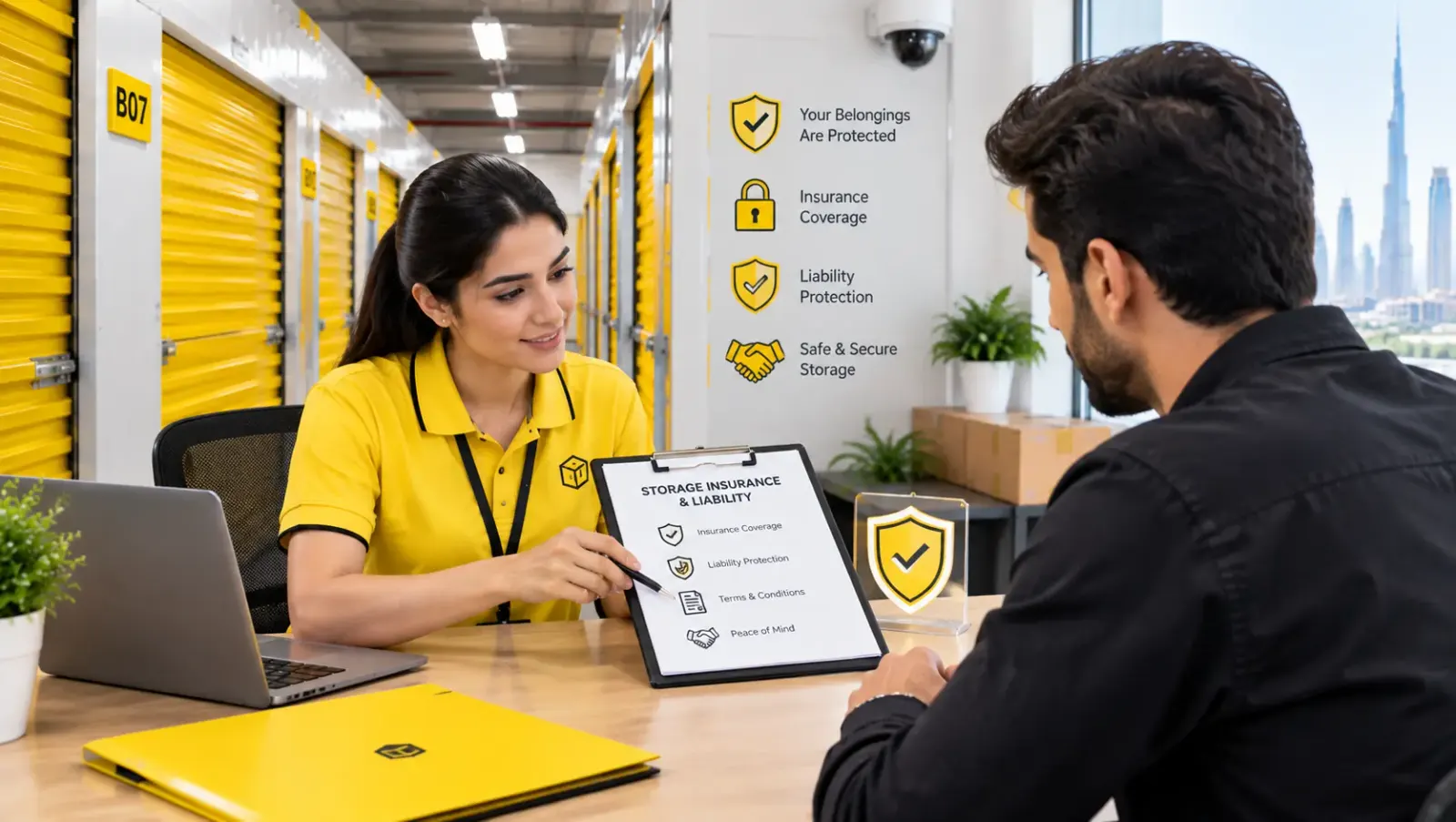
Putting your furniture, electronics, documents, business stock, or other stored belongings into a storage unit comes with an obvious question: what happens if something goes wrong? If your items are damaged, stolen, affected by water, or lost while they are in storage, who pays for the loss?
This is where storage insurance and liability in Dubai can become confusing. Many customers assume that renting a secure storage unit automatically means everything inside it is insured. That is not always the case. A storage facility may have security systems, CCTV, controlled access, and other protection measures without accepting unlimited financial responsibility for the belongings stored there.
The answer usually depends on the storage agreement, the facility’s liability terms, any insurance included with the service, and whether you have separate cover for your belongings. Before moving your things into storage, it is worth understanding exactly what is covered, what is excluded, and what you may need to insure yourself.
What Is the Storage Facility Liable For?
The first thing to understand is the difference between security and liability. A storage company can take reasonable steps to protect a facility without automatically being responsible for every loss involving a customer’s belongings. Your storage contract should explain the circumstances in which the facility accepts liability. It may set limits on the amount the provider will pay for certain types of loss or damage. There may also be conditions that must be met before a claim can be considered.
For example, a provider may have controlled access, CCTV, alarms, and security personnel. Those measures can reduce the risk of theft, but they do not necessarily mean the company guarantees the value of everything you store. Your responsibility may include properly packing your belongings, following storage rules, using an approved lock, and declaring certain information about valuable items. This is why reading the liability section of the agreement matters. Do not rely only on a salesperson saying that the facility is “fully secure.” Security and financial liability are two different things.
What Does the Storage Contract Exclude?
Storage agreements commonly contain exclusions. These are situations where the facility may not accept responsibility for a loss or where separate insurance may be required. The exact exclusions vary between providers, so there is no single list that applies to every storage unit in Dubai. However, you should look carefully for clauses relating to natural deterioration, poor packing, prohibited goods, pests, moisture, temperature-sensitive belongings, undisclosed valuables, and events outside the provider’s reasonable control.
Your contract may also place limits on certain categories of belongings. Jewellery, cash, important documents, artwork, collectibles, high-value electronics, and other expensive items may require special declaration or separate cover. The important point is simple: never assume that every item inside your unit has unlimited protection simply because you are paying a monthly storage fee. If something is particularly valuable or difficult to replace, ask the storage provider specifically how that item would be treated under its liability and insurance terms.
Declaring the Value of Your Belongings
Declared value is another part of storage insurance that customers sometimes overlook. When you rent a storage unit, the provider may ask you to estimate the value of the belongings you are storing. This figure can be important when determining the level of cover available to you or the maximum amount payable if you make a successful claim. Try to be realistic when calculating the value. If you store furniture, appliances, electronics, clothing, documents, and other belongings, create a simple inventory and estimate what it would cost to replace them.
Do not automatically use what you originally paid for an item. A five-year-old television, for example, may not have the same current value as a new television. On the other hand, some belongings may have sentimental or specialist value that is difficult to calculate. Ask the provider how declared value is assessed and whether claims are based on replacement value, current value, repair cost, or another method. For business stock, the process can be even more important. Inventory levels may change from month to month, so a business should understand whether its declared value needs to be updated when the amount of stock changes. Keeping an inventory also makes things easier if you ever need to prove what was stored in the unit.
What Cover Can You Buy and What Does It Cost?
If insurance is not included in your storage agreement, you may have the option to purchase additional cover. The cost can depend on the declared value of the belongings, the type of items being stored, the risks covered, the storage conditions, and the terms of the policy. There is no single “storage insurance Dubai” price that applies to every customer, just as storage rent itself varies by unit size, location and storage conditions. You can compare the factors that affect storage costs in Dubai before working out your overall monthly budget. Two people renting identical storage units could have very different insurance costs if one stores ordinary household furniture while the other stores expensive electronics or business inventory.
Before paying for additional cover, ask what you are actually getting for the premium. Check the maximum claim amount, deductible or excess, exclusions, geographical limits, valuation method, and whether individual categories of belongings have separate limits. It is also worth checking whether insurance is mandatory under your storage contract or simply recommended. Some facilities may offer protection as part of their service, while others may leave customers responsible for arranging their own insurance. The cheapest policy is not necessarily useful if the exclusions leave out the items you actually care about.
What Your Home Contents Policy May Already Cover
Before buying separate storage insurance, check your existing home contents insurance. Some home insurance policies may provide cover for belongings kept away from the insured home, but the conditions can vary considerably. There may be limits on the amount covered, the types of risks included, or the length of time belongings can remain outside the home. For example, a policy might provide some cover for belongings temporarily stored elsewhere but exclude commercial stock or certain high-value items. Another policy may have specific requirements for approved storage facilities.
Do not assume that your existing policy covers everything simply because it covers your household contents at home. Contact your insurer and explain exactly what you are doing.If you need to understand the wider insurance framework in the UAE, you can also review the UAE insurance guidance published by the official UAE Government portal. Tell them that your belongings will be stored in a rented storage unit in Dubai, how long they are likely to remain there, and what types of items you are storing. Ask whether your current policy covers theft, fire, water damage, accidental damage, and other risks while the belongings are inside the storage facility. Also ask whether there is a maximum claim limit. Getting a clear answer before moving your belongings is much better than discovering an exclusion after something has happened.
Making a Storage Insurance Claim
If your belongings are damaged or lost, act quickly. Your first step should usually be to contact the storage provider and your insurer, depending on who is responsible under your agreement and policy. Do not immediately throw away damaged items unless you are instructed to do so. Take photographs and videos showing the condition of the belongings and the storage unit. Record when you noticed the problem and what happened before you discovered the damage.
If something has been stolen, follow the provider’s incident-reporting process and ask whether a police report or other documentation is required. Keep copies of emails, forms, receipts, photographs, inventory records, and any communication relating to the incident. Your insurer may ask for proof of ownership or value. This is where receipts, invoices, photographs, warranty documents, and inventory records become useful. A claim can become much harder when you cannot demonstrate what was stored, what it was worth, or what condition it was in before the incident. Good documentation may feel unnecessary when everything is going well, but it can save a lot of frustration later.
Document the Condition Before You Store
One of the simplest things you can do before moving belongings into storage is to document their condition. Take clear photographs of furniture, electronics, appliances, artwork, business equipment, and other valuable items before they enter the unit. If something already has a scratch, dent, stain, crack, or other damage, photograph it clearly. For expensive belongings, keep receipts or other proof of purchase where available. For business inventory, maintain stock records that show quantities and values.
You can also create a basic storage inventory with the item’s description, estimated value, condition, and photograph. It does not need to be complicated. A spreadsheet or organised folder on your phone can be enough. This documentation gives you a reference point. If you later discover damage, you can compare the item’s condition before and after storage rather than trying to remember what it looked like months earlier.
Check These Insurance Questions Before Renting
Before signing a storage agreement, ask the provider a few direct questions. The answers can tell you much more than a general statement about security.
Is insurance included in the monthly storage price? If yes, ask exactly what the policy covers and whether there is a maximum claim amount.
Who is liable if my belongings are damaged or stolen? Ask whether liability is limited and where those limits are stated in the contract.
Do I need to declare the value of my belongings? If so, find out how the declared value affects your cover.
What items are excluded? Pay particular attention to high-value belongings, electronics, documents, business stock, and items that require specific storage conditions.
Can I purchase additional cover? If additional insurance is available, ask for the premium, coverage limit, exclusions, and claim conditions in writing.
Does my home insurance already provide cover? If you already have a contents policy, confirm the position with your insurer rather than assuming.
What happens if I need to make a claim? Find out who you contact, what evidence you need, and whether there are specific reporting deadlines.
These questions are worth asking before you move anything into the unit. Once your belongings are already stored, discovering an important exclusion is too late.
Is My Storage Unit Insured?
So, is your storage unit insured? Not necessarily. Renting a storage unit does not automatically mean that every item inside it has unlimited insurance cover. The storage facility may have strong physical security and still limit its financial liability under the rental agreement. You may also have insurance through your home contents policy, or you may be able to purchase separate storage insurance.
The safest approach is to check all three areas: the storage contract, the facility’s insurance or liability arrangements, and your existing insurance policy. Your stored belongings deserve the same attention you would give them at home. Before you sign, find out what is covered, what is excluded, whether you need to declare their value, and how a claim would actually work. A few questions and some basic documentation can make a big difference. Instead of assuming your belongings are insured because they are inside a professional storage facility, know exactly where the liability sits and what protection you have before you hand over the keys.
Khalid Al Mansoori
Storage & Warehousing Operations Specialist
14+ years in UAE self-storage and warehousing, managing facilities across Dubai, Abu Dhabi, and the Northern Emirates. Specializes in climate-controlled storage, unit sizing, security systems, and Free Zone vs Mainland compliance.
Sarah Mitchell
Content Lead & Storage Solutions Researcher
8 years researching and writing on UAE storage and logistics. Focuses on storage costs, unit-size guides, and packing for Dubai's climate, working closely with facility teams for accurate pricing and specs.