Storage Cost in Dubai: Price per Sq Ft and by Unit Size
Storage cost in Dubai — compare price per sq ft & unit sizes to find the most affordable & secure storage option today.
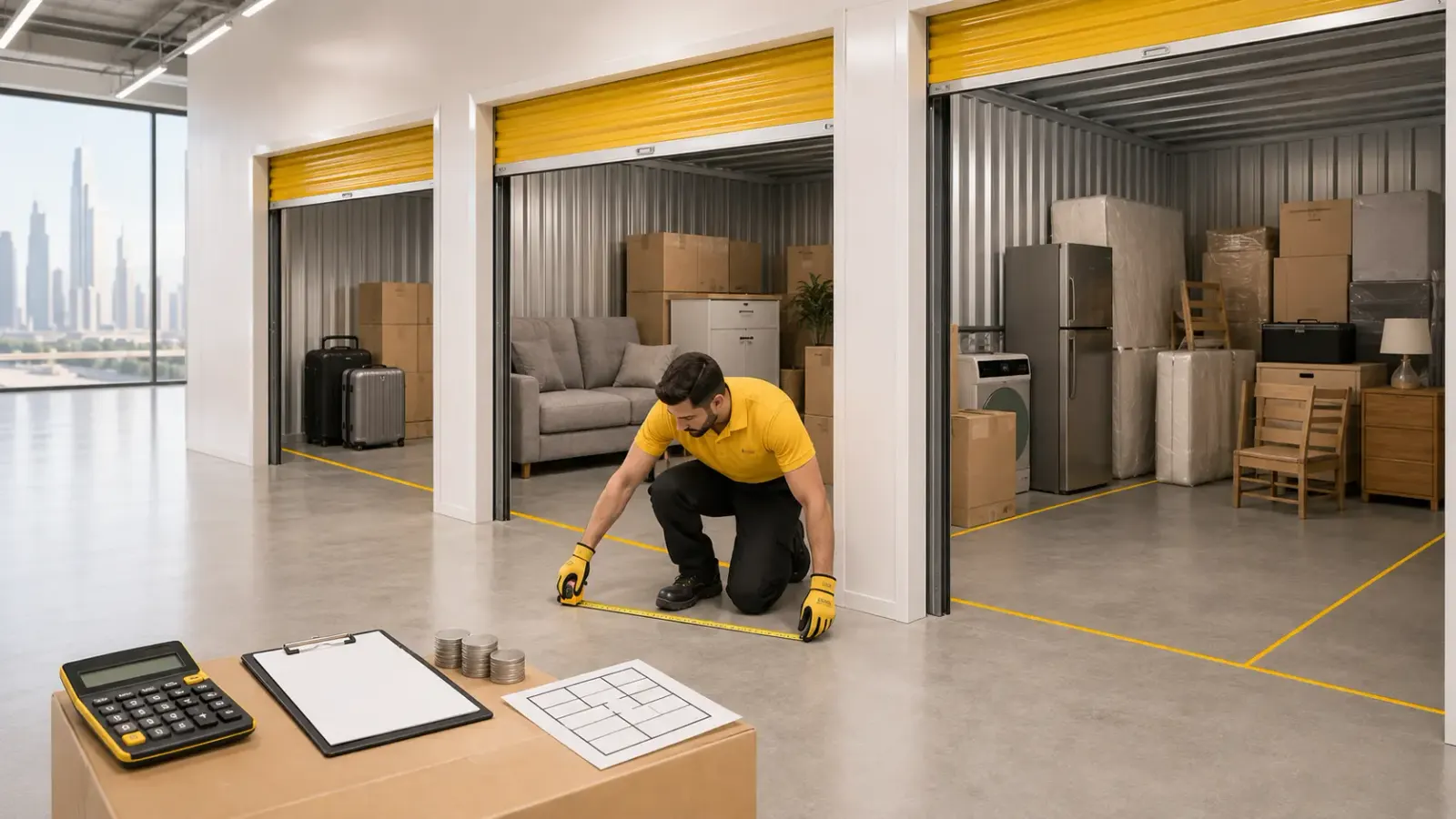
Storage cost in Dubai can look straightforward when you see a monthly price on a website. But that number rarely tells the whole story. A 25 sq ft locker, a 100 sq ft room and a 300 sq ft unit will have very different monthly prices, and the cost per square foot can change considerably as the unit gets larger. Then there are the other factors: location, contract length, climate control, access, pickup and delivery, insurance and VAT.
For budgeting purposes, current Dubai storage pricing generally starts at around AED 150 per month for very small storage and can reach AED 3,000 or more per month for larger units. Published market ranges show approximately AED 300–450 for 25 sq ft, AED 550–750 for 50 sq ft, AED 900–1,300 for 100 sq ft and AED 1,600–2,200 for 200 sq ft in non-climate-controlled storage. Climate-controlled units typically cost more. The smartest way to compare storage cost in Dubai is not to look at the monthly rent alone. Look at the unit size, calculate the AED per sq ft, check what is included and then compare the total cost for the period you actually need.
How Much Does Storage Cost in Dubai?
For many customers, self-storage in Dubai falls somewhere between AED 150 and AED 3,000+ per month, depending mainly on the size and type of unit. Very small lockers sit at the lower end, while large household, villa and business storage units can cost considerably more.
Here is a practical pricing guide:
| Unit size | Typical monthly price | Common use | | 10 sq ft | AED 150–250 | Documents, luggage and small boxes | | 25 sq ft | AED 300–450 | Small household storage | | 50 sq ft | AED 550–750 | Studio or 1-bedroom belongings | | 100 sq ft | AED 900–1,300 | 2-bedroom apartment contents | | 200 sq ft | AED 1,600–2,200 | 3-bedroom or compact villa contents | | 300 sq ft | AED 2,200–3,000 | Larger villa or bulky business stock |
These are indicative market ranges, not guaranteed quotes. The final amount can change according to the facility, area, storage conditions, access arrangements and services included. A useful point to remember is that bigger units generally cost more overall but can offer a lower price per square foot.
What Is the Average Storage Price per Sq Ft in Dubai?
The storage price per sq ft in Dubai varies by unit size and facility. Current published ranges put many residential self-storage units around AED 9–19 per sq ft per month, while very small lockers can exceed AED 20 per sq ft. Why does that happen? A small unit still requires security, lighting, access control, administration and facility space. Those operating costs do not disappear just because the customer rents fewer square feet.
For example:
| Monthly rent | Unit size | Cost per sq ft | | AED 300 | 25 sq ft | AED 12 | | AED 450 | 25 sq ft | AED 18 | | AED 600 | 50 sq ft | AED 12 | | AED 950 | 50 sq ft | AED 19 | | AED 1,200 | 100 sq ft | AED 12 | | AED 2,400 | 200 sq ft | AED 12 | | AED 3,600 | 300 sq ft | AED 12 |
The calculation is simple:
Monthly storage cost ÷ unit size in sq ft = AED per sq ft per month
This gives you a much fairer way to compare two storage quotes.
How Do You Calculate Storage Cost per Sq Ft?
Suppose one provider offers a 50 sq ft storage unit for AED 900 per month.
AED 900 ÷ 50 sq ft = AED 18 per sq ft per month.
Another provider may offer 100 sq ft for AED 1,600.
AED 1,600 ÷ 100 sq ft = AED 16 per sq ft per month.
The second unit costs more in total, but it is cheaper on a square-foot basis. That does not automatically mean you should rent the larger unit. If you only need 50 sq ft, paying for another 50 sq ft is still unnecessary. The calculation is there to help you compare value, not to encourage you to rent more space than you need. When comparing providers, use the same calculation for every quote and make sure you are comparing similar storage conditions.
How Does Unit Size Change Storage Cost?
Unit size is one of the biggest factors affecting Dubai storage costs. A small locker may cost only a few hundred dirhams each month, while a 200 or 300 sq ft unit can run into several thousand dirhams. But the relationship is not perfectly linear. A 25 sq ft unit might cost AED 400, while a 50 sq ft unit could cost AED 700 rather than AED 800. The larger unit gives you twice the floor area without necessarily doubling the monthly rent.
That is why it is useful to compare both:
Total monthly price: How much will actually leave your bank account?
Price per sq ft: How much are you paying for each square foot?
The right choice depends on your belongings. If your inventory fits comfortably into 50 sq ft, there is little reason to pay for 100 sq ft simply because the larger unit has a lower price per square foot.If you are still deciding how much space you actually need, this guide to storage unit sizes in Dubai breaks down common unit dimensions, square footage and cubic capacity.
How Does Location Affect Storage Cost in Dubai?
Location can influence storage pricing because land, accessibility, traffic, facility type and operating costs vary across Dubai. Storage facilities can be found in areas including Al Quoz, Ras Al Khor, Dubai Investment Park, Jebel Ali, Al Qusais and Dubai South. Current market guides show differences between these areas, with location affecting both price expectations and convenience. The cheapest facility is not necessarily the cheapest option for you.
Imagine you live near Downtown Dubai and visit your storage unit twice a week. A cheaper facility much farther away could save AED 100 or AED 200 on rent but cost you considerably more in fuel and travel time over several months. On the other hand, if you are storing belongings for a year and expect to retrieve them only once or twice, distance may matter much less. Think about your access frequency before choosing a location.
How Does Climate Control Change the Price?
Climate-controlled storage generally costs more than basic storage because the facility has to maintain controlled temperature and humidity conditions. Published Dubai pricing examples show climate-controlled units ranging from around AED 200 for 10 sq ft to AED 3,800 for 300 sq ft, compared with lower non-climate ranges. The extra cost can be worthwhile for belongings that are sensitive to Dubai’s heat and humidity.
These can include:
- Wooden furniture
- Leather furniture
- Electronics
- Important documents
- Books
- Artwork
- Photographs
- Musical instruments
Not everything requires climate control. Metal tools, sealed plastic items and some durable household goods may have lower environmental sensitivity. Ask the facility what its climate-controlled service actually maintains rather than assuming the term means the same thing everywhere.
How Does Rental Length Affect the Price?
The length of your rental can have a noticeable effect on the effective monthly cost. Short-term storage gives you flexibility. That can be valuable when you are between homes, renovating, travelling or waiting for a property handover. Longer contracts can sometimes reduce the monthly rate. Current Dubai pricing examples show discounts of around 5% to 15% for six- or twelve-month commitments, although the exact saving depends on the provider and plan.
For example, one published pricing table lists a 30 sq ft unit at AED 360 for one month compared with AED 3,600 for a year. The annual plan works out at AED 300 per month. That is a useful saving if you know you will definitely need the unit for a year. But do not sign a long contract simply to get a lower rate if your moving date is uncertain. A cheap monthly rate can become expensive if you end up paying for several unused months.
What Extra Charges Can Appear on the Invoice?
The advertised monthly rent is not always the final amount. Potential additional charges can include:
- VAT
- Security deposit
- Administration or registration fee
- Pickup charges
- Delivery charges
- Packing materials
- Insurance
- Lock charges
- Late-payment fees
- After-hours access fees
- Early cancellation charges
VAT is particularly important, so it is worth checking the official UAE VAT guidance when reviewing whether VAT has been included in your storage quotation. The standard VAT rate in the UAE is 5%, so ask whether the advertised price is VAT-inclusive or exclusive. For example, a storage unit advertised at AED 1,000 before VAT would cost AED 1,050 after 5% VAT. Pickup and delivery can also change the final cost. A provider may advertise a low storage rate but charge separately for collecting your furniture and returning it. That does not make the provider expensive. It simply means you need to compare the complete cost, not one number from the advertisement.
How Can You Compare Two Storage Quotes Properly?
Suppose Provider A offers:
50 sq ft: AED 800 per month
Provider B offers:
50 sq ft: AED 900 per month
At first glance, Provider A looks cheaper. But then you discover Provider A charges separately for insurance, pickup and administration, while Provider B includes some of those services. Now the AED 100 difference may not tell you much. Before choosing, ask both providers for an itemised quote showing:
- Monthly rent
- Unit size
- VAT
- Deposit
- Insurance
- Pickup and delivery
- Access conditions
- Climate control
- Administration fees
- Cancellation or notice requirements
You want the final number for the entire rental period, not just the advertised starting price.
How Do Dubai Storage Prices Compare With the Rest of the UAE?
There is no single UAE-wide storage rate. Dubai generally has a broader range of storage options because of its large residential population, business activity, property market and logistics sector. Other emirates have their own pricing based on local demand, land costs, facility availability and storage models. You should therefore avoid assuming that a price from Abu Dhabi, Sharjah or Ajman automatically represents the correct storage cost in Dubai. Even within Dubai, two facilities can charge different rates for similar-sized units.If you are comparing storage with a larger commercial space, this guide to self storage vs warehouse in Dubai explains how the two options differ in cost, access and operational requirements.
The better comparison is always between facilities offering similar:
- Unit sizes
- Security
- Access
- Climate conditions
- Insurance
- Contract terms
- Pickup and delivery services
When Is Cheap Storage Actually Expensive?
A low monthly price is not necessarily a bargain. Imagine you rent a 25 sq ft unit because it is cheaper. After moving in, you discover that your sofa and several boxes do not fit. You then need another small unit. You could end up paying more than you would have spent on one correctly sized unit from the beginning.
The same applies to poor access. If you regularly need your stock but the facility is difficult to reach, your business may lose time every week. The cheapest storage option should be the one that meets your actual needs at the lowest total cost, not simply the one with the lowest advertised starting price.
How Can You Bring Your Storage Cost Down?
There are several practical ways to reduce storage Dubai cost without choosing a poor-quality facility.
Declutter before renting
Do not pay monthly to store belongings you no longer want. Sell, donate or dispose of unwanted items first.
Measure bulky furniture
A quick measurement of sofas, wardrobes, beds and cabinets can prevent you from renting an unnecessarily large unit.
Dismantle furniture
Remove table legs and dismantle suitable furniture where possible. This can make stacking much easier.
Use consistent boxes
Uniform cartons stack more efficiently than bags and irregular containers.
Choose the smallest safe unit
Do not rent extra space just because it sounds convenient. At the same time, do not cram everything into a unit that is clearly too small.
Consider your rental period
If you are certain that you need storage for a year, ask whether a longer commitment provides a better rate.
Compare the full quote
Ask for VAT, pickup, insurance and other charges in writing before making your decision.
How Much Should You Budget for Storage in Dubai?
As a broad planning figure, budget around AED 300–750 per month for smaller 25–50 sq ft storage, around AED 900–1,300 for 100 sq ft, and around AED 1,600–3,000 for 200–300 sq ft, depending on the facility and storage conditions. Climate-controlled options can push the monthly price higher. For very small lockers or compact storage, you may find options around AED 150 per month. At the other end, large or climate-controlled units can exceed AED 3,000.
Your actual budget should be based on your inventory rather than your property size alone. A studio apartment with very little furniture may need only 25–50 sq ft. A furnished 2BHK may need around 100 sq ft, while a villa or business with bulky inventory could require 200 sq ft or more.
Final Takeaway: Compare the Total Storage Cost, Not Just the Rent
The real cost of storage in Dubai depends on more than the number printed beside “per month.” Unit size determines the base rent. Location can affect the price and convenience. Climate control adds protection but usually costs more. Longer contracts may reduce the monthly rate. Pickup, insurance, VAT and other charges can increase the final invoice. That is why the most useful comparison is AED per sq ft per month plus the total cost of your rental period.
Start by making an inventory. Measure your largest belongings. Decide whether climate control is necessary. Think about how often you will visit the facility. Then ask for an itemised quote. The cheapest storage is rarely just the facility with the lowest headline price. It is the option that gives you the right amount of usable space, suitable protection and predictable costs without paying for storage you do not actually need.
Khalid Al Mansoori
Storage & Warehousing Operations Specialist
14+ years in UAE self-storage and warehousing, managing facilities across Dubai, Abu Dhabi, and the Northern Emirates. Specializes in climate-controlled storage, unit sizing, security systems, and Free Zone vs Mainland compliance.
Sarah Mitchell
Content Lead & Storage Solutions Researcher
8 years researching and writing on UAE storage and logistics. Focuses on storage costs, unit-size guides, and packing for Dubai's climate, working closely with facility teams for accurate pricing and specs.