Is Climate-Controlled Storage Worth the Extra Cost in Dubai?
Is climate-controlled storage worth the extra cost in Dubai? Compare benefits, risks & prices before you decide. Book Now!
Climate-controlled storage sounds like an obvious choice in Dubai. Summers are extremely hot, humidity can be uncomfortable, and nobody wants to open a storage unit months later to discover that furniture, electronics, documents or leather goods have deteriorated. But there is a more practical question to ask: is climate-controlled storage actually worth the extra money? Not always.
The right answer depends on what you are storing, how much those belongings are worth, how long you plan to keep them in storage and how sensitive they are to heat and humidity. If you are storing valuable furniture or important documents for a year, paying more for a controlled environment may make sense. If you are storing garden equipment for two months, it may simply be an unnecessary expense. The easiest way to decide is to compare the extra monthly cost against the potential cost of damage or replacement.
What Is the Extra Cost of Climate-Controlled Storage?
Start with the simplest part of the calculation: the price difference. Ask the storage provider for the price of a standard unit and a comparable climate-controlled unit. The units should be roughly the same size, with similar access and rental terms. For example:
| Storage option | Monthly price | | Standard unit | AED 600 | | Climate-controlled unit | AED 750 | | Extra cost | AED 150/month |
In this example, climate control costs an additional AED 150 every month. That figure is more useful than simply looking at the total rental price because it tells you exactly what you are paying for the additional environmental protection. The next question is how long you will need the unit. If you rent for three months, the additional cost is AED 450. For six months, it becomes AED 900. Over twelve months, you would pay AED 1,800 more. That can sound like a lot until you compare it with the value of the belongings inside the unit.
Why Dubai’s Summer Conditions Matter
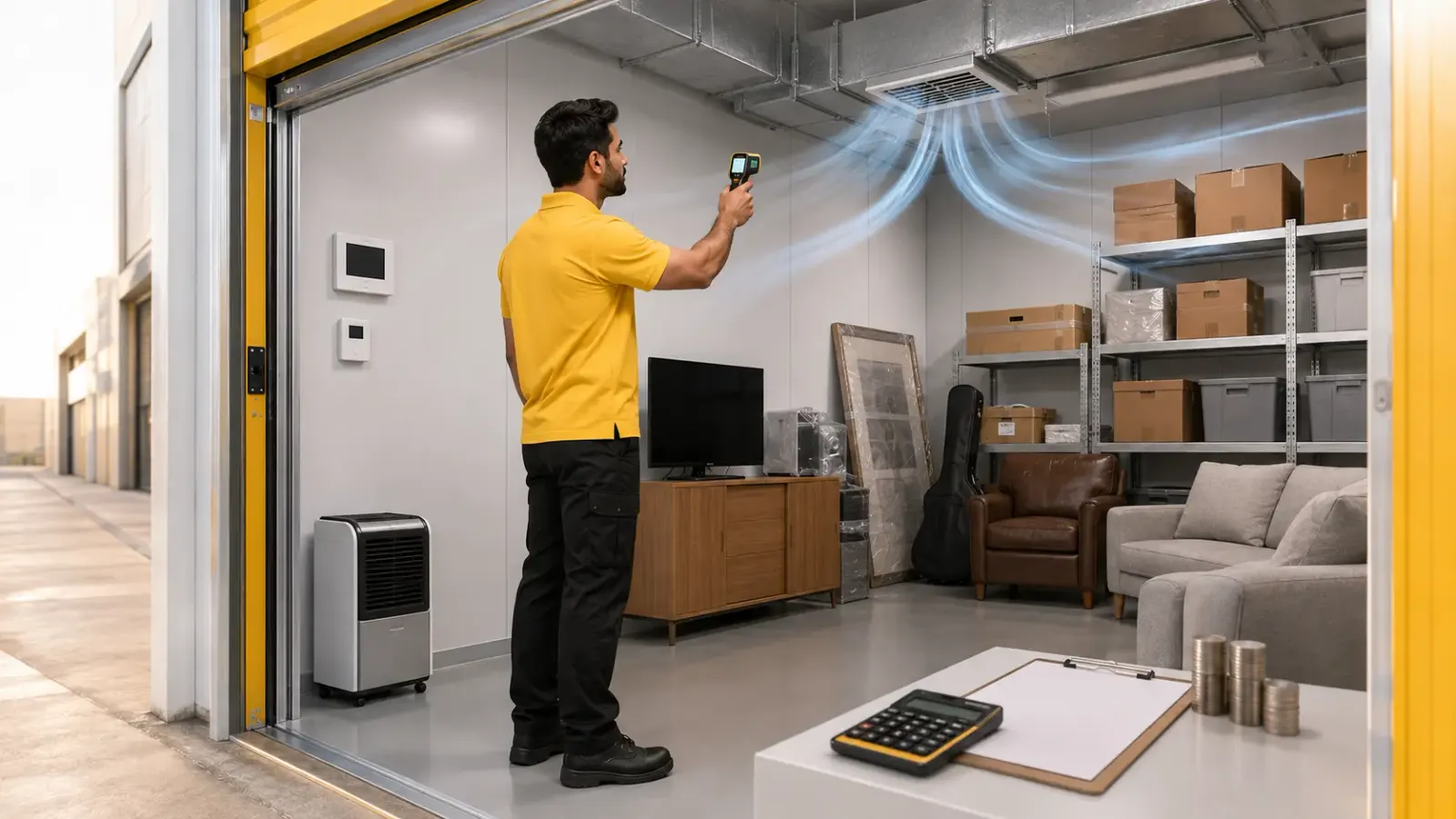
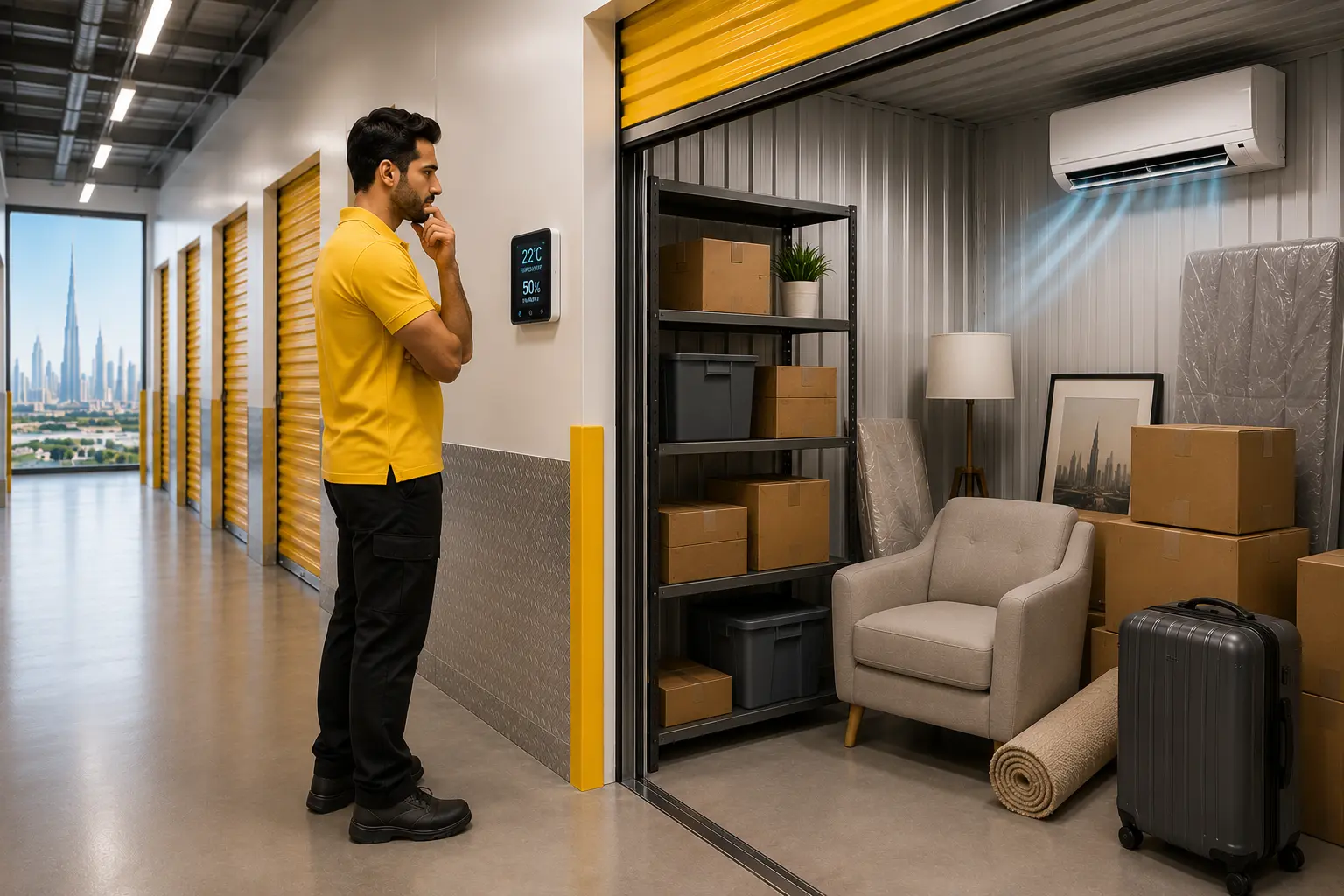
Dubai’s climate is one of the main reasons this question comes up in the first place. The Dubai Building Code provides official design guidance for indoor and outdoor conditions, including a 46°C outdoor design temperature and indoor conditions of around 24°C with relative humidity of 50% ±5%.
These figures are not a guarantee that a storage facility will operate at exactly those conditions. They simply provide useful context for understanding the difference between Dubai’s outdoor environment and a controlled indoor space.
Heat and humidity can affect different materials in different ways. Wood can react to changes in moisture, leather may deteriorate under unsuitable conditions, and paper, photographs and some electronics can be particularly vulnerable to poor environmental conditions. That does not mean everything stored in a standard unit will be damaged. It means that the risk matters more for some belongings than others.
When Is Climate-Controlled Storage Worth Paying For?
Climate-controlled storage becomes easier to justify when your belongings are valuable, sensitive or difficult to replace. For example, imagine you are storing:
- A leather sofa
- Solid-wood furniture
- Expensive electronics
- Important business documents
- Family photographs
- Artwork
- Musical instruments
- Sensitive business inventory
If these belongings are worth AED 15,000 or AED 20,000 collectively, spending an additional AED 1,000 or AED 2,000 over a long rental period may be reasonable. The calculation becomes even stronger when the items have sentimental or practical value that cannot easily be measured in dirhams. A box containing old photographs may have almost no resale value, but replacing the photographs may be impossible. The same applies to original certificates, family records and certain documents. So don’t look only at what the items could be sold for. Think about what it would actually cost to replace them, repair them or live without them.
When Is Standard Storage the Better Choice?
There are plenty of situations where standard storage is perfectly sensible. You may not need climate control if you are storing durable items such as:
- Garden tools
- Metal equipment
- Plastic containers
- Outdoor furniture designed for harsh conditions
- Empty suitcases
- Durable household items
- Some renovation and building materials
Suppose you are paying AED 150 extra every month for climate control but your entire inventory is worth AED 1,500. After ten months, you would have paid another AED 1,500 for climate control. That may not be a sensible trade-off for belongings that are relatively resistant to environmental changes. This is why the cheapest storage option is not always the best option, but neither is the most expensive one. You are paying for protection. The question is whether your belongings actually need that level of protection.
Calculate the Climate-Controlled Storage Break-Even Point
A simple calculation can help you make the decision without overthinking it.
Use:
Extra monthly cost × number of rental months = total climate-control premium
For example:
Standard storage: AED 700/month Climate-controlled storage: AED 900/month Monthly premium: AED 200 Rental period: 8 months
Your additional cost would be:
AED 200 × 8 = AED 1,600
Now look at the items being stored. If the unit contains AED 15,000 worth of sensitive belongings, an additional AED 1,600 may be a reasonable expense. If the contents are worth AED 2,000 and are mostly durable items, the same AED 1,600 premium is much harder to justify. There is no fixed break-even percentage that works for everyone. Your decision should reflect both the financial value of your belongings and how much risk you are willing to accept.
A Simple Climate-Controlled Storage Calculator
You can run the calculation using four numbers:
1. Standard monthly storage price: AED
2. Climate-controlled monthly price: AED
3. Expected rental period: months
4. Estimated value of sensitive belongings: AED
Then calculate the premium:
Climate-control premium = Climate-controlled price − Standard price
And:
Total premium = Monthly premium × Rental period
For example:
| Calculation | Amount | | Standard storage | AED 650/month | | Climate-controlled storage | AED 850/month | | Monthly premium | AED 200 | | Rental period | 6 months | | Total climate premium | AED 1,200 | | Sensitive belongings | AED 10,000 |
Here, the customer would pay AED 1,200 more over six months to store belongings worth around AED 10,000. Whether that is worth it depends on how sensitive those belongings are and how comfortable the customer is with the risk of storing them in a standard environment.
Rental Length Can Change the Decision
The length of your rental is easy to overlook. For a one-month storage requirement, paying a climate-control premium might be relatively insignificant. But if you plan to store your belongings for two years, the difference can become substantial. Consider a monthly premium of AED 175:
| Rental period | Additional climate-control cost | | 1 month | AED 175 | | 3 months | AED 525 | | 6 months | AED 1,050 | | 12 months | AED 2,100 | | 24 months | AED 4,200 |
The longer you rent, the more carefully you should consider whether the additional protection remains worthwhile. This is particularly important if you are storing belongings temporarily during a move or renovation. You may initially expect to need storage for three months but end up renting for nine months. Ask the provider whether you can change unit types or storage conditions later if your circumstances change.
What Does Climate Control Protect Against?
Climate-controlled storage is primarily about creating a more stable environment. It is not a guarantee that nothing can ever happen to your belongings. The main concern is prolonged exposure to unsuitable temperature and humidity conditions.
Wooden Furniture
Wood can respond to changes in moisture. Over time, unsuitable conditions may contribute to warping, cracking, swelling or other changes. If you are storing an inexpensive flat-pack table for a few weeks, this may not be a major concern. A valuable wooden dining set stored for twelve months is a different matter.
Leather Furniture
Leather sofas, chairs, bags and other leather products deserve extra attention. Excessive heat and unsuitable humidity can affect the material and finish. Before storage, clean and completely dry leather items. Use appropriate breathable covers rather than sealing them carelessly in plastic.
Electronics
Electronics can be affected by moisture and condensation, particularly when stored for extended periods. If you are storing expensive computers, monitors, cameras or business equipment, climate control may be easier to justify than if you are storing inexpensive cables and accessories. Follow the manufacturer’s recommendations for long-term storage, particularly when batteries are involved.
Documents and Photographs
Important documents and photographs can be particularly difficult to replace. Paper can absorb moisture, while photographs may deteriorate under poor storage conditions. If the contents include original certificates, family photographs, legal documents or business records, environmental protection can be more valuable than their apparent monetary value.
What About Business Inventory?
Businesses should consider more than the replacement cost of physical stock. Suppose an online retailer stores AED 20,000 worth of products. If environmental damage makes part of that inventory unsellable, the business may also face delayed deliveries, refunds, customer complaints and lost revenue. That makes the potential cost higher than the value printed on the stock sheet. Climate-controlled storage can therefore make sense for:
- Electronics
- Cosmetics or sensitive products
- Paper-based products
- Packaging materials
- Temperature-sensitive inventory
- Valuable merchandise
- Office equipment
However, a business storing metal shelving, durable tools or other resilient equipment may have little reason to pay the premium. The right choice depends on the inventory, not simply on whether the customer is a business.
What If You Are Storing an Entire Apartment?
For household storage, start by separating your belongings into two groups.
Group one: Items that are valuable or environmentally sensitive.
Group two: Items that are durable and inexpensive to replace.
You may discover that only part of your inventory genuinely needs climate-controlled storage. For example, a customer moving out of a 1BHK apartment might have a wooden bed, leather sofa, television, clothes, kitchen equipment and plastic storage boxes. The sofa, wooden furniture and electronics may deserve more protection. Plastic boxes and certain kitchen items may not. Instead of automatically putting everything into the most expensive unit, consider the actual condition and value of each category. If you need help estimating the amount of space your belongings require, the storage unit sizes in Dubai guide can help you compare unit capacity before requesting a quote.
Compare Climate Control With the Total Storage Cost
The climate-control premium should not be considered on its own. Your final storage bill may also include:
- Monthly unit rental
- VAT
- Insurance
- Pickup and delivery
- Packing materials
- Administration charges
- Special access arrangements
- Other optional services
A climate-controlled unit that appears expensive may become competitive if more services are included in the price. On the other hand, a low advertised rate may not remain low after additional charges are added. For that reason, ask for the total monthly cost rather than comparing headline prices. You can also review the broader storage cost in Dubai guide to understand how unit size, rental terms and other factors can affect the overall price.
When Paying More Is Clearly the Better Choice
There are several situations where paying the climate-control premium is relatively easy to justify. It may be worthwhile when:
- Your belongings have a high replacement cost.
- You are storing valuable wooden furniture.
- You have leather furniture or goods.
- You are storing electronics for several months.
- The unit contains important documents or photographs.
- You are storing sensitive business inventory.
- Your rental period covers the hottest months.
- The climate-control premium is relatively small compared with the value of the contents.
In these circumstances, the extra cost can be viewed as part of protecting the inventory rather than simply paying for a nicer storage environment.
When You Should Probably Save the Money
Standard storage may be the better choice when:
- Your belongings are durable.
- The replacement cost is low.
- The rental period is short.
- You are storing outdoor or utility equipment.
- Most of your items are plastic or metal.
- The climate-control premium is large.
- You are comfortable accepting some additional environmental risk.
There is no reason to pay for climate control just because it is available. Storage should be matched to the contents.
How to Check Whether a Climate-Controlled Unit Is Actually Worth It
Before signing a contract, ask the provider some specific questions.
- What temperature range is maintained?
- Is humidity controlled as well?
- Are temperature and humidity monitored?
- Are readings recorded?
- Is every unit climate controlled?
- Does climate control operate continuously?
- What happens if the cooling system fails?
- Is climate control included in the quoted price?
- Are there separate charges for insurance or access?
- Can you inspect the facility before renting?
The answers matter because “air-conditioned storage” and genuinely managed environmental conditions are not necessarily the same thing. A provider should be able to explain what its climate-control system actually does.
Don’t Forget Insurance
Climate control reduces environmental risk, but it does not replace insurance. Before storing valuable belongings, find out what the storage agreement says about loss, theft, accidental damage and environmental damage. Check:
- Coverage limits
- Exclusions
- Deductibles or excess
- Whether business stock is covered
- Whether high-value items require separate cover
- Whether your existing home or business insurance applies
Do not assume that the storage provider automatically covers the full replacement value of everything inside your unit. Climate control and insurance solve different problems, so they should be considered separately.
A Practical Decision Guide
If you are still unsure, use this quick framework.
- Choose climate-controlled storage when the contents are valuable, sensitive and likely to remain stored for several months.
- Choose standard storage when the contents are durable, inexpensive and being stored for a relatively short period.
- Consider climate control carefully when the contents have high sentimental value even if their financial value is low.
- For business inventory, consider both replacement cost and the financial impact of damaged stock.
Most importantly, compare the price difference for the exact unit you need. A climate-controlled option is only useful if the additional protection justifies the premium.
Is Climate-Controlled Storage Worth the Extra Cost in Dubai?
There is no universal yes or no. For some belongings, climate-controlled storage is a sensible investment. For others, it is an expense that adds little practical value. The strongest case for climate control is when you are storing valuable or sensitive belongings for a long period, particularly through Dubai’s hottest months. Furniture, leather, electronics, important documents, photographs and sensitive business stock can all justify closer attention to storage conditions. For durable belongings with a low replacement cost, standard storage may be enough.
The decision becomes much easier when you put actual numbers against it. Find the standard monthly rate, find the climate-controlled rate, calculate the premium and multiply it by your expected rental period. Then compare that figure with the replacement cost and importance of your belongings. If paying an additional AED 1,000 protects items worth AED 15,000 and those items are vulnerable to environmental conditions, the premium may be well worth it.
If the same AED 1,000 is being spent to protect a collection of durable items worth AED 1,500, standard storage is probably the more practical choice. Don’t pay for climate control simply because it sounds better. Pay for it when the protection it provides makes sense for what you are actually storing.
Khalid Al Mansoori
Storage & Warehousing Operations Specialist
14+ years in UAE self-storage and warehousing, managing facilities across Dubai, Abu Dhabi, and the Northern Emirates. Specializes in climate-controlled storage, unit sizing, security systems, and Free Zone vs Mainland compliance.
Sarah Mitchell
Content Lead & Storage Solutions Researcher
8 years researching and writing on UAE storage and logistics. Focuses on storage costs, unit-size guides, and packing for Dubai's climate, working closely with facility teams for accurate pricing and specs.