Climate-Controlled Storage Dubai | How It Works & Costs
Climate-controlled storage in Dubai — how it works, what it costs & why it protects furniture, art & documents from heat.
Dubai’s summer heat can be tough on people, and it can be tough on stored belongings too. Furniture, electronics, leather, documents, photographs and fabrics can all react differently to prolonged heat and humidity. That is why climate-controlled storage in Dubai is worth considering when ordinary storage is not enough.
The important thing is to understand what “climate controlled” actually means. It should be more than putting an air conditioner somewhere inside a building. A properly managed storage environment is designed to keep temperature and humidity more stable, reducing the environmental stress placed on your belongings.
Dubai’s climate makes this particularly relevant. The UAE Government describes the country as having a desert climate, with summers that are hot and humid. Dubai’s building regulations also use an outdoor design temperature of 46°C and an indoor design condition of 24°C with relative humidity around 50% ±5% for air-conditioned buildings.
What Is Climate-Controlled Storage in Dubai?
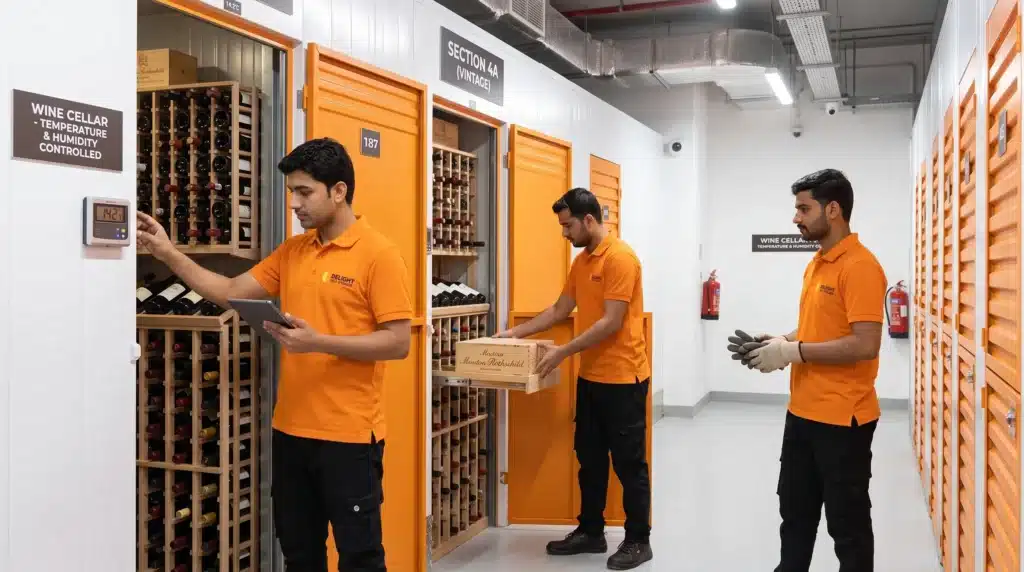
Climate-controlled storage is a type of self-storage unit where the indoor environment is managed to reduce large fluctuations in temperature and humidity. Instead of allowing the unit to experience the same extreme conditions as an unconditioned room, the facility uses cooling, ventilation and environmental controls to create a more stable storage environment.
That distinction matters in Dubai. A standard storage space may protect your belongings from rain, direct sunlight and unauthorised access, but it does not necessarily provide the same protection against heat and moisture. Climate-controlled storage is particularly useful for belongings that can deteriorate when exposed to prolonged heat or humidity, including:
- Wooden furniture and antiques
- Leather sofas, bags and other leather goods
- Electronics and office equipment
- Books and important documents
- Photographs and artwork
- Musical instruments
- Clothing and textiles
- Business inventory that is sensitive to heat or moisture
Not every item needs climate control. Metal tools, plastic storage containers and some outdoor equipment are generally less vulnerable to environmental changes. The decision should be based on what you are storing, how valuable it is and how long it will remain in storage.
Why Does Dubai’s 45°C Summer Matter?
Dubai’s summer conditions are one of the main reasons climate-controlled storage deserves attention. The UAE Government’s building regulations use 46°C as the outdoor design dry-bulb temperature for Dubai and 24°C with approximately 50% relative humidity as an indoor air-conditioning design condition. That does not mean every outdoor day reaches 46°C or that every storage facility maintains exactly 24°C. It simply illustrates the substantial difference between Dubai’s external summer conditions and a controlled indoor environment.
Heat can accelerate ageing in materials. Humidity adds another problem. Wood can absorb and release moisture, leather can develop mould or change texture, paper can become damp, and metals and electronics can be affected by corrosion. For belongings that remain in storage for a few weeks, the risk may be relatively low. For items stored throughout the summer or for several months, environmental stability becomes much more important.
How Does Climate Control Actually Work?
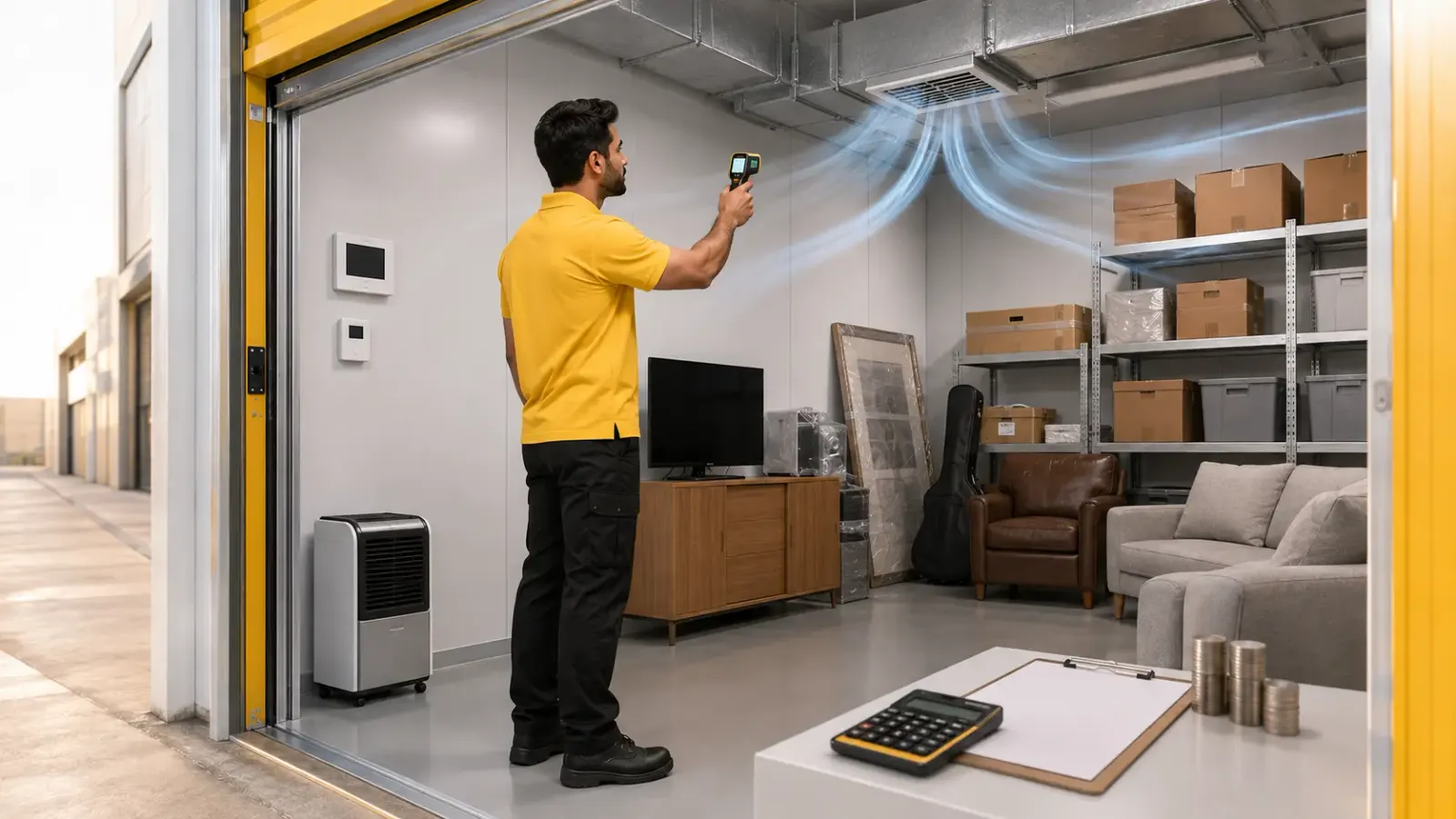
A climate-controlled facility typically combines cooling, ventilation and humidity management rather than relying on an ordinary air-conditioning unit alone. The cooling system helps bring down the temperature inside the storage environment. Ventilation helps move air through the facility, while humidity management helps reduce excessive moisture. Insulation and building design can also make it easier to maintain stable indoor conditions. The objective is not to create a refrigerator-like environment. It is to avoid the large temperature and humidity swings that can occur in unmanaged storage.
This is particularly important when different materials are stored together. A wooden wardrobe, leather sofa, cardboard boxes and electronic equipment do not all respond to environmental changes in exactly the same way. A good facility should therefore be able to explain what it means by “climate controlled” rather than simply using the phrase as a marketing label.
What Temperature and Humidity Should You Look For?
There is no single temperature and humidity range that is appropriate for every type of stored item. Different materials have different requirements.Dubai’s own building guidance provides useful context for these conditions, including a 46°C outdoor design temperature and an indoor design condition of 24°C with relative humidity of 50% ±5%. You can refer to the Dubai temperature and humidity conditions published through the UAE Government for the technical reference. For general household and business storage, stability is often more useful than chasing one exact number. A facility should be able to tell you its target temperature range, humidity range and how those conditions are monitored.
For example, one published Delight Self Storage guide describes climate-controlled storage using a temperature range of around 18°C to 24°C and relative humidity of approximately 30% to 55%. If you are storing particularly sensitive items, ask more specific questions before booking:
- What temperature range is maintained?
- What relative humidity range is targeted?
- Is the environment monitored continuously?
- Are temperature and humidity readings recorded?
- What happens during a power outage?
- How quickly is the system restored after maintenance?
- Are all units climate controlled or only certain areas?
These questions give you a much clearer picture than simply asking whether the facility has air conditioning.
Climate-Controlled vs Standard Storage in Dubai
The difference becomes easier to understand when the two options are placed side by side.
| Factor | Standard Storage | Climate-Controlled Storage | | Temperature | Less controlled | Actively managed | | Humidity | May fluctuate | Managed more closely | | Summer protection | Limited | Better protection from heat | | Sensitive furniture | Higher risk | Better suited | | Electronics | Basic protection | Better suited | | Documents and photos | More environmental exposure | Better suited | | Monthly cost | Usually lower | Usually higher | | Best for | Durable, low-risk items | Heat- and humidity-sensitive belongings |
Standard storage can still be perfectly reasonable for some belongings. If you are storing garden tools, sealed plastic containers or items that are not sensitive to heat and moisture, paying extra for climate control may not be necessary. For a wooden dining table, leather sofa or business electronics, the calculation is different.
How Much Does Climate-Controlled Storage Cost in Dubai?
The climate controlled storage Dubai price depends on several factors, so there is no single monthly rate that applies to every unit.
The biggest factors are:
- Unit size
- Rental duration
- Storage location
- Type of belongings
- Climate-control specification
- Access arrangements
- Additional services
- Current promotions or discounts
Climate-controlled storage normally costs more than a comparable standard unit because the facility has additional cooling, environmental management and monitoring costs. One useful way to think about the price is as a premium over the equivalent standard unit, rather than as a completely separate price category. For example, if a standard unit costs AED 800 per month and a comparable climate-controlled option costs AED 1,000, the climate-control premium is AED 200 per month. That AED 200 needs to be considered against the potential cost of replacing or repairing the items being stored.
Current Dubai storage pricing also varies considerably by unit size, so comparing the climate-controlled price with the standard rate for the same size is important. For a broader breakdown of Dubai storage rates by unit size and pricing factors, see this guide to storage cost in Dubai. Do not compare a 25 sq ft climate-controlled unit with a 50 sq ft standard unit and conclude that one facility is cheaper. The units are not equivalent.
Which Unit Sizes Are Available With Climate Control?
Climate-controlled storage can be available across different unit sizes, although the exact availability depends on the facility. Small units can work well for documents, seasonal clothing, electronics and a limited number of boxes. Medium units may suit apartment furniture, while larger units can accommodate business inventory or household contents.
Before booking, ask whether the specific unit size you want is climate controlled. Some facilities may have different areas within the same building, so it is better to confirm rather than assume. If you are unsure about the amount of space required, compare floor area with total storage volume. Our guide to storage unit sizes in Dubai explains how square feet and cubic feet can give you a better idea of the capacity you are paying for. The right size matters because there is little value in paying a climate-control premium on a unit that is much larger than necessary.
How to Tell Real Climate Control From a Marketing Claim
This is one of the most important questions to ask. “Air-conditioned” and “climate controlled” are not necessarily interchangeable terms. Air conditioning primarily tells you that cooling is available. Climate control suggests that the storage environment is being managed more systematically, including temperature and, where stated, humidity. Before signing a contract, ask the provider to explain exactly what is controlled.
A credible provider should be comfortable discussing:
- Target temperature
- Humidity limits
- Monitoring systems
- HVAC operation
- Maintenance procedures
- Backup arrangements
- Environmental records
You can also ask whether you can see the storage area before renting. Look for signs that the environment is genuinely managed, such as clean enclosed spaces, appropriate ventilation and clearly maintained HVAC equipment. If the only answer you receive is “Don’t worry, we have AC,” ask another question. What temperature and humidity does the unit actually maintain? That answer tells you much more.
Which Items Benefit Most From Climate-Controlled Storage?
Some belongings are much more vulnerable to Dubai’s climate than others.
Wooden Furniture
Wood naturally responds to moisture in the surrounding air. Repeated changes can contribute to swelling, shrinking, warping and changes around joints or veneers. If you are storing antique furniture or expensive wooden pieces, stable environmental conditions can be worth paying for.
Leather
Leather furniture, handbags and shoes can react badly to excessive heat and moisture. Humidity can encourage mould, while prolonged heat can affect the material and finish. Clean and completely dry leather before placing it into storage, and avoid sealing it in airtight plastic for long periods unless the storage method is specifically appropriate.
Electronics
Electronics can be vulnerable to moisture and corrosion. Climate control is particularly worth considering for laptops, monitors, office equipment, cameras and other valuable electronics that will remain stored for months. Remove batteries from suitable devices where recommended by the manufacturer and keep equipment clean and dry before storage.
Documents and Photographs
Paper absorbs moisture. That makes important documents, photographs, certificates and archives good candidates for climate-controlled storage. Use appropriate boxes and avoid placing paper directly against floors or walls.
Clothing and Textiles
Dubai’s humidity can create unpleasant conditions for fabrics when they are stored for long periods. Wash and completely dry clothing before packing it. Breathable garment covers can be preferable to trapping textiles in unsuitable plastic packaging.
Is Climate-Controlled Storage Worth the Extra Cost?
It depends on what you are storing. For low-value, durable belongings, standard storage may be sufficient. Paying an additional monthly premium for climate control may not provide much practical benefit. For valuable or sensitive belongings, the calculation changes.
Imagine you are storing a leather sofa, wooden dining set, electronics and several boxes of important documents for six months. If climate control costs an extra AED 150 per month, the six-month premium would be AED 900. That is not automatically cheap. But compare it with the cost and inconvenience of replacing damaged furniture, electronics or irreplaceable documents.
The question is not simply:
“Is climate-controlled storage expensive?”
It is:
“Is the additional protection worth the premium for my belongings?”
For sensitive items, it often can be.
How to Prepare Your Belongings for Climate-Controlled Storage
Climate control does not replace proper packing. Your belongings should still be clean, dry and packed appropriately before they enter the unit. A few practical steps can make a difference:
- Clean furniture before storage so dirt and food residue do not attract pests.
- Dry fabrics completely before packing.
- Use breathable covers for suitable furniture.
- Keep boxes raised from the floor where appropriate.
- Do not pack cartons so tightly that air cannot circulate.
- Leave sensible clearance around large furniture.
- Use sturdy boxes that can safely be stacked.
- Label each box clearly.
- Keep an inventory of valuable items.
- Photograph valuable belongings before storage.
For furniture, avoid wrapping every surface tightly in plastic if the material needs to breathe. Trapped moisture can create its own problems.
What Should You Ask Before Booking Climate-Controlled Storage?
Before committing to a unit, ask the provider for specific information rather than relying on general claims.
What is the monthly price for the exact unit size I need?
Is climate control included in that price?
What temperature range is maintained?
What humidity range is maintained?
Are temperature and humidity monitored?
How often are environmental readings recorded?
What happens if the cooling system stops working?
Is the unit available for my preferred rental period?
Are there additional charges for access, insurance, pickup or delivery?
Can I inspect the facility before booking?
These questions should give you enough information to compare providers on more than price alone.
When Should You Choose Standard Storage Instead?
Climate control is not automatically necessary for everything. Standard storage may be suitable for items such as:
- Metal tools
- Garden equipment
- Plastic containers
- Outdoor furniture designed for heat exposure
- Empty suitcases
- Durable household goods
- Items being stored for a very short period
Even then, cleanliness and proper packing matter. If your belongings are valuable, sensitive or likely to remain in storage through the hottest months, climate control deserves more serious consideration.
How to Book a Climate-Controlled Storage Unit in Dubai
Start by making an inventory of what you plan to store. Separate sensitive items from belongings that can tolerate ordinary storage conditions. Next, estimate the required unit size. Do not choose a larger unit simply because it is climate controlled. You should still pay for the amount of space you actually need.
Then request a quote based on:
- Exact unit size
- Rental duration
- Climate-control requirements
- Access frequency
- Insurance
- Pickup and delivery
- Any additional services
Ask the provider to confirm the final price in writing. Finally, check the contract before paying. Make sure the environmental conditions, rental period, access arrangements and charges match what you were told.
Choosing the Right Climate-Controlled Storage in Dubai
Climate-controlled storage is ultimately about protecting the things that matter, not simply keeping a storage unit cool. Dubai’s hot and humid summer conditions make environmental control particularly relevant for furniture, electronics, documents, leather, artwork and sensitive business stock. The right choice depends on the vulnerability of your belongings, the length of storage and the additional cost of climate control.
Before booking, compare the same unit size on a standard and climate-controlled basis. Ask for actual temperature and humidity information. Check what is included in the quoted price and confirm any additional charges. If your belongings can comfortably tolerate ordinary storage, there may be little reason to pay a premium. But if you are storing items that would be expensive, difficult or impossible to replace, a controlled environment can be a sensible part of the storage budget.
Frequently Asked Questions
What is climate-controlled storage in Dubai?
Climate-controlled storage is a storage environment where temperature and, depending on the facility, humidity are actively managed to create more stable conditions for stored belongings.
Is air-conditioned storage the same as climate-controlled storage?
Not necessarily. Air conditioning mainly refers to cooling, while climate control generally involves managing the wider indoor environment, including temperature and potentially humidity.
How much more does climate-controlled storage cost?
There is no universal premium. The additional cost depends on the unit size, facility, rental period and services included. Always compare the climate-controlled price with the standard price for the same unit size.
Is climate control necessary during Dubai's summer?
It can be particularly useful during the hotter months for furniture, electronics, leather, documents, artwork and other items that are sensitive to heat or humidity.
What temperature should a climate-controlled storage unit be?
There is no universal temperature for every stored item. Ask the provider for its actual operating range and humidity target, then compare those conditions with the requirements of your belongings.
How can I verify that a storage facility is genuinely climate controlled?
Ask for its temperature and humidity ranges, monitoring process and recent environmental records. A provider should be able to explain how the environment is controlled rather than simply saying that the building has AC.
Khalid Al Mansoori
Storage & Warehousing Operations Specialist
14+ years in UAE self-storage and warehousing, managing facilities across Dubai, Abu Dhabi, and the Northern Emirates. Specializes in climate-controlled storage, unit sizing, security systems, and Free Zone vs Mainland compliance.
Sarah Mitchell
Content Lead & Storage Solutions Researcher
8 years researching and writing on UAE storage and logistics. Focuses on storage costs, unit-size guides, and packing for Dubai's climate, working closely with facility teams for accurate pricing and specs.