
Personal storage in Abu Dhabi now sits at the point where fast population growth, rising rents, and a harsh desert climate meet everyday tenant decisions. Emirate reached about 4.14 million residents in 2024. The emirate’s real GDP expanded by 3.8 % in 2024 compared to 2023, reaching an all time high value of AED 1.2 trillion, driven by the non oil economy which recorded a strong growth rate of 6.2 %, marking its highest ever annual contribution of 54.7 % to total GDP. This underscores Abu Dhabi’s continued success in implementing economic diversification strategies, reducing reliance on oil revenues, and fostering a sustainable, long term growth. A rapidly expanding UAE self storage market confirms that storage is becoming a normal part of housing decisions, not a niche service. Yet many tenants still treat storage as a side note to the main lease, and overlook fee lines, renewal rules, insurance caps, and climate clauses that quietly drain deposits.
This guide sets out nine specific cost traps in Abu Dhabi personal storage contracts and shows how to read them before they turn into surprise bills.
Why does personal storage in Abu Dhabi matter for tenant costs and deposits?
Personal storage in Abu Dhabi matters for tenant costs and deposits because strong population growth, higher rents, and desert climate now push more residents into paid storage units.
- Emirate’s population reached about 4.14 million residents in 2024, after a 7.5 % growth in a single year and about 51 % growth over one decade, from roughly 2.7 million residents in 2014.
- Abu Dhabi’s GDP reached about AED 1.2 trillion, with non oil sectors accounting for more than 54 % of output, which supports continuous inward migration and housing demand.
- Abu Dhabi has an average annual temperature of 27.9 °C and annual rainfall close to 42 millimetres, with a hot desert classification, which increases the risk of mold and warping in unsecured storage units.
- The UAE self-storage market generated about USD 602.5 million in 2024 and is expected to reach USD 859.2 million by 2030, with about 6.3 % compound annual growth between 2025 and 2030.
These indicators together show that personal storage in Abu Dhabi is linked to wider housing and economic trends, not only to rare relocation cases.
Cost trap 1: How do promotional rates and renewals change the real cost of personal storage in Abu Dhabi?
Promotional rates and renewals change the real cost of personal storage in Abu Dhabi because the discounted months often cover a short period, while standard rates apply for most of the contract.
Key patterns in Abu Dhabi storage pricing
- Introductory rates can apply only for 1 to 3 months, while tenants use units for 9 to 18 months.
- Standard rates can be 20 to 40 % higher than promotional rates, based on typical marketing differentials.
- Some contracts allow mid contract rate reviews after a short notice period, for example, 30 days.
Example:
- Promotional rate: AED 220 per month for 3 months.
- Standard rate after promotion: AED 340 per month for 9 months.
- Total for 12 months: 3 × 220 + 9 × 340 = 660 + 3,060 = 3,720 AED.
- Effective average: 3,720 ÷ 12 = 310 AED per month.
The tenant may focus on 220 AED, but the real long term figure is 310 AED per month.
Checklist questions for this cost trap
- How many months does the promotional rate for personal storage in Abu Dhabi actually cover?
- What is the standard monthly rate after the promotional period?
- Does the contract allow the provider to change the standard rate during the term with short notice?
Cost trap 2: How do access fees and restricted access hours increase storage bills in Abu Dhabi?
Access fees and restricted access hours increase storage bills in Abu Dhabi because tenants pay extra for each visit or for visits outside standard time windows.
Climate, work patterns, and traffic restrictions often push moves into evenings and weekends, especially in dense areas like Al Reem Island, Al Raha Beach, Yas Island, and the Corniche, where luxury apartment rents now range from about AED 70,000 to AED 100,000 per year for 1 bedroom units, with annual increases between roughly 8 and 26 % in recent reports.
Access related charges
- A fixed access fee after a set number of free visits, for example, after the first visit per month.
- A surcharge for weekend or late evening access.
- A call out fee is charged when staff must attend the unit.
- Base fee for personal storage in Abu Dhabi: AED 320 per month.
- Contract allows one free visit per month, then charges AED 30 per extra visit.
- Tenant visits 4 times per month during a villa renovation.
Example:
Extra access cost per month equals 3 × 30 = 90 AED. The new effective monthly cost becomes 410 AED, which is an increase of about 28 %.
Tenant checks
- Count your planned visits per month before choosing a facility.
- Ask for a clear access fee table, with working hours and off hour fees.
- Confirm whether movers’ visits are counted separately as chargeable entries.
Cost trap 3: How do minimum terms and non refundable billing cycles affect personal storage in Abu Dhabi?

Minimum terms and non refundable billing cycles affect personal storage in Abu Dhabi because tenants pay for full time blocks even if they use only part of them. Average yearly rent for apartments in Abu Dhabi has climbed from around AED 93,000 in late 2023 to about AED 106,000 in the first half of 2024, an increase close to 14 %, which pushes many households to shorten leases or change units more frequently. This movement increases demand for flexible storage, but many contracts keep rigid billing rules.
Common patterns in storage contracts
- Minimum rental period: 3 or 6 months.
- Billing frequency: Full calendar month, with no partial refunds.
- Invoicing date: Fixed at the start of the month.
Example:
- Minimum term: 3 months.
- Monthly storage fee: AED 360.
- Tenant vacates after 2 months and 5 days.
If the contract states that months are indivisible, the tenant pays:
- 3 × 360 = 1,080 AED,
- Even though occupancy lasted about 2.17 months,
- So roughly 0.83 months or about 299 AED represent unused time.
Points to verify before signing
- Does the contract for personal storage in Abu Dhabi allow pro rata refunds for partial months?
- Does the provider charge from the date of move in or from the first day of the following calendar month?
- Can the minimum term be negotiated when storage is linked to a short renovation?
Cost trap 4: How do deposits, admin charges, and refund rules become hidden costs in Abu Dhabi storage?
Deposits, admin charges, and refund rules become hidden costs in Abu Dhabi storage when tenants confuse refundable and non refundable items or underestimate delays in getting money back.
Deposit and admin structures often used
- Refundable security deposit equal to one month of storage rent.
- Non refundable administration or documentation fee.
- Key card, padlock, or gate remote charge, sometimes refundable.
Example:
- Monthly fee: AED 340.
- Security deposit: AED 340, refundable.
- Admin fee: AED 175, not refundable.
- Access card: AED 100, refundable only when returned on time and in good condition.
Total upfront payment equals 615 AED beyond the first month’s rent. If the card is lost and the provider retains the full card amount, non refundable charges equal AED 175 + AED 100 = AED 275.
Refund timeline factor
- Some providers commit to refunding deposits within 30 to 60 days after move out and after deduction of any unpaid storage, cleaning, or damage.
- During this period, tenants may also wait for apartment deposits, so cash flow pressure increases.
Checklist for this trap
- Ask for a line by line list of all initial payments, with “refundable” or “non refundable” written clearly next to each line.
- Confirm the exact refund period in days and the refund method, such as bank transfer or cheque.
- Check whether cleaning or clearance fees can be deducted from the storage deposit.
Cost trap 5: How do climate control surcharges and basic units change long term risk for stored items in Abu Dhabi?

Climate control surcharges and basic units change long term risk because heat and humidity in Abu Dhabi can damage unprotected items in non climate controlled storage, which creates future replacement costs.
Climate data confirm that Abu Dhabi has an average temperature close to 27.9 °C, with summer averages above 30 °C and maximums often above 40 °C, and annual rainfall around 42 mm, with many dry months and variable humidity near the coast.
Pricing gap
- Standard unit without climate control: AED 260 to 300 per month.
- Climate controlled unit for the same size: Often AED 80 to 150 more per month.
Scenario comparison for one year
- Non climate-controlled unit: AED 280 per month, total 3,360 AED per year.
- Climate controlled unit: AED 380 per month, total 4,560 AED per year.
- Price difference: 1,200 AED over 12 months.
If furniture, textiles, and electronics worth AED 12,000 lose 25 % of their value due to mold, corrosion, or warping, the loss equals 3,000 AED, which is significantly higher than the climate control surcharge.
Questions to ask about climate and personal storage in Abu Dhabi
- Is the unit described as climate controlled with stated temperature and humidity ranges?
- Is the unit located on an upper floor, basement, or ground level where heat or moisture may accumulate?
- Does the contract explicitly exclude liability for mold or humidity damage in standard units?
Cost trap 6: How do insurance, damage waivers, and liability caps shift financial risk to tenants?
Insurance, damage waivers, and liability caps shift financial risk to tenants because providers limit their own liability and expect tenants to insure contents at their own cost. Global self storage research notes that many operators apply low liability caps for unit contents and promote add on insurance to cover higher values, with the global self-storage market valued at around USD 56.81 billion in 2023, expected to reach about USD 83.20 billion by 2030.
In the UAE self-storage market, which generated about USD 602.5 million in 2024, similar structures appear in local contracts.
Insurance structure
- Provider liability cap: Fixed amount, for example, AED 2,000 or AED 5,000 per unit.
- Tenant declared value: Often much higher, for example, AED 30,000 for household items.
- Optional insurance premium: A percentage of the declared value per year, for example, 1 to 2 %.
Example:
- Liability cap: AED 2,500.
- Declared contents value: AED 25,000.
- Optional insurance premium at 1.2 %: AED 300 per year.
If a major covered incident occurs and no extra insurance was bought, the maximum payout is 2,500 AED, which leaves 22,500 AED of loss with the tenant.
Checklist
- Read the liability section and note the cap in AED.
- Confirm whether the cap is per unit, per claim, or per event.
- Ask for a copy of any insurance policy associated with personal storage in Abu Dhabi and review exclusions for mold, gradual damp, or packing errors.
Cost trap 7: How do late fees, non payment penalties, and lockout rules escalate costs in Abu Dhabi storage?
Late fees, non payment penalties, and lockout rules escalate costs in Abu Dhabi storage because they add fixed penalties, restrict access, and sometimes lead to the disposal or sale of stored goods.
Regional market analyses for the Middle East self-storage sector show that the wider region generated around USD 2.2 billion in 2024, with growth driven by urbanisation and expatriate movement, and that many operators rely on strong overdue payment mechanisms to protect cash flow.
Common features in penalty structures
- Flat late fee per overdue invoice, for example, AED 50 to 100.
- Interest style fee expressed as a percentage of outstanding balance.
- Lock out rule after a defined period, such as 30 or 45 days of non payment.
- Disposal, sale, or auction of contents after a further period.
Example of cumulative cost
- Monthly rent for personal storage in Abu Dhabi: AED 310.
- Late fee: AED 70 per unpaid month after a 7 day grace period.
- Tenant pays one month late for 4 months in a row.
Extra cost equals 4 × 70 = 280 AED. The total paid over those four months becomes 4 × 310 + 280 = 1,240 + 280 = 1,520 AED, which is about 22.6 % more than the base sum of 1,240 AED.
Lockout implications
- Lockout can prevent tenants from removing items until full payment plus fees are made.
- Some contracts add a reconnection fee to restore access.
Key questions
- What is the fixed late fee, and from which day does it apply?
- After how many days of non payment can the provider lock the unit?
- After how long can the provider dispose of or sell stored goods to recover outstanding amounts?
Cost trap 8: How do packing rules, pallets, and cleaning fees create extra storage expenses in Abu Dhabi?
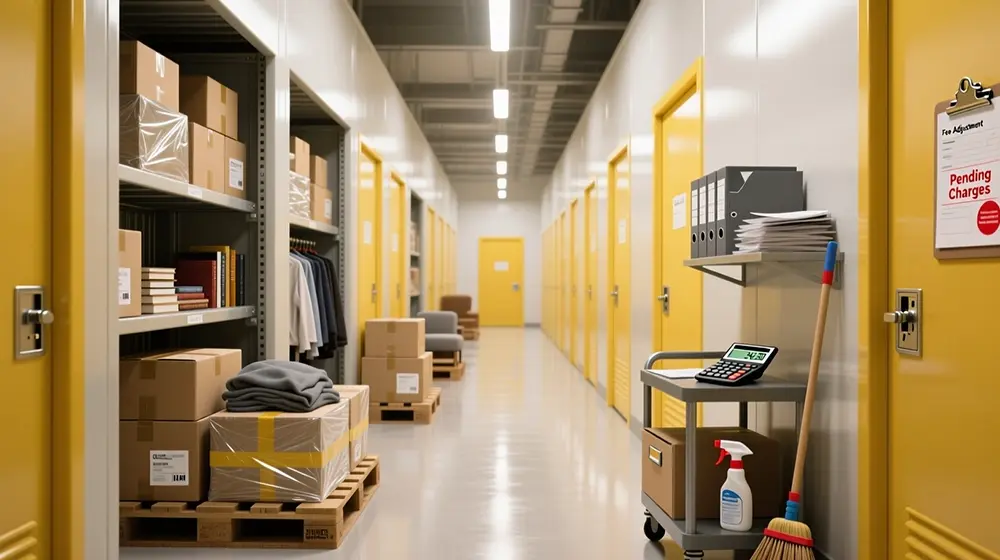
Packing rules, pallets, and cleaning fees create extra storage expenses in Abu Dhabi because required materials and services add to the base rental cost, especially for large households.
Hot desert climate and dust intrusion risk make many operators insist on proper packing for personal storage in Abu Dhabi.
Operational requirements
- Use of sealed cartons for small items and textiles.
- Protective covers for sofas, mattresses, and large furniture.
- Pallets or raised platforms under boxes to avoid floor contact.
- Obligation to leave the unit clean and free of waste.
Cost estimate for packing and pallets
- Medium cartons: AED 7 each, quantity 25.
- Large cartons: AED 10 each, quantity 8.
- Plastic furniture covers: AED 30 each, quantity 4.
- Pallet rental: AED 25 per pallet per month, quantity 2.
One time material cost equals:
- Cartons: 25 × 7 + 8 × 10 = 175 + 80 = 255 AED.
- Covers: 4 × 30 = 120 AED.
- Total initial packing cost: 375 AED.
Recurring pallet cost equals 2 × 25 = 50 AED per month, or 600 AED per year if used continuously.
Some contracts also state that improper packing or abandoned items can attract cleaning or disposal fees, which may be fixed amounts per cubic metre or per visit.
Checklist
- Ask whether pallets are mandatory or optional for personal storage in Abu Dhabi.
- Request an estimate for in house packing services and compare it with self packing costs.
- Check the cleaning fee schedule, especially for cases where mold or pests appear due to packing issues.
Cost trap 9: How do automatic renewals and notice periods extend storage bills for Abu Dhabi tenants?
Automatic renewals and notice periods extend storage bills for Abu Dhabi tenants because monthly contracts continue until written notice is given within a defined time window. In a market where rent indices for apartments by bedroom type show significant price levels, such as an index over 140 for one and 2 bedroom apartments with price per square foot values around AED 79 to AED 86, households already manage tight monthly budgets.
When personal storage in Abu Dhabi uses strict renewal rules, an extra month of storage can represent a noticeable share of income.
Renewal and notice structure
- The contract renews each month automatically after the minimum term.
- Notice must be given 15 to 30 days before the next billing date.
- Notice given after that point only applies to the subsequent cycle.
Example:
- Monthly storage rent: AED 330.
- Billing date: First of each month.
- Notice period: 30 days.
If a tenant decides to vacate on 10 September and gives notice on that day, the provider may treat the notice as applying to 1 November rather than 1 October, depending on the wording. The tenant then pays for October even if the unit is empty for most of that month.
Key points for tenants
- Record the billing date and required notice period as fixed calendar dates.
- Send a written notice by email or portal message and keep confirmation.
- Ask the provider to confirm the final bill and move out date in writing.
Tenant Action Plan: Use These Nine Checks Before Paying for Storage
Personal storage in Abu Dhabi is no longer a side topic in the housing search. It sits inside the same decision set as rent, deposits, and moving costs. The same forces that shape your lease also shape your storage bill. Population growth, higher apartment rents, and harsh desert climate all push more tenants into paid units, and providers respond with detailed contracts that protect their revenue first.
The nine cost traps in this guide show that small clauses can move real money. A low monthly headline rate can hide higher renewal charges. A simple access rule can add almost one third to the bill during a renovation. A basic unit without climate control can quietly destroy thousands of dirhams of furniture value. Late fees, insurance caps, cleaning charges, and strict notice periods can drain cash just when tenants are already waiting for apartment deposits.
The most effective response is not to avoid storage, but to treat the contract as seriously as the lease. Read every fee line, test the numbers with your own examples, and ask for written confirmation of rates, deposits, and notice rules. If a clause is unclear, ask for a plain language explanation before you sign. Personal storage in Abu Dhabi can protect your furniture and your time, but only if the contract protects your budget with the same care.
Frequently Asked Questions.
What is personal storage in Abu Dhabi, and who uses it most?
Personal storage in Abu Dhabi means renting a private unit for furniture, boxes, and personal items, most often used by tenants who are relocating, downsizing, or renovating.
Why can promotional storage rates be misleading for tenants?
Promotional rates often apply only for the first one to three months, so the long term bill is driven by the higher standard rate that applies for the rest of the contract.
How do access fees and restricted hours increase my storage bill?
Access fees add a charge for extra visits, weekends, or late evenings, so frequent trips during a move can push the real monthly cost well above the base rent.
Why do minimum terms and non refundable billing cycles matter?
If the contract uses fixed monthly blocks with no pro rata refunds, you may pay for full months even when you vacate partway through a billing period.
What should I watch for with deposits and admin fees in storage contracts?
Separate refundable security deposits from non refundable admin and card fees, and confirm in writing how long refunds will take and what deductions are allowed.
Is climate control worth the extra cost for storage in Abu Dhabi?
Climate controlled units usually cost more each month, but they can be cheaper in the long run if they prevent mold, warping, and corrosion on higher value items.
How do insurance clauses and liability caps shift risk to tenants?
Providers often cap their own liability at a low figure and expect you to buy extra insurance, so any loss above that cap usually falls on you.
Can late fees and lockout rules really add much to storage costs?
Yes, repeated late fees and reconnection charges can add more than twenty % to your bill over several months, especially if access is blocked until full payment.
How do packing rules and cleaning fees create surprise costs?
Mandatory cartons, covers, pallets, and cleaning fees can add several hundred AED to the cost of storage, particularly for larger households with many items.
Why are automatic renewals and notice periods such a common cost trap?
If notice must be given well before the billing date, a late email can trigger an extra month of rent even when the unit is standing empty.