Storage Unit Sizes in Metres, Square Feet and Cubic Feet
Storage unit sizes in metres, square feet & cubic feet — find the right storage unit size in Dubai for your needs. Book Now!
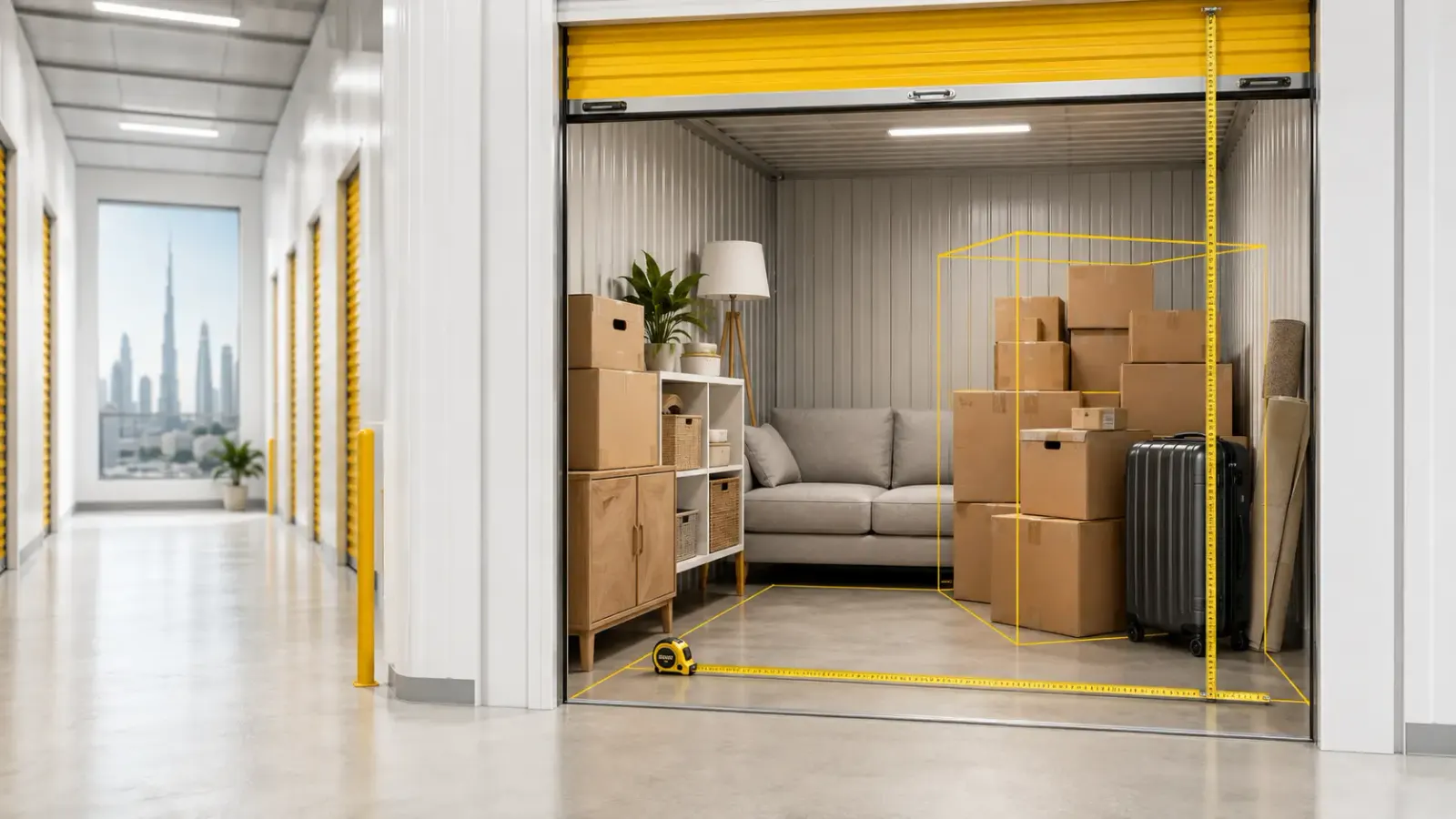
If you are comparing storage unit sizes in Dubai, it helps to understand how the measurements used by different providers relate to one another.Searching for a self-storage unit in Dubai can get confusing when one provider talks about square feet and another describes the same kind of space in metres. Then there is cubic feet, which brings height into the picture. If you are comparing storage options for the first time, it is easy to wonder whether a 1 × 1 metre unit is the same as 10 sq ft, or why two units with the same floor area can hold different amounts.
The simple answer is that square metres and square feet measure floor area, while cubic feet measure volume. The difference matters because a storage unit has height as well as length and width. For anyone comparing storage unit dimensions in Dubai, understanding these measurements makes it much easier to request an accurate quote and avoid choosing a space that is either too small or unnecessarily large.
Why Dubai Storage Listings Use Metres and Square Feet
Dubai is an international market, so storage providers may use both metric and imperial measurements in their descriptions. Square metres (m²) are part of the metric system, while square feet (sq ft) are commonly used in property and storage discussions in the UAE. You may therefore see a storage unit described as 2 × 2 metres, approximately 43 sq ft, or simply as a 40–50 sq ft unit. They can be referring to broadly similar floor areas. The important thing is to check whether a measurement refers to length and width or to total floor area.
For example, a unit measuring 2 × 2 metres has a floor area of:
2 m × 2 m = 4 m²
One square metre is approximately 10.764 sq ft, so:
4 m² × 10.764 = 43.06 sq ft
That means a 2 × 2 metre storage unit has roughly 43 sq ft of floor area.
Storage Unit Sizes in Metres and Square Feet
Here is a quick conversion guide for some measurements you may encounter when comparing a self-storage unit in Dubai. One square metre is approximately 10.764 sq ft. For reference, you can check the official square metre to square feet conversion information provided through NIST.
| Metric measurement | Approx. floor area | Approx. square feet | | 1 × 1 m | 1 m² | 10.8 sq ft | | 1 × 2 m | 2 m² | 21.5 sq ft | | 1 × 3 m | 3 m² | 32.3 sq ft | | 2 × 2 m | 4 m² | 43.1 sq ft | | 2 × 3 m | 6 m² | 64.6 sq ft | | 3 × 3 m | 9 m² | 96.9 sq ft | | 3 × 4 m | 12 m² | 129.2 sq ft | | 4 × 5 m | 20 m² | 215.3 sq ft |
These are floor-area conversions only. They do not tell you the total amount of storage volume available because ceiling height has not yet been included. That distinction becomes important when you start comparing cubic feet.
What Does a 1 × 1 Metre Storage Unit Mean?
A 1 × 1 metre storage unit has a floor area of exactly 1 square metre, or approximately 10.76 sq ft. It is a relatively compact space. The actual amount you can store depends on the unit’s height and how efficiently your belongings can be stacked. For example, if the unit has a usable height of 2 metres:
1 m × 1 m × 2 m = 2 m³
That is approximately 70.6 cubic feet. This is why searching for storage sizes 1x1m in Dubai should not stop at the floor dimensions. Ask about the unit’s height as well. A 1 × 1 metre unit that is 2 metres high does not provide the same volume as one that is only 1.5 metres high. It is a small difference on paper, but it can affect how many cartons or smaller belongings you can stack.
What Does a 2 × 2 Metre Storage Unit Mean?
A 2 × 2 metre unit provides:
2 m × 2 m = 4 m²
That is approximately 43.1 sq ft.
If the ceiling height is 2 metres, its volume would be:
2 m × 2 m × 2 m = 8 m³
Eight cubic metres is approximately 282.5 cubic feet.
This gives you a much better idea of why a 40–45 sq ft storage unit can have significantly more capacity than its floor area initially suggests. The same 2 × 2 metre floor area with a 2.5 metre ceiling would provide 10 m³ of volume instead.
What Does a 3 × 3 Metre Storage Unit Mean?
A 3 × 3 metre storage unit provides 9 m² of floor space. Converted into square feet:
9 × 10.764 = approximately 96.9 sq ft
So a 3 × 3 metre unit is almost exactly equivalent to a 100 sq ft storage unit in terms of floor area. If the unit has a 2 metre height, its volume would be:
3 m × 3 m × 2 m = 18 m³
That is approximately 635.7 cubic feet. This is why a 3 × 3 metre unit may appear as a 100 sq ft unit on another storage provider’s website. The terminology is different, but the floor area is broadly the same.
Square Feet to Cubic Feet: Why Height Matters
This is where storage measurements often become confusing.
Square feet measure area. Cubic feet measure volume.
You cannot convert square feet directly into cubic feet without knowing the height. The formula is:
Cubic feet = floor area in sq ft × height in ft
For example, suppose you have a 100 sq ft storage unit with an 8 ft ceiling:
100 sq ft × 8 ft = 800 cubic ft
If another 100 sq ft unit has a 10 ft ceiling:
100 sq ft × 10 ft = 1,000 cubic ft
Both units have the same floor area. The second one has more storage volume because it is taller. This is especially relevant when you are comparing storage unit dimensions in Dubai between providers.
How Stacking Height Changes Usable Volume
Having a tall ceiling does not automatically mean you can use every centimetre of it. Some belongings cannot be safely stacked very high. Heavy boxes should generally stay lower, fragile items need protection, and large furniture may not be suitable for vertical stacking at all. Packing also makes a difference.
Uniform cartons can be stacked more efficiently than oddly shaped bags and loose belongings. Dismantling a bed frame or table can free up valuable floor space, allowing you to use more of the available height. Think of the unit as a three-dimensional box rather than a flat room. If you have 100 sq ft of floor area, the goal is not simply to fill the floor. It is to organise belongings safely across the available height while keeping access to the things you may need.
Quick Storage Measurement Conversion Table
If you are comparing storage listings, this table provides a quick reference.
| Measurement | Approximate equivalent | | 1 m² | 10.76 sq ft | | 2 m² | 21.53 sq ft | | 3 m² | 32.29 sq ft | | 4 m² | 43.06 sq ft | | 5 m² | 53.82 sq ft | | 6 m² | 64.58 sq ft | | 8 m² | 86.11 sq ft | | 9 m² | 96.88 sq ft | | 10 m² | 107.64 sq ft | | 20 m² | 215.28 sq ft |
For volume:
1 cubic metre = approximately 35.31 cubic feet
So if a storage unit has a volume of 10 m³:
10 × 35.31 = approximately 353.1 cubic feet
Remember that volume is only useful when you also understand the unit’s shape and how your belongings can actually be arranged.
How to Calculate Storage Volume Yourself
You can calculate the approximate volume of a storage unit with a simple formula:
Length × Width × Height = Volume
If the dimensions are in metres, the result will be cubic metres.
For example:
3 m × 3 m × 2 m = 18 m³
To convert that into cubic feet:
18 × 35.31 = approximately 635.6 cubic ft
If the provider gives you measurements in feet, use the same formula:
10 ft × 10 ft × 8 ft = 800 cubic ft
There is no need to overcomplicate it. The main thing is to make sure all three measurements use the same unit before calculating.
Which Measurement Should You Use When Requesting a Quote?
When contacting a storage provider, give as much information as possible rather than mentioning only the size you have seen online. If you know the required floor area, provide it in either square metres or square feet. If you know the actual dimensions, provide the length and width as well. More importantly, describe what you need to store.
For example, instead of saying:
“I need 50 sq ft.”
You could say:
“I need storage for one double bed, a three-seater sofa, one wardrobe, a small dining table, six chairs, two appliances and around 15 cartons.”
That gives the provider a much better basis for recommending a suitable unit. If you are storing business stock, mention the number and approximate dimensions of cartons, pallets or other items, along with how frequently you need access. Also ask about the usable height. A quoted floor area without a ceiling measurement does not give you the complete picture.
What Measurement Matters Most?
It depends on what you are trying to compare. Use square metres or square feet when you want to compare the floor area of different storage units. Use cubic metres or cubic feet when you want to understand total storage volume. Use length × width × height when you need to assess whether a particular collection of belongings can physically fit.
For most customers comparing storage options, square feet is the easiest starting point because it is commonly used in storage listings. But height should not be ignored, particularly when you plan to store many cartons or smaller items that can be stacked.
Choosing a Self-Storage Unit in Dubai
If you are still unsure which storage unit size you need, start with the items you plan to store and compare their dimensions with the available unit options. Measurements are useful, but they are only one part of choosing a self-storage unit. You should also consider how frequently you need access, whether the facility offers suitable security, whether your belongings require controlled storage conditions, and whether pickup or delivery services are available. Most importantly, do not choose a unit solely because the number looks right on paper.
A 100 sq ft unit may be perfect for one customer’s belongings and too small for another person’s furniture. Likewise, a compact 1 × 1 metre space may be ideal for a few boxes but unsuitable for bulky household items.
If you are unsure, give Delight Self Storage an inventory of the items you want to store and ask for a recommendation. Providing the actual contents, approximate dimensions and expected storage duration will make it easier to identify the right option.
The goal is simple: understand the measurement, account for height, and choose storage based on your actual belongings rather than square footage alone.
Khalid Al Mansoori
Storage & Warehousing Operations Specialist
14+ years in UAE self-storage and warehousing, managing facilities across Dubai, Abu Dhabi, and the Northern Emirates. Specializes in climate-controlled storage, unit sizing, security systems, and Free Zone vs Mainland compliance.
Sarah Mitchell
Content Lead & Storage Solutions Researcher
8 years researching and writing on UAE storage and logistics. Focuses on storage costs, unit-size guides, and packing for Dubai's climate, working closely with facility teams for accurate pricing and specs.