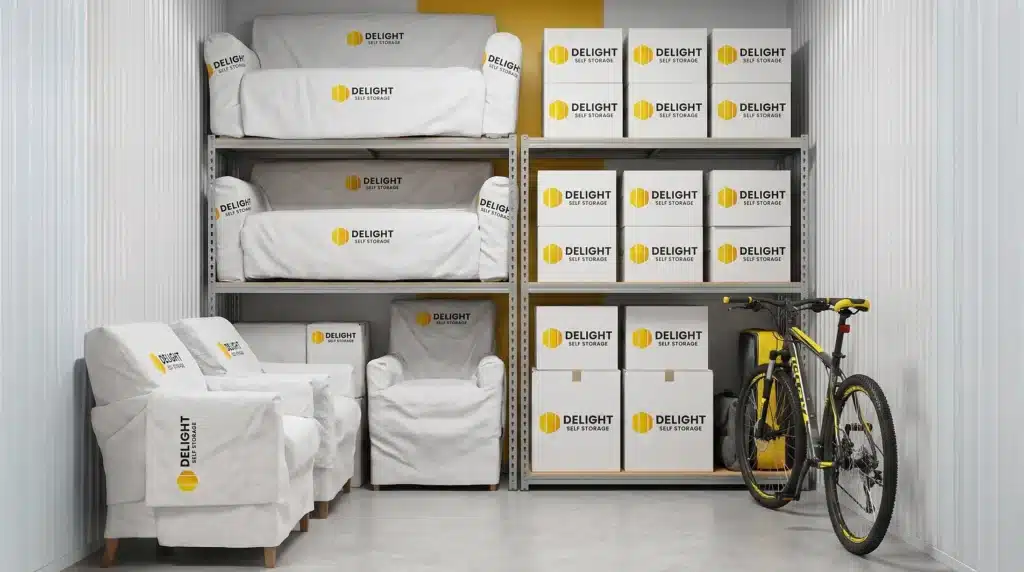
Office and Business Storage Space Sizes in Dubai
Office & business storage space sizes in Dubai — compare unit sizes, costs & find the perfect fit for your business needs.
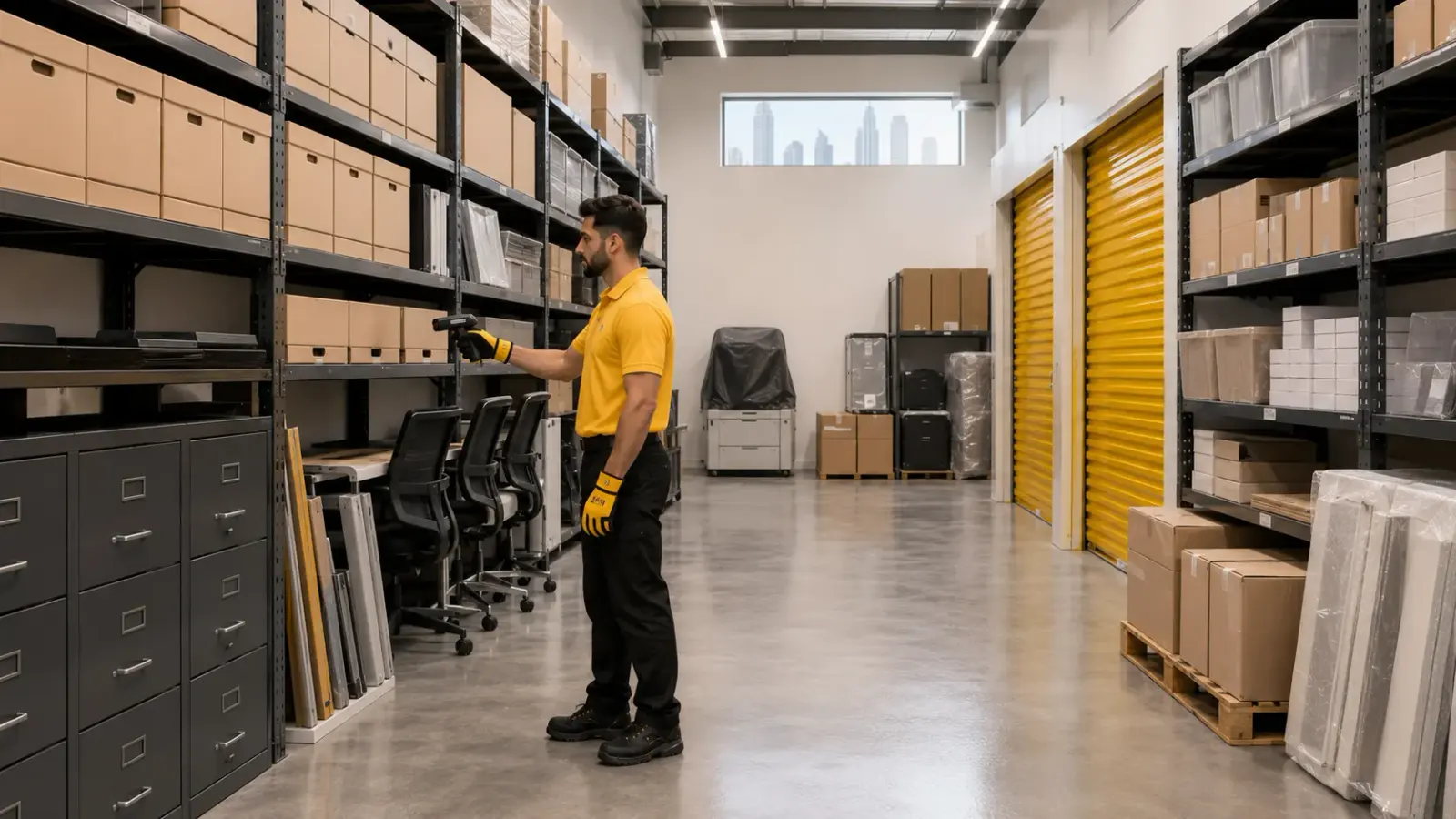
Office space in Dubai is expensive enough without using valuable desk space to store old files, spare furniture, marketing materials, or boxes of stock. As a business grows, storage often becomes an afterthought. A few cartons turn into a cupboard full of inventory, then a corner of the office disappears, and eventually employees are working around things that have nothing to do with their daily jobs. That is where a self-storage unit can help. For a small office, 25–50 sq ft may be enough for documents, equipment, and a limited amount of stock. Businesses with more furniture, inventory, or e-commerce stock may need 75–100 sq ft or more. The right size depends less on the number of employees alone and more on what the business stores, how bulky those items are, and how often the team needs access.
What Size Storage Unit Does an Office Need in Dubai?
There is no universal storage size for every office. A five-person consultancy that mainly needs document storage has very different requirements from an online retailer keeping hundreds of products.
| Business Requirement | Suggested Size | Typical Contents | | Small office / documents | 25 sq ft | Files, records, small equipment, and cartons | | Small business storage | 50 sq ft | Office equipment, files, stock, and supplies | | Growing business | 75–100 sq ft | Furniture, inventory, and larger quantities of stock | | E-commerce / larger office | 100–160 sq ft | Product stock, fixtures, equipment, and cartons | | Heavy inventory | 160+ sq ft | Larger stock volumes and frequent business storage |
These are planning ranges rather than fixed rules. A business with compact cartons can fit more into a unit than one storing bulky office furniture. The best approach is to make an inventory before booking: count cartons, measure furniture, and estimate how much stock you expect to hold at the busiest point of the year. For businesses that are unsure how square footage translates into actual usable volume, this guide to storage unit sizes in Dubai explains how different unit dimensions can accommodate household and business belongings.
What Do Offices Actually Put Into Storage?
Office storage is not always about furniture. In many cases, the items taking up the most room are things that employees only need occasionally. A typical office storage list includes desks, spare chairs, filing cabinets, computers, monitors, printers, archived documents, marketing materials, exhibition stands, promotional merchandise, product samples, packaging materials, e-commerce inventory, seasonal stock, spare fixtures, office supplies, signage, and event equipment. A company moving offices may also need temporary storage for almost everything in the existing workplace. Before renting, separate items that are genuinely needed from things that have simply been sitting around. There is little value in paying monthly storage fees for broken furniture or obsolete equipment.
How to Size Storage by Desk Count and Headcount
Headcount can give you a rough idea of office furniture requirements, but it should not be the only measurement. For example, a small company with ten employees may have ten desks, ten chairs, filing cabinets, and several monitors. If it is moving offices, storing all of that furniture can require considerably more space than storing a few boxes of records. Conversely, a business that operates mostly digitally may have very little physical storage despite having a larger team. Think about the storage load in distinct categories:
- Furniture: How many desks, chairs, cabinets, and tables need to be stored?
- Technology: Are you storing monitors, computers, printers, networking equipment, or other hardware?
- Documents: How many archive boxes do you have?
- Supplies: Are there cartons of stationery, packaging, or promotional materials?
- Stock: Does the company sell physical products?
This approach gives you a much more realistic estimate than simply sizing by employee headcount.
How Much Space Does Business Stock Need?
For businesses, stock volume can matter more than office size. An e-commerce company might operate from a small office but hold hundreds of product units. A fashion retailer may need racks and cartons, while a spare-parts company may have dense boxes containing relatively small products. Start with your SKU count, but do not stop there. Ten SKUs do not necessarily mean ten small boxes; one SKU could occupy a single carton, while another may require a pallet-sized amount of space.
A better calculation relies on total stock volume: Total stock volume = number of cartons × average carton volume, plus additional room for movement and future inventory. If your business receives 100 cartons every month but sells only 70, your storage requirement will gradually increase even if your current stock level looks manageable.
Sizing Storage by SKU Count
SKU count is useful for planning, particularly for online sellers, but the number itself does not tell you how much space you need. Consider two businesses: Business A has 100 SKUs, with each SKU fitting into a small carton; Business B also has 100 SKUs, but its products include large household goods. Both businesses have the same SKU count, yet their storage requirements are completely different. Instead, estimate the number of cartons per SKU and the average size of those cartons. If stock levels fluctuate during Ramadan, Eid, seasonal promotions, or major sales campaigns, size the unit around your peak inventory rather than your quietest month. This prevents the common situation where a business rents a unit that works in January but becomes overcrowded by March.
How Often Will You Need to Access the Unit?
Access frequency should heavily influence the size and layout you choose. A company storing old accounting files may only visit the unit a few times a year. In that case, the space can be packed tightly and efficiently because the contents are rarely disturbed.
An e-commerce business requires a completely different approach. If staff need to collect products every day, the unit needs a practical layout where boxes are labelled and arranged so that commonly requested stock remains accessible. This is where paying for slightly more space makes sense. A smaller unit may cost less, but if employees have to move ten cartons every time they need one product, the business loses valuable time. The question is not simply “How much can we fit?”, but “How easily can we get it back out?”
Is 25 Sq Ft Enough for a Small Office?
For a small office, 25 sq ft can be a useful starting point. It easily holds archive boxes, office supplies, small equipment, and a limited quantity of marketing materials. However, it is less suitable for storing multiple desks, large cabinets, or significant business inventory. A 25 sq ft unit is most useful when a company needs to remove day-to-day clutter from the workplace without storing its entire physical office. If you mainly need somewhere to keep old files, seasonal promotional material, or spare supplies, a small unit is significantly more economical than renting additional office space.
When Is 50 Sq Ft Better?
A 50 sq ft unit provides far more flexibility for a growing business. It accommodates a combination of cartons, office equipment, files, and some furniture, depending on the size and shape of those items. For example, a small company might use 50 sq ft to store:
- Archived documents and several cartons of stock
- Spare office chairs, two or three desks, and computer equipment
- Marketing materials, product samples, and trade show displays
The key to maximizing a 50 sq ft unit is to pack vertically and use consistent carton sizes whenever possible.
When Do You Need 75–100 Sq Ft?
Businesses with a larger physical inventory should consider 75–100 sq ft as a practical range. This space comfortably suits e-commerce inventory, spare office furniture, exhibition equipment, product packaging, seasonal stock, multiple filing cabinets, and larger quantities of archived records. Current Dubai storage guides put 100 sq ft units broadly around AED 1,700–2,600 per month, depending on the facility, location, access, and storage conditions. A 100 sq ft unit acts as an efficient overflow space for a small business without committing to a full commercial warehouse.
How Much Does Business Storage Cost in Dubai?
The office storage size in Dubai affects the monthly price, but it is not the only factor. Location, access, climate control, contract terms, and the type of storage facility all impact the final quote.
| Unit Size | Approximate Monthly Range | Suitable For | | 25 sq ft | AED 300–400 | Documents, supplies, and small items | | 50 sq ft | AED 895–1,400 | Small office storage and light stock | | 75 sq ft | AED 1,000–1,500 | Growing stock and furniture | | 100 sq ft | AED 1,700–2,600 | Business inventory and office overflow | | 160+ sq ft | AED 3,000+ | Larger stock or full office equipment |
These figures are useful for budgeting, but prices vary by unit size, location, access and storage conditions. For a broader breakdown of storage cost in Dubai, including price per square foot and factors that can change the final bill, see the complete pricing guide. These are indicative market ranges rather than guaranteed quotes, as prices vary across different Dubai providers and locations. When budgeting, always ask for an all-inclusive quote and check whether VAT, access, pickup, delivery, insurance, or other service fees are billed separately.
When Is Self Storage Better Than Using the Office?
The simplest test is whether stored items are taking away productive workspace. If employees have to walk around boxes, spare chairs, or archived files every day, the business is effectively paying expensive office rent for basic storage. Moving those items into a separate storage unit frees up space for desks, meeting areas, or clients. This is especially useful for items not needed daily such as old financial records, trade show exhibition stands, or off-season stock. There is little reason for those items to occupy prime commercial real estate throughout the year.
What About E-Commerce and Retail Stock?
E-commerce businesses operate on a continuous flow: stock comes in, orders go out, and inventory levels fluctuate constantly. Because of this, access and organisation become just as important as unit dimensions. Fast-moving products should sit near the entrance, while slower-moving inventory goes toward the back. Label cartons clearly, maintain a clear inventory tracking system, and leave enough aisle room to safely move boxes around. However, if your business processes a high volume of orders daily, self-storage may eventually become inefficient, making a warehouse with dedicated receiving, packing, and dispatch facilities a better fit.
When Have You Outgrown Self Storage?
Self-storage works exceptionally well for small business overflow, but a full warehouse becomes necessary once operational demands scale up. You have likely outgrown self-storage if:
- Pallets arrive regularly and require dedicated forklift access
- Daily stock deliveries and continuous dispatches require loading bays
- Staff require dedicated space for packing and order fulfilment
- Inventory requires specialized commercial receiving and distribution facilities
While a self-storage unit is designed around securely storing belongings, a warehouse is engineered for active, large-scale commercial operations.
How to Organise Business Storage
Once you select the right unit size, operational organization becomes the priority. Apply clear labels to every carton specifying SKUs, product names, or document categories, and maintain a digital inventory list detailing box locations. Store heavier cartons on the floor and stack lighter ones on top, keeping fragile electronics safely protected. Most importantly, always leave a clear walkway down the middle; a storage unit packed tightly wall-to-wall maximizes square footage, but severely compromises operational efficiency.
What Should Businesses Check Before Renting?
Businesses should always look beyond advertised square footage and verify exact door dimensions, ceiling heights, length, and width before signing a lease. In addition, always review key operational details including:
- Access hours, security infrastructure (CCTV, controlled entry), and climate control options
- Loading bay facilities, rental duration terms, notice periods, and insurance coverage
- Invoicing procedures, business documentation compliance, and VAT inclusiveness. Businesses should also confirm whether quoted prices include VAT and review the official UAE VAT guidance when checking the tax treatment of storage services.
If you plan to store paper records, delicate electronics, wooden furniture, or climate-sensitive stock, opt for a temperature-controlled unit to protect items against Dubai’s extreme heat.
The Right Business Storage Size in Dubai
For most small offices in Dubai, space planning typically begins in the 25–100 sq ft range. A 25 sq ft unit easily handles documents and small equipment, while a 50 sq ft unit provides flexibility for light furniture and extra supplies. Businesses managing growing stock, extensive furniture, or seasonal inventory will find 75–100 sq ft far more practical. E-commerce operations should calculate unit sizes based on peak seasonal inventory rather than average quiet months. Ultimately, selecting the right self-storage unit balances stock volume, access needs, and growth projections allowing your business to reclaim useful office space without overpaying for unnecessary square footage.
Khalid Al Mansoori
Storage & Warehousing Operations Specialist
14+ years in UAE self-storage and warehousing, managing facilities across Dubai, Abu Dhabi, and the Northern Emirates. Specializes in climate-controlled storage, unit sizing, security systems, and Free Zone vs Mainland compliance.
Sarah Mitchell
Content Lead & Storage Solutions Researcher
8 years researching and writing on UAE storage and logistics. Focuses on storage costs, unit-size guides, and packing for Dubai's climate, working closely with facility teams for accurate pricing and specs.