
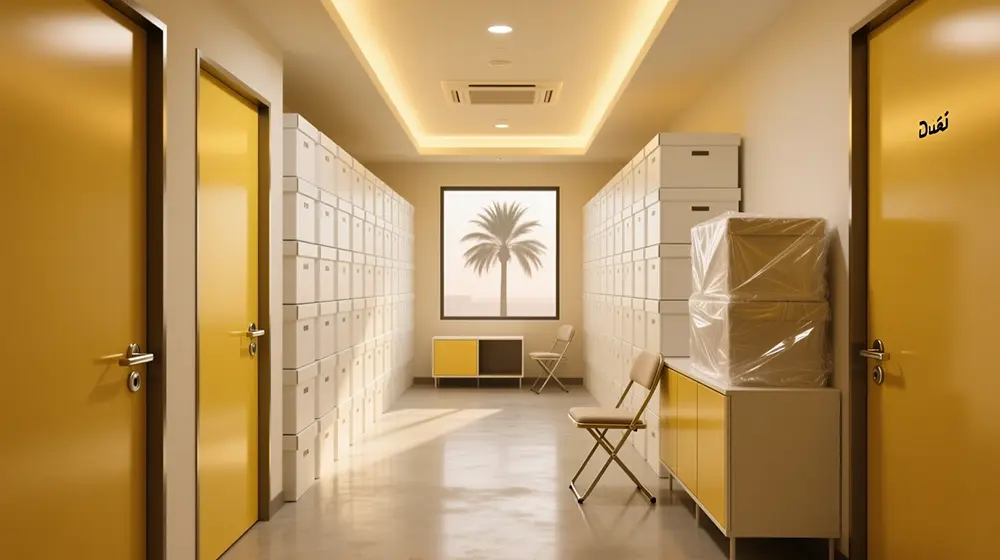
Smart tenants in Dubai use box storage in Dubai because of population growth, rising average rent, and small apartment sizes compress living space and increase the cost of every stored item.
- Dubai’s population reached about 3.95 million residents in 2025, up from 3.79 million in 2024. As of October 2025, Dubai’s population has reached 4,036,863, marking a 5.43% annual increase addition of over 208,030 new residents in just one year.
- Average annual apartment rent in Dubai stands at AED 40,439 for studios, AED 61,885 for one bedroom units, and AED 141,653 for three bedroom apartments. Studio rents often range between AED 45,000 and AED 70,000 per year, while one bedroom units range between AED 70,000 and AED 110,000 per year.
These numbers describe a simple reality. Each extra square metre in a Dubai apartment carries a clear yearly cost. Box storage in Dubai appears as a structural tool that shifts low use items out of the living room and into cheaper cubic metres in a warehouse.
This guide explains what box storage in Dubai is, how it works, what it costs compared with larger apartments, and what smart tenants learn after using it through one full rent cycle.
What is box storage in Dubai, in practical terms
Box storage in Dubai is a pay per box storage service where a provider delivers empty boxes, collects them after packing, stores them in a secure warehouse, and returns individual boxes on request.
Core features of box storage in Dubai include:
- Delivery of standard cartons or plastic storage boxes to the apartment.
- Packing is done by the tenant inside the home.
- Collection of sealed boxes by trained drivers at a booked time.
- Storage of each box in climate protected and monitored facilities.
- Digital inventory and box-level tracking to manage retrieval.
Box storage in Dubai is not a full storage room. It is a granular storage model where tenants store, for example, six, twelve, or twenty boxes rather than renting an entire unit.
How Box Storage in Dubai Differs from Traditional Self-Storage Units
Box storage in Dubai differs from traditional self storage because tenants pay per box, do not visit the warehouse, and use scheduled collection and delivery instead of personal unit access.
Key differences appear in three areas.
1. Access method
- Traditional self storage in Dubai gives tenants a unit key or code and expects them to drive to the facility.
- Box storage in Dubai includes pick up and drop off at the home, often within booked time windows.
2. Pricing logic
- Traditional units charge for a full room or locker, for example, a 50 or 100 square foot space, even if half the volume remains empty.
- Box storage in Dubai charges for each box stored, with per box or per set pricing that scales linearly with volume.
3. User profile
- Self storage units suit residents and businesses with vehicles, large furniture, or high volumes.
- Box storage in Dubai suits tenants with compact apartments and limited car access who want to move small or medium items out of the home.
This structural difference makes box storage in Dubai closer to a logistics and inventory service than a simple room rental.
Pressure on Dubai Tenants After One Year of Rising Rents
Tenants in Dubai face pressure from rapid population growth, rising rent brackets, and limited apartment storage, which forces them to choose between cluttered rooms and higher lease costs.
Key indicators of this pressure include:
1. Population growth
- Dubai residents in 2024: About 3.79 million.
- Dubai residents in 2025: More than 4.0 million.
2. Rent levels and ranges
- Average annual rent for a studio apartment: Around AED 40439, with a practical market range from AED 45000 to AED 70000.
- Average annual rent for a one bedroom apartment: Around AED 61885, with a range from AED 70000 to AED 110000.
- Average annual rent for a two bedroom apartment: Around AED 85461, with some ranges between AED 115000 and AED 170000.
3. Implications for storage
- Tenants pay thousands of dirhams per year for corridors, cupboards, and corners filled with rarely used items.
- Seasonal clothing, travel luggage, hobby equipment, and archived documents occupy expensive residential space.
After one year of rising rents, smart tenants in Dubai begin to quantify how many dirhams they pay simply to keep boxes in an extra bedroom or larger unit.
How Box Storage in Dubai Saves Space and Rent for Tenants
Box storage in Dubai can replace the function of an extra storage room or even an additional bedroom for low use items, and it often costs less per year than the rent gap between unit sizes. A simplified comparison illustrates the position.
Indicative rent and storage cost comparison in Dubai
| Item | Approximate annual cost (AED) |
|---|---|
| Studio apartment average rent | 40,439 |
| One bedroom apartment average rent | 61,885 |
| Rent gap: studio to one bedroom | 21,446 |
| Estimated box storage plan for 8 boxes | 2,000 to 4,000 |
The table shows a pattern. Many tenants pay more than AED 20000 per year to upgrade from a studio to a one bedroom apartment. A comparable box storage in Dubai can plan for several boxes can sit below AED 4000 per year.
Space savings appear in practical terms.
- Wardrobes store only current season clothing.
- Bed bases, corners, and top shelves no longer hold suitcases or cartons.
- Workspaces contain active files, while archived records move into box storage in Dubai.
Smart tenants treat these differences as part of rent planning, not only as a decluttering task.
Which tenant profiles use box storage in Dubai most often
Tenant profiles that align with box storage in Dubai usually share compact living spaces, predictable, low use items, and stable income with rent sensitivity.
Common examples include:
1. Young professionals in studios and one-bedroom units
- Keep travel luggage, archived study material, and off season clothing.
- Use box storage in Dubai to prevent wardrobes and corridors from holding piles of cartons.
2. Families in two bedroom apartments
- Store baby equipment, children’s books, and toys that are not used daily.
- Use box storage in Dubai to keep living rooms functional while rents increase.
3. Long stay expatriates with accumulated belongings
- Retain documents, gifts, cultural items, and seasonal outfits from several years in the city.
- Combine box storage in Dubai with occasional moves between districts.
4. Remote workers and small business tenants
- Need storage for samples, trade fair materials, or archived invoices.
- Use box storage in Dubai instead of renting separate office storage units.
These categories show that box storage in Dubai is not a niche service for travellers only. It operates as a flexible instrument for several tenant types.
How Box Storage in Dubai Works: From Booking to Retrieval
A typical box storage in Dubai process follows a structured path from initial enquiry to final box return, and each step influences convenience and cost.
A standard operational sequence contains the following phases.
1. Plan selection
- Tenant selects a box storage plan in Dubai through a website or call centre, indicating the number of boxes required.
2. Box delivery
- Provider delivers flat packed or preassembled boxes, packing tape, and labels at an agreed time.
3. Packing and labelling
- Tenant packs items, records a content summary, and labels each box with a code and category, for example, clothes, books, documents, or equipment.
4. Collection and transport
- Drivers collect the sealed boxes, scan identifiers, and move them to the storage facility.
5. Warehouse storage
- Boxes are placed on racking in climate controlled, monitored environments with access control and video surveillance.
6. Retrieval and return
- Tenant requests one or more boxes through a portal or support line.
- Provider schedules delivery back to the apartment within standard time windows, often with a separate retrieval fee.
Smart tenants in Dubai monitor each step, maintain accurate inventories, and avoid adding items that require weekly access, because retrieval is not instant like opening a cupboard.
What Data Shows About Self & Box Storage Demand in the UAE
Data and market studies show that the UAE self storage market, including services such as box storage in Dubai, is growing in line with urbanisation, higher income levels, and e commerce activity.
Key figures from authority backed research include:
- The UAE self-storage market generated about US$602.5 million in revenue in 2024 and is forecast to reach about US$859.2 million by 2030, with a compound annual growth rate of 6.3 % from 2025 to 2030.
- The Middle East and Africa self-storage market overall reached about USD 2,249.8 million in 2024 and is expected to grow at a CAGR of 6.5% from 2025 to 2030.
- According to descriptive articles on box storage in Dubai, modern operators explicitly define per box pricing, collection and delivery inclusion, and digital inventory features for urban users.
These figures indicate that box storage in Dubai forms part of a wider structural market, not an isolated or experimental service. Growth in this category reflects persistent pressure on urban space and the financial logic behind externalising storage.
Risks and Limits of Box Storage in Dubai for Tenants
Box storage in Dubai includes risks and limits related to access timing, restricted item categories, insurance conditions, and long term discipline in labelling.
Main constraints can be summarised as follows.
1. Access and timing
- Retrieval and delivery operate through scheduled time slots.
- High frequency access to the same box increases logistics costs and reduces benefits.
2. Prohibited or sensitive items
- Hazardous materials, liquids, perishable food, and some high value goods remain restricted.
- Tenants rely on the provider’s terms and local safety regulations.
3. Insurance and liability
- Basic insurance cover per box may not match the real value of the contents.
- Claims processes depend on the provider, documented inventory, and evidence of damage.
4. Labelling quality
- Weak descriptions, such as “mixed items,” reduce the practical value of box storage in Dubai because tenants cannot quickly identify which box contains a specific file or item.
Smart tenants manage these risks by selecting suitable items, reading service conditions, and using clear labels and digital lists for every box stored.
Self-Audit Quiz: Is Box Storage in Dubai Right for Your Household?
Tenants can use a short self-audit quiz to test whether box storage in Dubai fits their current situation.
Answer “yes” or “no” to each question.
- Are there at least six boxes of items in the apartment that remain unused for three months or longer?
- Is the tenant paying more than AED 20000 per year extra to hold an additional bedroom that functions mainly as storage?
- Does the household live in a district where rents have risen faster than salary adjustments in the last year?
- Are most stored items compact, such as clothing, books, documents, or small equipment?
- Is car access limited or inconvenient for regular trips to out of town self storage facilities?
- Would a clear digital inventory be enough to manage stored items without weekly physical checks?
Three or more “yes” answers indicate a strong match between the household and box storage in Dubai.
Box Storage Costs in Dubai vs Extra Rent or Larger Apartments
Box storage in Dubai typically costs a fraction of the rent gap between apartment sizes, so the annual cost per box often remains far below the annual cost of upgrading from a studio to a one bedroom or from a one bedroom to a two bedroom unit.
The yearly gap between a studio and a one bedroom apartment in Dubai can stand around AED 20000, and the gap between a one bedroom and a two bedroom apartment can exceed AED 23000, based on average rents. Entry level storage plans in Dubai begin near AED 149 per month, while some companies quote tariffs around AED 10 per square foot or per defined module, depending on the format.
If a tenant uses box storage in Dubai for eight boxes at a total cost of AED 200 to 400 per month, the yearly outlay often remains below AED 4800, which still undercuts the rent difference between apartment sizes by a significant margin.
For tenants with steady income but limited savings, this price structure makes box storage in Dubai a practical way to regain space without committing to a higher long term lease.
Cost Comparison Table: Box Storage and Apartment Upgrade in Dubai
A concise financial comparison helps tenants understand how box storage in Dubai interacts with rent decisions. Values remain approximate and illustrate order of magnitude rather than precise quotes.
Apartment upgrade versus box storage in Dubai
| Scenario | Annual cost (AED) |
|---|---|
| Studio apartment only | 40,439 |
| One bedroom apartment only | 61,885 |
| Rent gap: studio to one bedroom | 21,446 |
| Studio apartment + 8 box storage in Dubai plan (low) | 42,439 |
| Studio apartment + 8 box storage in Dubai plan (high) | 44,439 |
This simple table shows that a tenant in a studio can externalise surplus items into box storage in Dubai and remain below or close to the cost of upgrading to a larger unit. Smart tenants repeat this comparison during each lease renewal cycle.
What Smart Tenants Learn About Box Storage in Dubai After Rising Rents
Smart tenants learn that box storage in Dubai functions as a precise cost control tool that releases internal space, stabilises rent related stress, and simplifies future moves without large capital outlay.
Lessons reported by frequent users can be summarised in three groups.
1. Financial learning
- External storage of eight to twelve boxes often costs less than half of the rent gap between apartment sizes.
- Redirected funds can support savings, education, or emergency reserves instead of additional storage floorspace.
2. Spatial and lifestyle learning
- Decluttered rooms support clearer furniture layouts and more efficient cleaning routines.
- Children and remote workers receive more functional space for study or work.
3. Planning learning
- When a move occurs, a share of possessions already sits in labelled boxes, which shortens packing time.
- Tenants integrate box storage in Dubai into their annual planning by reviewing inventory and adjusting volume.
Population statistics, rent data, and self storage market reports from recognised research firms collectively show that Dubai is likely to remain dense, expensive, and storage constrained.
Smart tenants, therefore, treat box storage in Dubai as a long term housing strategy, not as a one time reaction to clutter.
What conclusion do smart tenants reach about box storage in Dubai
Smart tenants conclude that box storage in Dubai works as a precise financial and spatial control tool that supports long term residency in an expensive and dense city.
Box storage in Dubai converts low use items into an external cost line instead of an invisible rent burden hidden in an extra bedroom. Tenants gain measured cubic metres in warehouses and regain functional square metres in apartments.
Key lessons that remain after one full rent cycle include:
- Box storage in Dubai often costs less than one quarter of the rent gap between apartment sizes.
- External storage protects liquidity because tenants keep current leases while delaying or avoiding costly upgrades.
- Decluttered apartments support consistent cleaning, healthier room layouts, and more focused work or study zones.
- Inventory discipline improves because boxes receive labels, categories, and periodic reviews instead of remaining in random piles.
Smart tenants in Dubai, therefore, treat box storage as a recurring line in annual housing planning. Each renewal period becomes an occasion to review stored volume, current rent, and future moves instead of reacting late to rising prices. This continuous review process raises awareness of every dirham linked to storage decisions and invites further optimisation.
What is box storage in Dubai for tenants?
Box storage in Dubai is a pay perbox storage model where providers deliver boxes to tenants, collect packed boxes, store them in secure warehouses, and return individual boxes when requested.
How much does box storage in Dubai usually cost per month?
Box storage in Dubai often starts near entry level tariffs around typical low hundreds of dirhams per month for several boxes, with exact charges defined by box count, location, and service options.
Is box storage in Dubai cheaper than upgrading to a larger apartment?
Box storage in Dubai generally costs far less than the annual rent gap between studio and one bedroom or between one bedroom and two bedroom apartments, especially when tenants store limited volumes.
Which items fit best into box storage in Dubai?
Box storage in Dubai suits compact and stable items such as seasonal clothing, documents, books, travel luggage, decor pieces, and small equipment that remain unused for several months.
Who benefits most from box storage in Dubai?
Box storage in Dubai benefits tenants in small apartments, long stay expatriates with accumulated belongings, families with rotating children’s items, and remote workers with sample products or archived files.
Is box storage in Dubai safe for stored items?
Box storage in Dubai usually relies on climate controlled facilities, racking systems, access control, and video surveillance, with additional protection from basic or optional insurance terms defined in each contract.
How does access work for box storage in Dubai users?
Tenants request specific boxes through portals or support channels, and providers schedule deliveries and collections inside defined time windows instead of offering unrestricted on site access.
Can small businesses use box storage in Dubai for inventory?
Small businesses can use box storage in Dubai for documents, promotional materials, and light inventory that fits inside cartons, which helps avoid separate warehouse leases for limited volumes.
How many boxes do typical households place in box storage in Dubai?
Typical households allocate between six and twenty boxes to box storage in Dubai, depending on family size, hobby equipment, and the extent of seasonal or archived belongings.
What factors matter most when choosing a box storage provider in Dubai?
Important factors include transparent pricing tables, clear access and retrieval rules, prohibited item lists, insurance conditions, warehouse security standards, and simple processes for box labelling and digital inventory.