
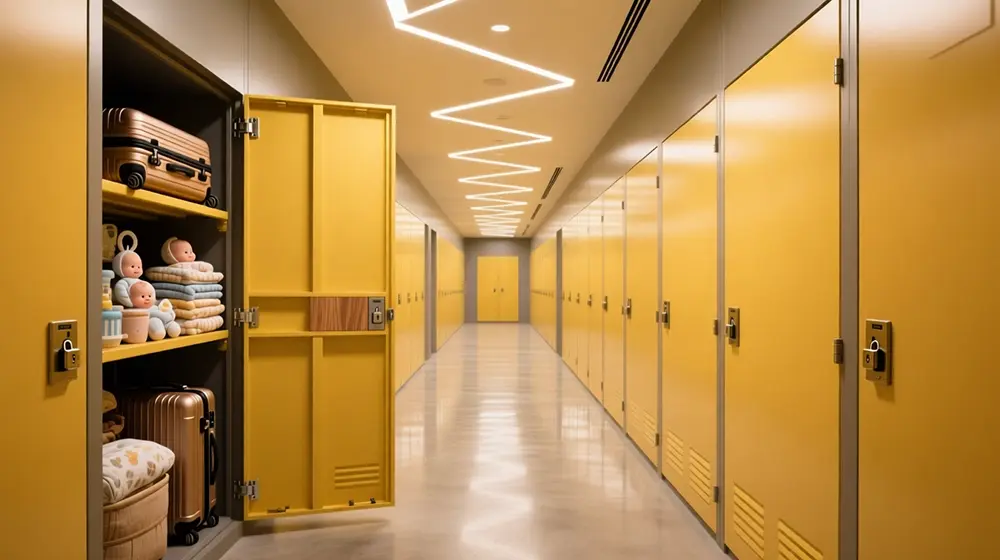
Self storage in Dubai is important for overseas employees’ families in Dubai because it separates storage space from living space in a city where most residents are expatriates and apartment rents absorb a large share of income.
Dubai hosts about 3.95 million residents in 2025, and expatriates account for roughly 92 % of the city’s population. Expatriates form about 88 % of the UAE population, equal to around 11.06 million residents.
According to Dubai rent guides from major agencies, average annual apartment rents cluster around these values.
- Studio apartments around 40,000 dirhams per year
- One-bedroom apartments around 62,000 to 65,000 dirhams per year
- Two-bedroom apartments around 85,000 to 110,000 dirhams per year
- Three-bedroom apartments around 140,000 dirhams per year
These numbers show a rent gap of roughly 20,000 to 30,000 dirhams per year between one bedroom and two bedroom units on average, or around 1,700 to 2,500 dirhams per month. A 25 square foot unit usually costs about 300 to 400 dirhams per month, and a 50 square foot unit that fits the contents of a studio or small one bedroom home costs about 900 to 1,400 dirhams per month.
The comparison shows a clear pattern:
- Upgrading to a larger apartment for extra cupboards and a spare room creates a permanent rent cost.
- Using self storage for overseas employees’ families in Dubai creates a flexible cost that tracks the real volume of furniture and boxes.
For overseas employees’ families, this difference often decides whether a rental or furniture crisis appears at the moment of a lease change.
How large is the overseas employee and family base in Dubai that depends on flexible space?
The overseas employee and family base in Dubai that depends on flexible space is large because expatriates dominate both the national and city level population. Dubai concentrates a major share of the expatriate population. City profiles report a Dubai population near 4 million in 2025, with expatriates forming about 92 % of residents.
Within this expatriate majority:
- Indians account for roughly 28 % of the national population.
- Pakistanis account for about 12 %.
- Other Asian, Arab, African, and Western groups cover the remaining expatriate share.
Many overseas employees follow a similar pattern:
- One adult arrives alone on a work contract and occupies a small flat or shared space.
- Later, spouse and children arrive, which triggers a move to a larger apartment or villa.
- After a job change, school change, or visa policy change, the family relocates again inside Dubai or to another country.
At each stage, furniture, baby equipment, school materials, seasonal clothing, and travel luggage accumulate. Self storage important for overseas employees’ families in Dubai enters the picture when living space no longer matches this volume, yet furniture still holds financial and emotional value.
Self storage market strength for overseas employees’ families in Dubai
The self storage market that serves overseas employees’ families in Dubai is strong and growing, which shows that storage is part of the structural urban system rather than a niche service. The UAE self storage market generated about US$602.5 million in 2024 and is expected to reach about US$859.2 million by 2030, with a compound annual growth rate of 6.3 % from 2025 to 2030. Medium units currently dominate revenue, and larger units record the fastest growth.
According to a Middle East and Africa self storage review, the regional self storage market generated around USD 2,249.8 million in 2024 and is projected to grow at about 6.5 % annually in the near term. Local market maps for the UAE describe four main storage formats:
- Traditional self storage units that customers access themselves.
- Box based storage with collection and delivery for renters in dense districts.
- Climate controlled warehouse storage for furniture and documents.
- Container and warehouse style storage for large volumes and long duration.
These formats align with the reality of overseas employees’ families in Dubai:
- Families in tower apartments use box based and small unit storage for boxes and a few furniture pieces.
- Families transitioning between villas and apartments use medium and large units for full home contents.
- Employees on regional assignments use long term storage for furniture between postings.
Dubai rental & furniture problems without self storage for overseas families
Overseas employees’ families in Dubai without self storage face clustered problems in three areas: rent pressure, forced furniture decisions, and stress inside the home.
1. Rent pressure during renewals and relocations
According to Dubai rent surveys, average annual rents for two bedroom apartments sit around 85,000 to 110,000 dirhams, and three bedroom apartments reach about 140,000 dirhams.
Without self storage:
- Families remain tied to oversized apartments because cupboards and spare rooms hold surplus items.
- Landlords proposing higher renewal rents meet less resistance because vacating becomes complex.
- Double rent for a brief overlap between old and new apartments appears more often, because furniture cannot be moved out quickly.
2. Forced, last minute furniture decisions
Without external storage:
- Large wardrobes, extra beds, and sofas often crowd children’s rooms and corridors.
- Balconies sometimes become informal storage, which exposes furniture to heat and humidity damage and may conflict with building rules.
- During urgent moves, families sell furniture at low prices through online platforms or leave items behind for disposal.
3. Stress inside expensive apartments
Clutter inside small apartments reduces usable living space. In a city where one bedroom apartments already consume around 62,000 to 65,000 dirhams per year in rent, unused items on floors, in corridors, and on balconies raise the effective cost of each square metre.
Self storage important for overseas employees’ families in Dubai, transforming these problems into addressable logistics tasks rather than personal crises.
Self storage prevents rental crises for overseas employees’ families
Self storage prevents a last minute rental crisis for overseas employees’ families in Dubai by separating lease dates from furniture decisions and by reducing the volume that must be moved at once.
Direct effects on rental negotiations
When a landlord announces a rent increase that stretches the family budget, a storage plan creates concrete options:
- Families can move non essential items into storage first.
- Movers can transport only core furniture to a smaller or better located unit.
- The family can vacate exactly on the contract date and avoid penalty or unplanned extra rent days.
Comparison of rent versus storage
The table below compares a simple scenario: an overseas employee family considers either upgrading from a one bedroom to a two bedroom apartment only for extra storage, or remaining in a one bedroom and renting a medium storage unit.
| Scenario | Typical capacity | Annual cost estimate in Dubai | Source notes |
|---|---|---|---|
| One bedroom apartment only | Living space plus limited cupboards | About 62,000 to 65,000 AED per year | Average one bedroom rent ranges from 65,000 to 110,000 AED, depending on the area. |
| Two bedroom apartment only | Extra room used mainly as storage | About 85,000 to 110,000 AED per year | The average two bedroom rent ranges from 85,000 AED upward. |
| One bedroom plus 50 sq ft self storage | Living space plus dedicated external storage | Rent for one bedroom plus about 10,800 to 16,800 AED per year for storage | Typical 50 sq ft storage costs around 900 to 1,400 AED per month in Dubai. |
In this simplified example, the family that upgrades to a two bedroom purely for storage pays around 20,000 to 30,000 dirhams more in rent each year than the one bedroom average. The family that uses self storage limits additional cost to around 11,000 to 17,000 dirhams per year and unlocks more options for future downsizing or district changes.
Practical outcomes
With self storage, an overseas employee’s family can:
- End a lease on time without losing furniture.
- Accept a temporary, smaller unit during a job or visa transition.
- Negotiate with landlords from a stronger position, because moving out remains realistic.
These outcomes reduce the chance of a last minute rental crisis, where the family feels forced to accept an unaffordable rent, stay in an unsuitable apartment, or discard furniture.
Self storage prevents furniture crisis for employees’ families Duba
Self storage prevents a last minute furniture crisis for overseas employees’ families in Dubai by creating a buffer between life events and irreversible decisions about belongings.
Typical triggers include:
- Arrival of spouse, children, or parents that shifts space requirements.
- Movement from villa communities to high rise towers or the reverse.
- Transfers to other emirates or other Gulf countries.
- Repatriation plans that still lack final timelines.
Without self storage, it is important for overseas employees’ families in Dubai:
- Families discard sofas, beds, cabinets, and white goods under time pressure.
- Replacement purchases occur at each new posting, which multiplies long term costs.
- Items with sentimental value, such as heirloom furniture or child furniture, disappear.
With self storage:
- Large pieces move into climate controlled units instead of balconies or open parking.
- Families phase decisions about which items to ship, sell, or donate over several months.
- Households maintain continuity of style and comfort across moves because core furniture remains preserved.
Furniture storage guides in Dubai describe 100 square foot units that hold the contents of a two bedroom home and usually cost about 1,000 to 2,000 dirhams per month. For many overseas employees, this cost over a limited transition period compares favourably with the cost of repurchasing a full set of furniture after a rushed disposal.
Self storage for overseas employees’ families job/visa risk Dubai
Overseas employees’ families in Dubai can connect self storage with job change and visa risk management by treating storage units as part of a contingency plan for several employment scenarios. The six Gulf states hosted 10.1 % of all migrants worldwide in 2024, up from 5 % in 1990. 2.7 % were recorded in the UAE, while Saudi Arabia alone accounted for 4.5 % of all migrants worldwide (down from 5 % in 2015). This reality creates frequent contract changes, restructurings, and policy adjustments.
A structured approach links self storage to three risk categories:
1. Contract uncertainty
- During probation or short term projects, families maintain a modest living space and store surplus furniture externally.
- If a contract ends early, the family can exit the apartment quickly and decide calmly about stored items.
2. Visa and residency adjustments
- When visa renewals, role localisation, or new rules create uncertainty, storage units protect furniture even if travel becomes necessary at short notice.
- Belongings remain accessible for later shipping or sale instead of forced abandonment.
3. Regional mobility
- Many careers move between Dubai, Abu Dhabi, Riyadh, Doha, and home cities.
- Self storage in Dubai acts as a regional base where furniture remains between postings.
In each case, self storage important for overseas employees’ families in Dubai, lowers the emotional and financial impact of employment shocks, because furniture and household equipment no longer anchor the family physically to a specific apartment.
Self storage with school calendars, family travel, split living plans?
Self storage interacts positively with school calendars, family travel, and split living arrangements by smoothing seasonal peaks in belongings and moves.
School driven moves
International and private schools in Dubai often follow September to June or August to June calendars. Families prefer to shift homes during these windows to align commutes with new campuses. At these times:
- Movers face high demand.
- Landlords adjust rents actively.
- Suitable apartments near target schools become scarce.
Self storage allows overseas employees’ families in Dubai to:
- Move non essential items into storage weeks before the main move.
- Accept temporary or smaller units near the school and retrieve stored items later.
- Protect project work, sports gear, and school archives in labelled boxes.
Summer travel and split households
Many expatriate families spend several weeks abroad during the summer while one parent remains in Dubai for work. Others relocate spouses and children temporarily to the home country while the job continues.
Self storage provides:
- Secure space for electronics, travel equipment, and sensitive items while the apartment remains partly empty.
- A place for furniture from rooms that no longer host family members, so the primary earner can downsize and reduce rent.
- Capacity to reorganise the home in stages as family members return or depart.
Self storage protects furniture & household items from Dubai climate & building limits
Self storage protects furniture and household items against the Dubai climate and building constraints by using engineered spaces rather than improvised storage corners.
Climate and building factors include:
- Long, hot summers with high humidity stress wood, leather, adhesives, and some plastics.
- Intermittent air conditioning in apartments when families travel and reduce energy use.
- Narrow lift cars and corridors in residential towers that complicate repeated moving.
- Rules that restrict the storage of items in car parks, lobbies, and balconies.
According to self storage providers in Dubai, many facilities offer climate control, fire protection, and twenty four hour CCTV monitoring across unit sizes from small lockers to large rooms.
For overseas employees’ families in Dubai, this environment offers several advantages:
- Wooden beds, tables, and cupboards sit in stable temperatures instead of on balconies under direct sunlight.
- Leather sofas and mattresses avoid condensation and dust that can appear in unventilated rooms.
- Documents, certificates, and children’s artwork remain in dry boxes rather than in cupboards near the kitchen steam.
By moving long term storage items into these controlled spaces, families reduce repair costs and extend the life of furniture.
How can self storage box planning & inventory help overseas families save costs
Careful box planning and inventory help overseas employees’ families in Dubai control self storage costs by increasing the ratio of stored value to space rented.
Storage cost guides for Dubai summarise typical ranges for personal units.
- 25 square foot units often cost around 300 to 400 dirhams per month.
- 50 square foot units often cost around 900 to 1,400 dirhams per month.
- 100 square foot units for two bedroom contents often cost around 1,000 to 2,000 dirhams per month.
A practical planning method includes five steps:
1. List all potential storage items
- Include beds, sofas, cupboards, appliances, suitcases, boxes, and sports or hobby equipment.
2. Classify by value and frequency of use
- Mark high value, low frequency items such as heirloom pieces or spare fridges.
- Mark low value, low frequency items such as old promotional materials or worn clothing.
3. Decide what to sell, donate, or recycle
- Remove items that do not justify rent in any unit size.
4. Group remaining items into boxes and furniture sets
- Use uniform box sizes and clear labels for each family member or function.
5. Match the final list to unit sizes
- Compare the required volume with example capacity charts from storage providers.
By following this process, families often discover that a 50 square foot unit plus good vertical stacking is enough for critical items, instead of an oversized room that stays half empty.
Self check for overseas employees’ families in Dubai
Use this three question checklist to decide whether self storage important for overseas employees’ families in Dubai and applies strongly to your situation.
- Does your current apartment contain at least one room that functions mainly as storage instead of living space?
- Are you expecting a job change, visa renewal, or school move within the next twelve to twenty four months?
- Would replacing your furniture in case of a rushed move cost more than one year of medium unit storage fees?
If the answer is “yes” for two or more points, self storage likely plays a material role in preventing last minute rental and furniture crisis in your case.
Conclusion: Self storage remains a long-term support tool for overseas employees’ families in Dubai
Self storage remains a long term support tool for overseas employees’ families in Dubai because the structural forces behind the service appear stable: a predominantly expatriate population, strong rent levels, and a growing self storage market. Real estate guides confirm that apartment rents remain high in many districts and that popular areas such as Dubai Marina, Business Bay, and Downtown Dubai maintain strong demand.
For individual families, the central message is simple and data-based:
- Treat self storage not as a luxury, but as a structural safety valve for rental and furniture decisions.
- Connect storage plans directly to lease dates, school calendars, and job timelines.
- Use objective numbers on rent, storage prices, and furniture replacement costs to decide how much space to rent.
When overseas employees’ families in Dubai follow this approach, self storage becomes a quiet partner that prevents last minute rental and furniture crisis, protects assets, and supports a more stable family life in a fast changing city.
Why is self storage important for overseas employees’ families in Dubai?
Self storage important for overseas employees’ families in Dubai because it removes surplus furniture and boxes from high-rent apartments and gives families flexibility during rent negotiations, moves, and visa-related changes.
How does self storage prevent last last-minute rental crisis?
Self storage prevents a last-minute furniture crisis by protecting furniture in climate-controlled units during life transitions instead of forcing panic sales or abandonment.
Is self storage cheaper than renting a bigger apartment only for storage?
Data on Dubai rents and storage prices show that a medium self storage unit often costs less per year than the rent difference between one and two-bedroom apartments, especially in central districts.
Do all self storage facilities in Dubai offer climate control?
Not all facilities offer the same standard, yet many leading providers advertise climate-controlled units, CCTV, and secure access for personal and furniture storage.
Which unit size suits a typical overseas employee family?
Guides suggest that 50 square foot units hold the contents of a studio and that 100 square foot units hold most items from a one or two-bedroom home, yet actual needs depend on furniture style and decluttering.
Can self storage support families between international postings?
Self storage supports families between postings because furniture remains in Dubai while work and immigration decisions settle, which reduces shipping and repurchase costs.
Does self storage help with school and university transitions in Dubai?
Self storage helps with school and university transitions by holding archived books, science projects, sports gear, and extra furniture while families move closer to campuses or adjust household size.
Is self storage relevant for single overseas employees without dependents?
Self storage also assists single overseas employees with frequent travel or regional projects, yet overseas employees’ families in Dubai usually gain the largest benefit because they hold more furniture and face more complex moves.
How can families avoid overpaying for self storage in Dubai?
Families avoid overpaying by decluttering early, measuring furniture, selecting the smallest workable unit, and reviewing prices across providers rather than choosing the first offer.