Student Storage in Dubai | Costs, Risks & Booking Checklist
Student storage in Dubai for summer & semester breaks — costs, risks & booking checklist covered.
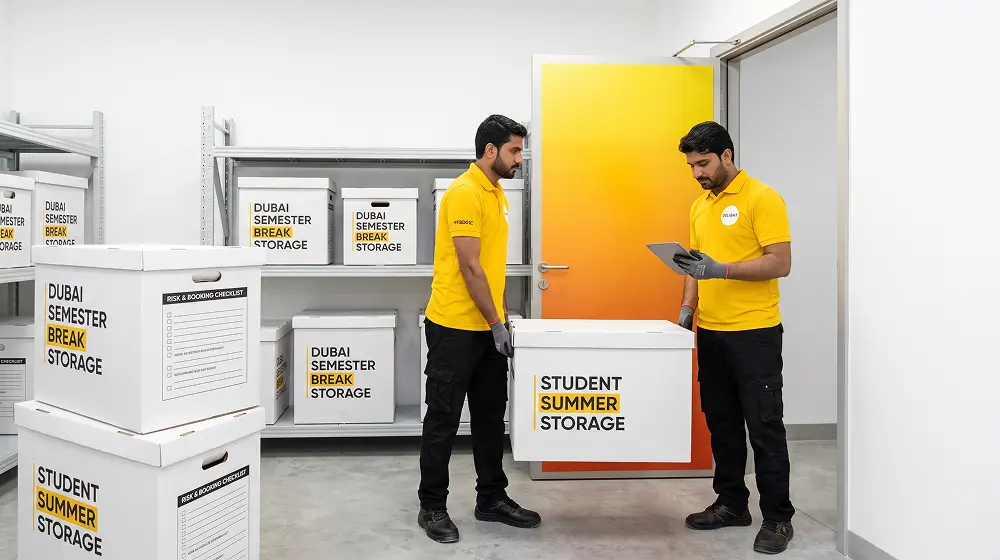
Leaving Dubai for summer or a semester break sounds simple until you start counting boxes, suitcases, books, electronics, bedding, and small furniture. For many students, the real problem is not packing. It is deciding where to keep everything safely without paying extra rent, excess baggage fees, or replacement costs later.
Student storage in Dubai gives you a short-term way to store belongings between move-out and move-in dates. The decision still needs care. Price, pickup timing, air-conditioned storage, item access, insurance terms, and handover proof can all affect your final cost and peace of mind.
For you, the practical question is simple. Does local storage cost less than unused rent, excess baggage, shipping, or replacing bulky items after the break?
This guide gives you 2 outcomes.
- You can estimate your student storage budget in AED.
- You can also avoid the common risks that affect students during room handover, summer travel, and semester return.
What is student storage in Dubai?
Student storage in Dubai is short-term storage for student belongings during summer holidays, semester breaks, room changes, internships, travel, or lease gaps.
You use student storage when your dorm, shared flat, or rented room ends before your next move-in date. International students use it when flying home costs more than local storage. Local students use it when moving between campus housing, family homes, and private apartments.
Student storage usually covers these item groups:
- Clothes, shoes, bedding, towels, and suitcases
- Books, notes, stationery, art supplies, and lab-safe personal items
- Laptops, monitors, keyboards, consoles, chargers, and small electronics
- Microwaves, mini fridges, lamps, fans, chairs, and small tables
- Bicycles, sports equipment, musical instruments, and seasonal items
Student storage differs from full household storage because the volume is smaller and the duration is shorter. A student may store 4 to 12 boxes, 2 suitcases, 1 chair, 1 small appliance, and 1 monitor. A family may store a full apartment’s worth of belongings.
For students, storage duration matters more than unit size. A 6-week summer course gap, a 10-week home trip, and a 4-month semester exchange create different price and access needs.
Why does student storage demand rise during summer and semester breaks?
Student storage demand rises because academic calendars create fixed move-out and return windows.
Heriot-Watt University Dubai lists May semester teaching from 4 May to 24 July 2026. The same calendar lists August exams from 27 July to 7 August 2026 and an August break from 10 August to 4 September 2026.
Canadian University Dubai lists Summer 1 classes from 1 June to 10 July 2026 and Summer 2 classes from 13 July to 21 August 2026.
These dates create 3 common storage windows:
- 4 to 6 weeks for a short academic gap
- 8 to 12 weeks for a summer break
- 12 to 20 weeks for exchange, internship, or delayed accommodation
International students create stronger short-term storage demand. KHDA reported that international student enrolment grew by 29% in Dubai private higher education institutions. International students also represented 35% of the total student body.
The storage decision becomes financial when you compare storage with extra baggage. flydubai states that airport excess baggage from Dubai costs AED 40 to AED 80 per kg, depending on destination.
Emirates states that passengers can buy extra baggage allowance in 5 kg blocks, up to 50 kg, on eligible routes.
A 20 kg extra baggage charge can exceed the monthly cost of a small storage unit in Dubai. That comparison matters when your items are bulky, low-value, or hard to pack.
How much does student storage in Dubai cost?
Student storage in Dubai often costs from about AED 150 to AED 900 per month for small student loads, depending on space, pickup, location, air conditioning, and access.
Public Dubai storage price guides show wide price variation. Some storage guides report that self-storage in Dubaistarts around AED 300 per month for small units of about 25 square feet and can exceed AED 3,000 per month for large units above 160 square feet.
A Dubai storage provider’s price page lists examples such as AED 795 per month plus VAT for 40 square feet and AED 895 per month plus VAT for 50 square feet, with availability affecting monthly rates.
VAT also affects your final storage bill. The UAE Federal Tax Authority (FTA) administers Value Added Tax, and the general UAE VAT rate is 5% on most goods and services.
A student’s quote of AED 500 becomes AED 525 after 5% VAT, before insurance, packing, pickup, or delivery charges.
Use this table to estimate the storage unit Dubai budget before booking. The table gives planning ranges, not fixed quotes.
Student storage loadTypical itemsLikely storage sizeExample monthly cost rangeBest duration fitLight luggage storage2 suitcases, 3 to 5 boxes, beddingLocker or 1 to 3 cubic metersAED 150 to AED 4001 to 2 monthsStandard student room6 to 10 boxes, 2 suitcases, monitor, chair15 to 30 square feetAED 300 to AED 7002 to 4 monthsStudio-style student loadBoxes, mini fridge, desk chair, small table40 to 50 square feetAED 795 to AED 900 plus VAT in some listings2 to 6 monthsShared student unit2 students sharing boxes and small furniture50 to 80 square feetAED 900 to AED 1,300 plus VAT in some listings3 to 6 months
The lowest monthly price is not always the lowest total cost. Pickup, redelivery, box supply, insurance, locks, admin fees, and minimum rental periods can change the final amount.
What cost factors change a student storage quote?
Seven cost factors change a student storage quote: volume, duration, pickup, redelivery, access, climate control, and insurance.
1. Volume
Volume controls the base price. A 10 square foot locker can fit suitcases and boxes. A 40 square foot unit can fit a lightly furnished bedroom or a small studio load.
A 10 square foot locker is good for 6 to 8 suitcases, moving boxes, and luggage. And 40 square feet is suitable for a full bedroom or lightly furnished studio.
2. Duration
Duration changes the total cost. A 6-week break costs less than a 4-month exchange, even when the monthly rate stays fixed.
Student storage duration usually fits 3 patterns:
- Short gap: 2 to 6 weeks
- Summer break: 8 to 12 weeks
- Long gap: 3 to 6 months
3. Pickup and redelivery
Pickup and redelivery matter because many students do not own a car in Dubai. A cheaper unit outside your area can cost more after 2 transport trips.
Ask for 3 prices in writing:
- Pickup from the dorm, flat, or residence
- Monthly storage charge
- Return delivery to the new address
4. Access
Access affects service type. Self-storage gives direct access during facility hours. Pickup storage gives a scheduled return by appointment.
Choose direct access if you may need 1 suitcase, 1 textbook set, or 1 monitor during the break.
5. Climate control
Climate control protects electronics, paper, leather, fabric, and photographs. The UAE summer runs from June to September, with a mean summer temperature from 32°C to 37.2°C and possible highs up to 50°C.
The United States Environmental Protection Agency recommends indoor relative humidity (RH) below 60% and ideally between 30% and 50% to reduce mold risk.
Which student storage option fits your break?
The right student storage option fits your item volume, break length, transport access, and retrieval date.
There are 4 common options.
- Self-storage unit: You rent a storage unit, move items in, and keep access under facility rules.
- Pickup and storage: The provider collects packed items and stores them until redelivery.
- Box storage: You pay by box, suitcase, or item rather than renting a full unit.
- Shared storage unit: You share a larger unit with a trusted friend and split the cost.
Self-storage works for students with furniture, appliances, bicycles, and frequent access needs. Pickup storage works for students leaving Dubai quickly after exams. Box storage works for international students with only clothes, books, and bedding. Shared storage works when both students return on similar dates.
Choose box storage if your load fits under 10 boxes and 2 suitcases. Choose a small storage unit if you have furniture or appliances. Choose pickup storage if transport is your main problem. Choose climate-controlled storage if you store electronics, paper, leather, instruments, or photographs.
What items need climate-aware storage in Dubai?
Electronics, paper, leather, photographs, wood, fabric, and musical instruments need climate-aware storage in Dubai.
Dubai’s heat affects materials in different ways. Heat can weaken adhesives and deform plastics. Humidity can support mold on paper, fabric, and leather. Dust can enter weak cartons and open bags.
The Library of Congress recommends a cool, dry, stable environment with 30% to 50% RH for photographs.
Use this risk table before you choose a storage unit at a Dubai facility.
Item typeMain riskPacking control****Storage controlLaptop and monitorHeat, impact, moisturePadded carton or original boxAir-conditioned indoor storageBooks and notesHumidity, bending, pestsSmall cartons, silica gel, no damp paperDry indoor storageLeather shoes and bagsMold, odor, shape lossClean, dry, stuff with paperHumidity-aware storageBedding and clothesMildew, odor, compressionWash, dry fully, and bag by categoryDry storageMini fridgeOdor and trapped moistureDefrost, clean, dry, door ajarVentilated storageBicycleScratches and tyre pressure lossClean frame, cover chain, and photograph conditionSecure unit or rackGuitar or instrumentHeat, humidity, case damageHard case, loosen tension where relevantStable indoor climate
Do not store wet towels, food, perfume bottles, candles, gas canisters, vapes, medicine, cash, passports, Emirates ID, bank cards, or original degree documents.
Keep primary electronics with you if they contain assignments, bank data, passport scans, or personal files.
What risks matter most before booking student storage?
The main student storage risks are hidden costs, damage, delayed redelivery, weak inventory records, poor access terms, and unclear liability.
1. Hidden costs
Hidden costs appear when you compare only the monthly rate. A storage quote can exclude VAT, pickup, redelivery, stair carry, packing materials, insurance, access fees, and late payment charges.
Ask this exact question: “What is the total AED cost for pickup, 3 months of storage, VAT, insurance, and return delivery?”
2. Damage
Damage risk rises when you hand over items without photos. Photograph electronics, appliance serial numbers, furniture corners, bicycle frame marks, and box contents.
Use this file name format: Student-name, provider-name, pickup-date, box-number.
3. Delayed redelivery
Delayed redelivery can affect your first week of class. A late return can block access to bedding, books, uniforms, lab coats, shoes, or laptop accessories.
Book return delivery 3 to 5 working days before classes or move-in. Add more buffer for late August and early September.
4. Weak inventory
Weak inventory causes disputes. Use numbered labels on every box.
Example:
- Box 01: winter clothes and bedding
- Box 02: books and notebooks
- Box 03: kitchen items
- Box 04: chargers and desk items
- Box 05: shoes and sportswear
5. Liability
Liability depends on written terms. Storage insurance may exclude cash, jewelry, documents, passports, electronic data, pre-existing damage, or poorly packed items.
According to the UAE Consumer Protection Law, a provider must repair, replace, recover, reimburse, or re-provide a service without charge when a flaw appears in a commodity or service, as prescribed by the law’s executive regulation.
How do tenancy and room handover affect storage timing?
Tenancy and room handover affect storage timing because your belongings must leave before inspection, cleaning, key return, and deposit review.
Dubai Land Department states that its Ejari service allows customers to register or renew a tenancy contract in Dubai.
Dubai Land Department’s tenancy guide explains that Ejari is an online program developed by RERA to record tenancy contracts for all property types in Dubai.
If you rent a student room, shared flat, or studio, your move-out process usually includes:
- Removing personal items
- Cleaning the room
- Returning keys or access cards
- Photographing walls, floors, furniture, and appliances
- Closing utility or internet obligations, if applicable
- Waiting for deposit review
A 10-day lease gap can create more pressure than a 3-month holiday. Short gaps require exact pickup and redelivery dates.
Use this timing plan:
- Book storage 21 days before the May, June, August, or September peak movement.
- Sort items 10 days before pickup.
- Pack non-essential items 7 days before pickup.
- Keep the passport, Emirates ID, wallet, laptop, medicine, chargers, and exam notes outside storage.
- Photograph the empty room before handover.
The handover pack protects your room deposit and storage claim. Keep dated room photos, box inventory, provider quotes, pickup receipts, and return bookings in one folder.
How do you book student storage in Dubai?
Book student storage in Dubai by measuring your items, choosing the storage type, requesting a written quote, checking exclusions, confirming pickup, and saving proof.
Follow this booking sequence.
- Count items: Count boxes, suitcases, appliances, furniture, bicycles, and loose items.
- Measure volume: Estimate square feet or cubic meters with item dimensions.
- Select duration: Choose exact dates for pickup and return.
- Request a quote: Ask for rent, VAT, pickup, delivery, packing, insurance, and access fees.
- Check conditions: Confirm air conditioning, CCTV, pest control, humidity control, and access hours.
- Review exclusions: Ask what items the provider refuses and what insurance excludes.
- Prepare evidence: Photograph every item and label every box before pickup.
- Confirm return: Book redelivery before your accommodation move-in date.
The quote must state AED amounts, storage duration, item count, pickup address, delivery address, VAT, payment schedule, cancellation terms, and claim process. Do not rely on a voice note alone.
What should your student storage checklist include?
A student storage checklist includes sorting, cleaning, packing, climate checks, cost checks, proof, and return planning.
Use this checklist before pickup.
- Separate documents: Passport, Emirates ID, visa, bank cards, certificates, and tenancy papers.
- Keep essentials: Laptop, charger, medicine, wallet, 3 days of clothes, and travel documents.
- Clean appliances: Mini fridge, kettle, microwave, fan, and lamp.
- Dry fabrics: Bedding, towels, jackets, and laundry bags.
- Pack books: Use small cartons because paper becomes heavy fast.
- Pack electronics: Use padded boxes and remove loose cables.
- Label boxes: Write name, box number, category, and handling note.
- Photograph contents: Take one open-box photo and one sealed-box photo.
- Save receipts: Keep payment receipts, pickup lists, and provider contact details.
- Confirm return: Book delivery before move-in week.
This checklist reduces common problems, such as paying for unused space, losing proof during a claim, and receiving key items after classes restart.
What are the best ways to reduce storage costs?
The best ways to reduce storage costs are to reduce volume, share space, avoid last-minute pickup, compare total price, and match duration to the academic break.
Reduce volume first. Sell or donate low-value items that cost more to store than to replace. Examples include plastic hangers, worn bedding, old cookware, cheap lamps, and damaged shelves.
Share a unit only when the inventory stays separate. Use separate box numbers, separate photos, and separate payment records. Shared storage works best for students from the same campus returning in the same week.
Compare total cost, not monthly cost. A unit at AED 350 per month can cost more than a unit at AED 500 per month if pickup, redelivery, and access charges are high.
Avoid storing airline-friendly items. If 5 kg of clothes fits within your ticket allowance, carry them. If a bulky monitor, chair, and bedding trigger excess baggage, store those items. flydubai’s Dubai excess baggage rate of AED 40 to AED 80 per kg shows how quickly extra weight can become expensive.
Book before peak weeks. May, June, August, and September create clustered demand because exams, breaks, and accommodation moves overlap across Dubai universities. University calendars show that summer teaching, exams, and breaks can fall across June, July, August, and early September.
Which documents and proof protect you?
A written quote, item inventory, condition photos, payment receipt, and signed pickup record protect you during storage disputes.
Your evidence pack must include:
- Provider trade name, phone number, email, and pickup team details
- Storage address or warehouse service description
- Pickup date, pickup time, and pickup location
- Return date, return address, and delivery fee
- Numbered inventory with box count and item count
- Photos of valuable items and box labels
- Payment receipt with VAT details
- Insurance wording, exclusions, and claim deadline
Dubai Consumer Rights states that its consumer complaint service is open to individuals, including residents and visitors in Dubai.
The UAE Ministry of Economy states that it receives consumer complaints, examines them, and verifies the completeness of submitted data.
A strong evidence pack does not create conflict. A strong evidence pack prevents confusion when a box, appliance, or electronic item returns damaged.
What should students avoid storing?
Students should avoid storing cash, passports, Emirates ID, bank cards, original certificates, medicine, food, liquids, flammables, batteries, and prohibited items.
Food attracts pests and causes odor. Liquids can leak inside boxes. Candles and cosmetics can melt in the heat. Loose batteries can corrode or create safety issues. Medicine can lose stability outside recommended storage conditions.
Do not store confidential university papers without a folder and a box label. Do not store hard drives without a backup. Do not store a laptop without password protection and cloud backup.
IT and data custody matter for students because laptops, tablets, hard drives, and USB drives may contain assignments, personal photos, bank statements, and visa documents. Keep primary devices with you. Store only non-critical accessories if data risk matters.
How should parents evaluate student storage in Dubai?
Parents should evaluate student storage by checking total AED cost, item security, redelivery reliability, claim terms, and student access.
A parent-friendly storage plan answers 7 questions.
- What exact items enter storage?
- What is the total cost after VAT, pickup, and delivery?
- Where does the provider store the items?
- Does the storage space use air conditioning?
- Who can access or release the items?
- What happens if delivery is late?
- What proof exists if an item arrives damaged?
Parents often focus on safety and documentation. Students often focus on speed and price. A balanced decision checks both.
A cheap quote without inventory proof can cost more if a monitor, textbook set, bicycle, or appliance goes missing.
What quick calculations help students decide?
Quick calculations help you compare storage, rent, baggage, and replacement cost.
Use these examples:
- AED 500 monthly quote plus 5% VAT equals AED 525.
- AED 895 monthly quote plus 5% VAT equals AED 939.75.
- 15 kg of excess baggage at AED 40 per kg equals AED 600.
- 15 kg of excess baggage at AED 80 per kg equals AED 1,200.
- 3 months of AED 350 storage equals AED 1,050 before VAT.
- 3 months of AED 595 storage equals AED 1,785 before VAT.
- 2 students sharing AED 895 storage pay AED 447.50 each before VAT.
- 4 students sharing AED 1,295 storage pay AED 323.75 each before VAT.
These calculations do not replace provider quotes. They help you identify when storage beats baggage or replacement.
Final thoughts: Store only what makes sense, and protect every step
Student storage in Dubai becomes useful when it solves a real timing problem. Summer breaks, semester gaps, lease changes, and international travel can leave you with more belongings than your flight, dorm, or new room can handle.
The right choice starts with a simple calculation. Compare the total storage cost with unused rent, airline baggage fees, shipping charges, and replacement costs. Then check the details that affect your belongings: air conditioning, pickup timing, redelivery dates, access rules, insurance terms, and written proof.
A safe student storage plan does not rely on memory. It uses labeled boxes, dated photos, a written quote, a clear inventory, and a confirmed return date. These small steps protect your budget, your belongings, and your first week back in Dubai.
Store less when possible. Document everything you store. Book early before peak student move-out periods. That approach gives you a cleaner break, fewer surprises, and a smoother return when the next semester begins.
FAQS
How early should I book student storage in Dubai before summer break?
Book student storage 2 to 3 weeks before your move-out date, especially during May, June, August, and September.
Is a storage unit in Dubai better than taking extra baggage home?
A storage unit in Dubai is often better for bulky items when excess baggage costs more than short-term storage.
What is the safest way to store electronics during semester break?
Store electronics in padded boxes, keep cables separate, photograph serial numbers, and choose air-conditioned indoor storage.
Can I share student storage with a friend?
You can share storage with a friend, but use separate box numbers, photos, payment records, and return dates.
What should I keep with me instead of storing?
Keep your passport, Emirates ID, visa papers, bank cards, medicine, laptop, chargers, and original certificates with you.
How do I avoid hidden student storage costs?
Ask for a written AED total that includes storage rent, VAT, pickup, delivery, insurance, packing, and access fees.
What storage size does a student usually need?
A student usually needs a locker, 15 square feet or 30 square feet, depending on boxes, luggage, appliances, and small furniture.
Why does climate control matter for student storage in Dubai?
Climate control matters because Dubai’s heat and humidity can affect electronics, paper, leather, bedding, photographs, and wooden items.
What proof should I collect before pickup?
Collect item photos, box labels, a numbered inventory, a written quote, a payment receipt, a pickup confirmation, and insurance terms.
Is student storage useful for short lease gaps?
Student storage is useful for short lease gaps because it keeps belongings secure between room handover and the next move-in date.
Storage & Warehousing Operations Specialist
14+ years in UAE self-storage and warehousing, managing facilities across Dubai, Abu Dhabi, and the Northern Emirates. Specializes in climate-controlled storage, unit sizing, security systems, and Free Zone vs Mainland compliance.
- Khalid Al Mansoori**Storage units in JVC: a practical guide to secure, flexible storage in Jumeirah Village Circle
- Khalid Al Mansoori**Storage units in Dubai Marina: What to verify before signing a storage agreement
- Khalid Al Mansoori**How to pack furniture for storage in Dubai humidity: Wood, leather, fabric, and metal packing rules
- Khalid Al Mansoori**What You Cannot Store in Self Storage: UAE Rules Behind Everyday Household Items
Content Lead & Storage Solutions Researcher
8 years researching and writing on UAE storage and logistics. Focuses on storage costs, unit-size guides, and packing for Dubai’s climate, working closely with facility teams for accurate pricing and specs.
Khalid Al Mansoori
Storage & Warehousing Operations Specialist
14+ years in UAE self-storage and warehousing, managing facilities across Dubai, Abu Dhabi, and the Northern Emirates. Specializes in climate-controlled storage, unit sizing, security systems, and Free Zone vs Mainland compliance.
Sarah Mitchell
Content Lead & Storage Solutions Researcher
8 years researching and writing on UAE storage and logistics. Focuses on storage costs, unit-size guides, and packing for Dubai's climate, working closely with facility teams for accurate pricing and specs.